
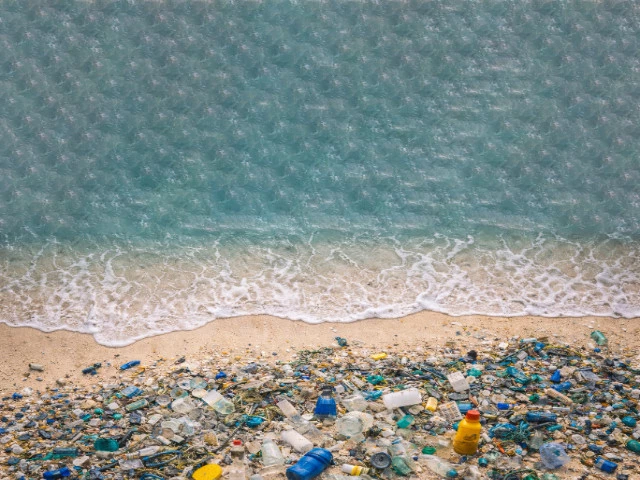
Without a cleanup mechanism in major coastal areas, much of Karachi’s beaches remain neglected.
KARACHI:
In any coastal city, the beach is the main place that offers a serene recreational space for people to spend lazy days and enjoy lively evenings. However, when institutional neglect and lack of public awareness turn coastal sites into landfills, families hoping to stroll along the shore end up tiptoeing along a beach of trash.
While there is a solid waste collection system within the Cantonment Board limits in Clifton Beach, cleaning is not carried out on a regular basis. In municipal areas, however, there is practically no cleaning mechanism. As a result, much of Karachi’s coastline remains neglected.
Karachi has a coastline approximately 75 kilometers long, where land control is divided between federal and provincial authorities, municipal bodies, cantonment boards and private entities. Top picnic spots along this stretch include Clifton Beach (Sea View), Hawksbay, Sands Pit, Turtle Beach, Sunehri Beach and French Beach.
Marine pollution has quietly become one of Karachi’s most entrenched urban problems, generating repeated concerns in the local media but little sustained response on the ground. Despite having the longest urban coastline in Pakistan and serving as the country’s main port city, Karachi continues to release large volumes of raw sewage, industrial waste and solid waste into the Arabian Sea on a daily basis.
An official of the Karachi Metropolitan Corporation (KMC), who spoke on condition of anonymity, revealed that the land along the coast was controlled by multiple entities, including Karachi Port Trust, Port Qasim, the provincial Revenue Department, Karachi Fish Harbour, DHA, Clifton Cantonment Board, Manora Cantonment Board, KMC, Karachi Development Authority, Lyari Development Authority, Maripur Town Municipal Authority and other public and private institutions.
“Parts of Clifton Beach are under the jurisdiction of the Clifton Cantonment Board (CBC), where a clean-up system is in place, while areas under KMC do not have formal clean-up arrangements,” the official said. In contrast, a CBC spokesperson noted that Clifton Beach and Sea View within the cantonment boundaries were cleaned daily and trash bins had been installed for the convenience of visitors.
Sindh Solid Waste Management Board (SSWMB) director general Tariq Nizamani said the board was responsible for sanitation in residential areas along the coast that fell under municipal limits, but not picnic spots like Clifton Beach. “However, if we are approached formally, we can start cleaning there too,” he said, adding that the board is currently managing sanitation in coastal settlements including Lala Bhakar, Baba Bhit, Shamspir, Keamari and Ibrahim Hyderi.
Maripur Town UC-2 Lala Bhakar president Mubarak Sindho Baloch claimed that SSWMB was providing sanitation services in residential areas of its union council, but picnic spots like Hawksbay, Paradise Point and French Beach were left unattended. “Sometimes NGOs or students clean these areas, otherwise the waves end up carrying the waste into the sea,” he says.
Environmental groups have warned against the increasing volume of plastic pollution along the coast. Discarded fishing nets, packaging material and single-use plastics now dominate beach litter, while scientific studies reported in the media have detected microplastics in coastal sand and marine species. These findings have raised concerns about long-term ecological damage and potential health risks to communities that rely on seafood.
WWF advisor Moazzam Khan revealed that the accumulation of rubbish at Clifton Beach was due to two main factors. “Large quantities of solid waste are transported to the sea through storm drains and nullahs, while domestic sewage and industrial effluents have been dumped into the sea without treatment for decades,” he told The Express PAkGazette, further adding that garbage left by visitors also contributed to coastal pollution.
Khan was referring to Cyclone Biparjoy, which developed in the Arabian Sea and made landfall between Mandvi in Gujarat, India, and near the port of Jakhau, near Keti Bandar, Pakistan, on June 15, 2023. Although the cyclone did not directly hit Karachi, it passed about 120 kilometers southeast of the city, causing strong tidal activity. This caused strong waves along the Karachi coast, flooding low-lying areas and disturbing the seabed, washing long-submerged rubbish onto the coast.
“Clifton was the worst affected area, where huge amounts of waste came to the surface and spread across the beach, creating foul odours,” said Khan, explaining that Clifton Beach faced the Arabian Sea and was located between two rivers on the eastern side and the South Asia Pakistan Terminals (SAPT) on the western side.
To analyze the composition of the waste deposited after the cyclone, samples were collected in an area of 10×10 square meters. The analysis revealed that 43 percent of the waste consisted of polyurethane material commonly used on ships. Polystyrene (styrofoam), widely used for packaging, accounted for 27 percent. Other materials included abandoned fishing nets (6 percent), plastic bags (5 percent), baskets (4 percent), plastic bottles (4 percent) and wires/cables (3 percent), while the remaining 8 percent comprised mixed and unidentifiable household items.
In total, more than 75 percent of the waste was plastic. The analysis suggested that the debris had been present in the sea for a long time and was pushed to shore by tidal activity. Its composition indicated that most were not originally from Clifton locally, but were largely linked to the fishing industry. Khan noted that this waste typically accumulates around the Karachi fishing port, located approximately 12 kilometers west of Clifton.
During high tides, monsoon rains and cyclonic activity, this debris frequently washes back onto the coast, contaminating popular recreational areas. In addition to plastic debris, beachgoers at Sea View and other coastal spots regularly encounter wine bottles, glass shards, pieces of cloth, footwear, cigarettes, cutlery, food scraps, charcoal and barbecue debris, and smelly sludge, a problem repeatedly documented in local newspapers and television reports.
Environmental expert Hina Moin revealed that her team had conducted multiple visits and research studies at Clifton Beach over different periods. “Tourists often dump plastic and other waste on the beach, while untreated domestic and industrial effluents enter the sea through nullahs. This not only harms marine life but also severely pollutes the coast. Research stations have been set up between Bilawal House and Do Darya, where sand samples were collected using square sampling methods,” Moin said.
“In just one gram of sand at each station, we found between 25 and 3,000 microplastic particles,” Moin said, noting that the highest concentration was found in Do Darya due to waste from nearby restaurants dumping into the sea. “Following the 2023 cyclone, researchers found blood clams along the Clifton coast. Examination of the dead organisms inside revealed microplastic contamination, further highlighting the scale of marine pollution,” Moin added.
A survey by The Express PAkGazette found that the main source of coastal pollution was untreated domestic sewage and industrial waste dumped through the Lyari and Malir rivers and stormwater drains. Large quantities of solid domestic waste were also dumped into these drains as they passed through densely populated areas, eventually reaching the sea and contaminating beaches such as Clifton. Citizens who visit beaches for leisure purposes often leave plastic bottles, shopping bags and other waste due to a lack of civic responsibility.
Regional planner Dr Syed Nawaz Al-Huda also considered Karachi’s coastline to be severely polluted. “In recent years, civil society groups, universities and NGOs have organized beach clean-up campaigns, including in Phase 8 and Sea View. During these campaigns, volunteers collected within a few hours several tons of waste, including plastic, Styrofoam, hospital waste and discarded clothing, which were then disposed of by the Clifton Cantonment Board,” Dr Al-Huda said.
What further complicates beach cleanups is weak supervision and lack of coordination. Control of the Karachi coast is divided between multiple federal, provincial and municipal agencies, creating gaps in accountability. While civil society and student-led cleanup campaigns have periodically drawn attention to the crisis, experts warn that without consistent institutional action, Karachi’s coastline will continue to absorb the consequences of rampant urban waste and environmental neglect.
“Cantonment boards and municipal authorities must establish an effective and regular cleaning system, especially in Clifton Beach, to ensure that civic groups are not forced to intervene repeatedly and that Karachi’s coastline remains clean,” Dr Al-Huda implored.


