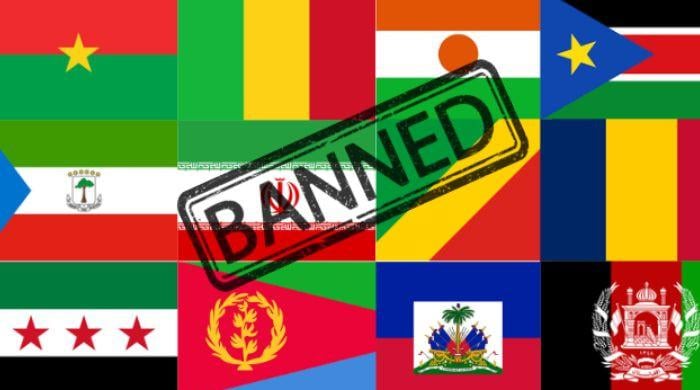
The Trump administration expanded its travel ban policy by adding 20 new countries and the Palestinian Authority to a list of nations facing severe entry restrictions into the United States.
With the new proclamation, the scope of the policy doubles, bringing the total number of affected countries to 39.
The expansion of the list of restricted countries follows last month’s shooting of two members of the National Guard in Washington, DC, for which an Afghan asylum seeker was charged.
The White House stated: “Today, President Donald J. Trump signed a Proclamation that expands and strengthens entry restrictions on nationals of countries with demonstrated, persistent, and serious deficiencies in detection, investigation, and information sharing to protect the Nation from threats to national security and public safety.”
Under the updated policy, there are two levels of restrictions:
Total entry ban
Nationals of the following countries are prohibited from obtaining visas for both immigration and tourism/business travel to the US:
- New additions: Burkina Faso, Mali, Niger, South Sudan and Syria.
- Previously listed: Afghanistan, Chad, Republic of the Congo, Equatorial Guinea, Eritrea, Haiti, Iran, Libya, Myanmar, Somalia, Sudan and Yemen.
- Updated since Partial Ban: Laos and Sierra Leone.
Additionally, all persons traveling with documents issued by the Palestinian Authority are subject to a complete entry ban.
Partial restriction
Nationals of the following countries are prohibited from obtaining common visas such as tourist (B-1/B-2), student (F, M) and exchange visitor (J) visas, but can still apply for other categories:
- New additions: Angola, Antigua and Barbuda, Benin, Ivory Coast, Dominica, Gabon, Gambia, Malawi, Mauritania, Nigeria, Senegal, Tanzania, Tonga, Zambia and Zimbabwe.
- Previously listed: Burundi, Cuba, Togo and Venezuela.
Turkmenistan saw its restrictions eased thanks to better cooperation.
The new rules will come into effect from January 1, 2026.
Exemptions exist for legal permanent residents (green card holders), diplomats, and those whose travel is considered in the national interest.
In the proclamation, President Trump stated that the new countries included on the list suffer from problems such as “widespread corruption, fraudulent or unreliable civil documents,” high overstay rates for expired visas, or a general lack of government control that hampers U.S. investigative efforts.