
Foreign Minister Offers to Host US-Tehran Talks; Reports on Senate efforts underway to help stranded nationals; Says Iran wants KSA land
ISLAMABAD:
Pakistan on Tuesday stepped up diplomatic efforts to defuse rising tensions in the Middle East, reminding Tehran of its long-standing defense deal with Saudi Arabia while engaging in shuttle diplomacy aimed at preventing further escalation between the United States and Iran.
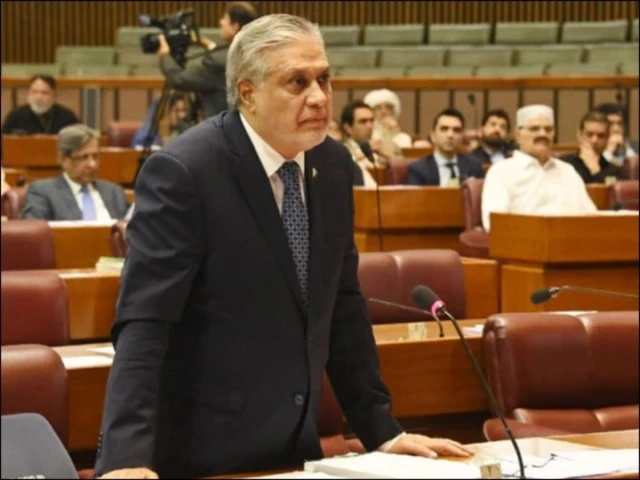
In a press conference and later in the Senate, Deputy Prime Minister and Foreign Minister Ishaq Dar underlined that Islamabad was seeking a de-escalation of tension through active diplomatic engagement, secondary contacts and regional outreach even as the situation in the Gulf remains fluid.
In a significant revelation, Dar said he had conveyed to the Iranian side that Pakistan maintains a defense pact with Saudi Arabia. “We have a defense pact with Saudi Arabia. I communicated to the Iranian side about our defense pact, to which they asked me to ensure that KSA lands were not used,” he said.
“Then I had a shuttle communication, as a result of which, as can be compared, fewer attacks from Iran are directed at Saudi Arabia and Oman,” he added. His statement is being seen as a calibrated attempt by Islamabad to balance its fraternal ties with Tehran while meeting its security commitments to Riyadh.
Pakistan and Saudi Arabia share close strategic and defense cooperation, including training, security collaboration and institutional ties. Officials said the diplomatic message was aimed at avoiding any spillover effects that could drag regional states into a broader confrontation.
Dar reiterated that Pakistan would continue its efforts to reduce tensions between Washington and Tehran. Speaking in the Senate, he revealed that he had been in contact with foreign ministers and senior officials from several countries over the past three days to persuade both sides to return to dialogue.
“Through dialogue a path of understanding can emerge,” he told lawmakers, adding that Pakistan is ready to facilitate talks if necessary. “We are ready for all help. If both sides want to talk in Islamabad, we are ready for that. We are ready at any time for any kind of mediation.”
Dar confirmed that following the first round of hostilities between the United States, Israel and Iran last year, Islamabad was seen as a serious option for talks between Washington and Tehran and had been proposed as a potential common capital. However, he noted that such considerations subsequently became “unfruitful” amid evolving geopolitical circumstances.
Expressing concern over a sudden coordinated attack by the United States and Israel against Iran, Dar said the development came despite diplomatic engagement moving in a positive direction. He recalled that Pakistan immediately condemned the attack on Iran, calling it a neighboring and brotherly Muslim country.
“This conflict benefits no one,” he said, adding that Pakistan recognizes Iran’s right to the peaceful use of nuclear energy. He noted that discussions between Washington and Tehran had previously shown encouraging signs.
Dar referred to meetings held during Prime Minister Shehbaz Sharif’s visit to Austria, where Pakistani officials interacted with International Atomic Energy Agency (IAEA) chief Rafael Grossi, who had expressed optimism about dialogue. Dar also cited his late-night conversation with Oman’s foreign minister, who conveyed to him that the most recent round of talks between the United States and Iran had ended on a positive note.
Amid the escalating crisis, the government has taken comprehensive measures to help Pakistani citizens stranded in Iran and Gulf countries due to airspace closure. “There are 35,000 Pakistanis in Iran,” Dar said, adding that approximately 33,000 currently reside there.
He informed the Senate that so far 792 Pakistanis, including 46 students, have been repatriated from Iran. Special facilitation desks have been set up to assist returning nationals, while the Crisis Management Unit of the Ministry of Foreign Affairs operates around the clock.
Pakistani embassies in Iran, UAE, Qatar, Bahrain and Saudi Arabia have been fully activated to support citizens. In Iran, three facilitation centers have been set up in Tehran, Zahedan and Mashhad to guide and help Pakistanis.
Dar said airspaces in several countries remain closed except Oman and Saudi Arabia, while land routes, although time-consuming, are being used for evacuations. Pakistani pilgrims in Iraq are also being assisted amid airspace restrictions there. He thanked Bahrain, Oman, Kuwait, Saudi Arabia, Qatar, Iran and Azerbaijan for extending cooperation and assistance to the Pakistani diaspora.


