
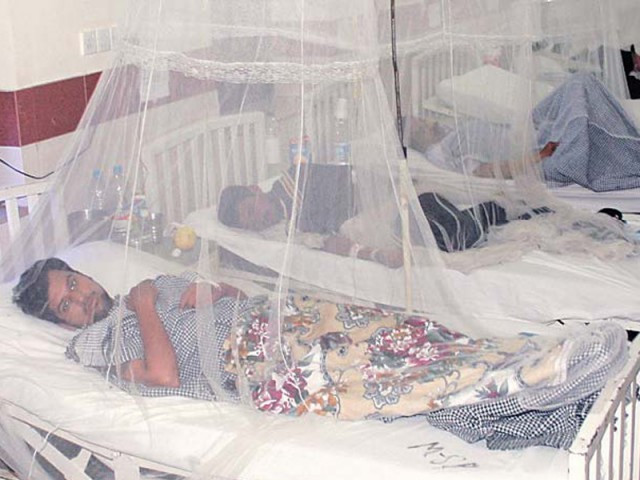
Without a policy regulating the prices of diagnostic tests, patients are forced to rely on laboratories that use unreliable kits.
KARACHI:
As the spread of dengue and malaria once again hits the people of the port city, diagnostic tests and platelet treatments have become unaffordable to the public. As a result, small laboratories are now performing tests using low-quality kits that, while lightweight, produce unreliable results.
Hundreds of laboratories continue to operate without registration and with insufficiently trained staff, often creating difficulties for patients. Even though doctors rely heavily on medical test reports when prescribing treatments for vector-borne diseases, the Department of Health has remained silent on the use of substandard kits and overcharging patients, allowing the medical sector to exploit poor families without fear of taking action.
Currently, almost all laboratories in Karachi charge their own fees for dengue, malaria and other blood tests, which are far beyond the reach of poor patients. Many laboratories use low-cost rapid kits for detection. A 2019 study conducted in Pakistan revealed that these fast devices provide only about 70 percent accurate results, with a 30 percent chance of error. Despite this, many laboratories continue to use cheap and unreliable kits, resulting in questionable reports that doctors then use to make treatment decisions, sometimes putting patients’ lives at risk.
A dengue patient, Saqib, revealed that he got dengue and malaria tests done at two different laboratories, one of which charged Rs 2,000 and the other Rs 1,400. Lab workers told him his tests were done with rapid kits. “My CBC reports from the two laboratories differed significantly, and the doctor explained that these variations were due to differences in diagnostic kits. Dengue patients often also need platelet transfusions, which cost between Rs 6,000 and Rs 35,000,” Saqib said, while urging the government to ensure availability of platelets for dengue patients.
Similarly, Shazia, a resident of Jamshed Road, shared that her two children developed high fever and the doctor told her to get tested for dengue, malaria and complete blood count. “I had to pay Rs 7,000 in total. When I questioned the cost, the lab claimed that they used high-quality kits whose results doctors trusted, unlike the cheaper kits used by small labs whose reports may not be reliable,” Shazia said.
According to the Vector-Borne Diseases Department of the Sindh Director General of Health Services, 22 people died due to dengue across Sindh from January to November 2025, including deaths reported in several districts of Karachi as well as in Hyderabad, Jamshoro, Tando Muhammad Khan and Tando Muhammad Aliyar. During the same period, the number of dengue cases in Karachi and Sindh increased to 18,728.
At Dow Laboratory, the dengue antigen test costs Rs 1,100, the dengue IgG/IgM test costs Rs 1,500, the dengue PCR test costs Rs 4,600 and the dengue ELISA test costs Rs 1,180, while the ESR blood count test costs Rs 680. The same tests at larger private hospitals are usually twice as expensive, while smaller laboratories do not have fixed prices. PCR and ELISA techniques are considered more reliable, which is why they are more expensive in certified laboratories.
According to Sindh Health Commission Chairman Dr Khalid Shaikh, new reduced prices have been fixed for dengue-related tests until December 31, 2025. The TIC malaria test, which earlier cost Rs 3,050, is now offered at Rs 600; dengue ELISA test, previously Rs 4,550, to Rs 1,100; the dengue IgM/Combo test, earlier from Rs 4,150, to Rs 1,500; and CBC with smear, which earlier cost Rs 1,250, is now available for Rs 500. Some larger labs have implemented the new rates, but many smaller labs continue to charge as they please.


