
we all know it Herculesbut Disney Cruise Line’s newest ship, the Disney Destiny, is putting a spin on the classic movie and story in more than a few ways. Disney has released theatrical versions of its animated films for years, but Hercules Aboard the Destiny is not just another musical and is separated from more recent adaptations.
One way is that it is a showcase for some of the most advanced projection, tracking and lighting technologies currently used in live entertainment, and it also uses exoskeletons, although more on this at a later date. One moment in particular, during Meg’s “I Won’t Say (I’m In Love)”, takes that technology further than one would expect within the theater of a cruise ship.
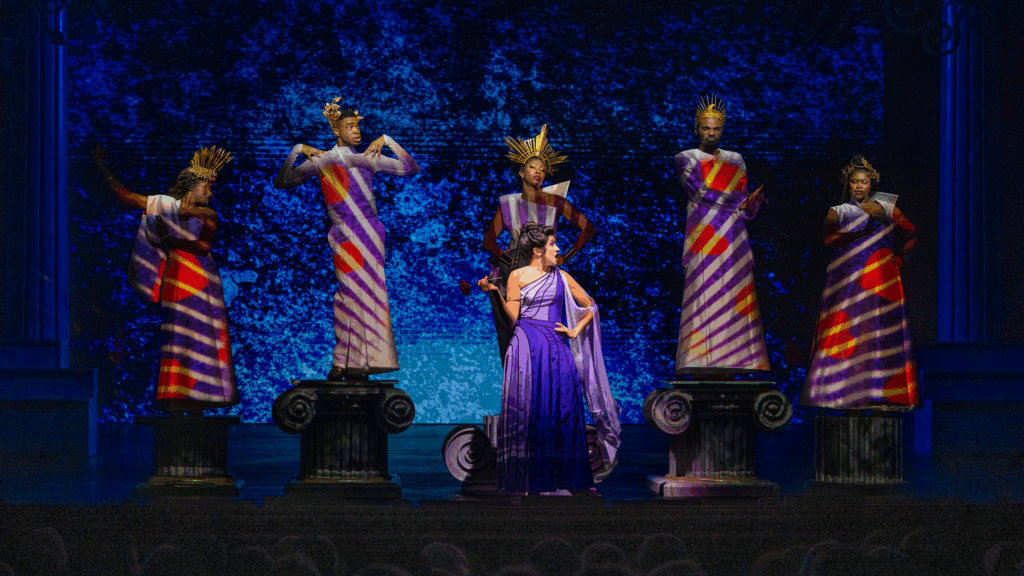
Throughout the number, the five Muses stand elevated behind Meg, their white dresses draped in bold, animated swathes of light. In one of our exclusive images, the projection lands perfectly on their bodies and the columns beneath them. However, Meg, who is directly in the path of the projection, remains completely intact.
There is no stain on her dress, no halo of faint color around her, nothing to suggest that a projector is shooting directly onto her torso. To the audience, it appears as if Meg is being “cut out” of the projection in real time, something one would expect to see in the visual effects of a film, not a live performer on a moving ship.
The Walt Disney Theater achieves this using a combination of real-time LiDAR spatial tracking, multi-projector pixel masking, and theatrical lighting. The theater’s cameras and sensors constantly generate a 3D model of the stage environment. As performers move, the system tracks them and delivers that data to projectors in the back of the house.
It’s essentially live occlusion masking, the same principle used in mixed reality and virtual production scenarios, but executed with theatrical projectors in front of an audience of hundreds of people. And yes, the theater lighting, which Disney custom built, helps a lot with the effect.
Disney Live Entertainment producer Arin Dale explained the basis for the effect: “We have cameras throughout the Walt Disney Theater that allow us to project on the walls but also on the stage pieces. We have LiDAR technology… to really create that immersive environment and that really fun moment for our muses.”
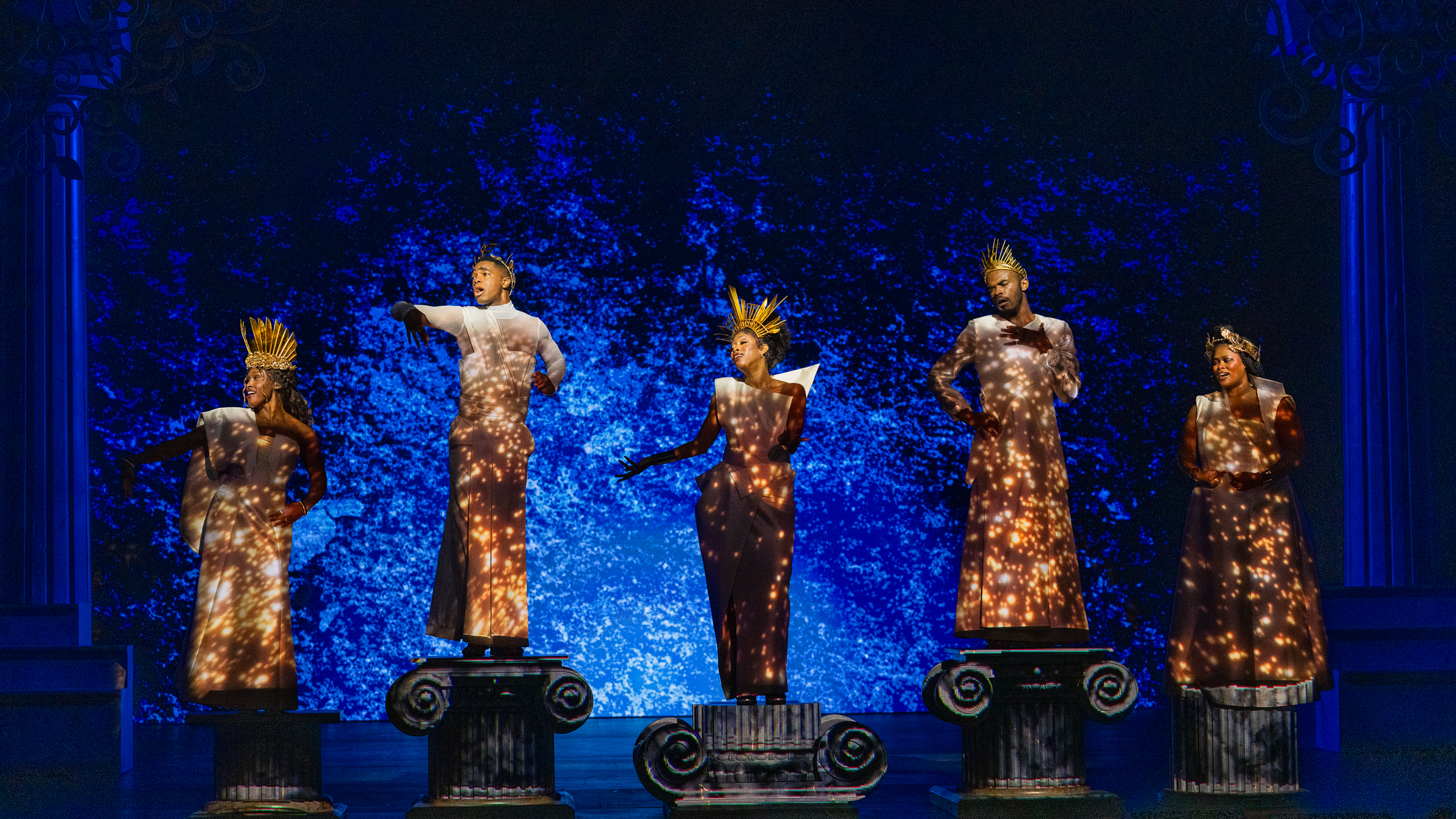
Of course, an effect like this is only as good as the surfaces it hits. The Muses were dressed in a bright white fabric that reacts predictably to projected light.
Dale recalled how early the team was testing the concept: “Our video designer said, ‘Hey, I have this idea.’ And the directors loved it. We tried it in Los Angeles… We were testing it and wondering, ‘Is this going to work?’ And it was like, ‘Yeah, that’s what we’re doing.'” She added that the first test garments were “improvised costumes that we cut by hand the night before.”
The Destiny, like the other Wish-class ships before it, was built with this level of projection technology in mind. Ambient projection walls, mesh-based illusions, and dynamically mapped scenic elements have become signature tools of Disney Cruise Line’s most recent productions.
Dale noted that “moana It was probably the first one we used. [this technology] in a really meaningful way. And then I would say Herculeswe took it and made it even better. You learn new things at every show.”
It’s a perfect example of how we can combine technology and storytelling to bring joy and wonder to the audience.
Arin Dale, Disney Live Entertainment Producer
But the scene isn’t just a technological flex. It’s a narrative choice. The Muses appear mythical and stylized, and their brilliant projections make them larger than life. Meg remains grounded, literally outside the light of the projection: a human in contrast to the goddesses who advise her.
Dale said it best: “The scene adds a whole new immersive layer…and gives us a way to tell Meg’s story that we’ve never tried before. It’s a perfect example of how we can combine technology and storytelling to bring joy and wonder to the audience.”
It also works because the production itself is so solid. Like the experience with the Haunted Mansion Parlor at Disney Treasure, and even the new Olaf robot that will soon roam the parks, the technology here elevates the immersion and complements the storytelling rather than competing with it.
Hercules on Disney Destiny is a modern version that takes classic songs and spices them up with new arrangements, rhythm and a tremendous cast that brings Hercules, Meg, Phil, Hades, Pain and Panic to life in fresh, engaging and genuinely entertaining ways.
It made me want to watch the classic again on Disney+, one of the best streaming services.
Beyond the effects themselves, the Walt Disney Theater looks more like a modern Broadway house than a cruise ship location. It is equipped with technology designed to immerse the audience in the orchestra or on the balcony. The Dolby Atmos soundscape is excellent, the projection system can extend images beyond the stage and onto surrounding walls, and the theatrical lighting and tracked projections create a surprisingly wide canvas.
Hercules was the highlight of the trip: tight pacing, careful staging, and the support of a cast that delivers crisp, coordinated movement even while performing on a ship that’s always moving.
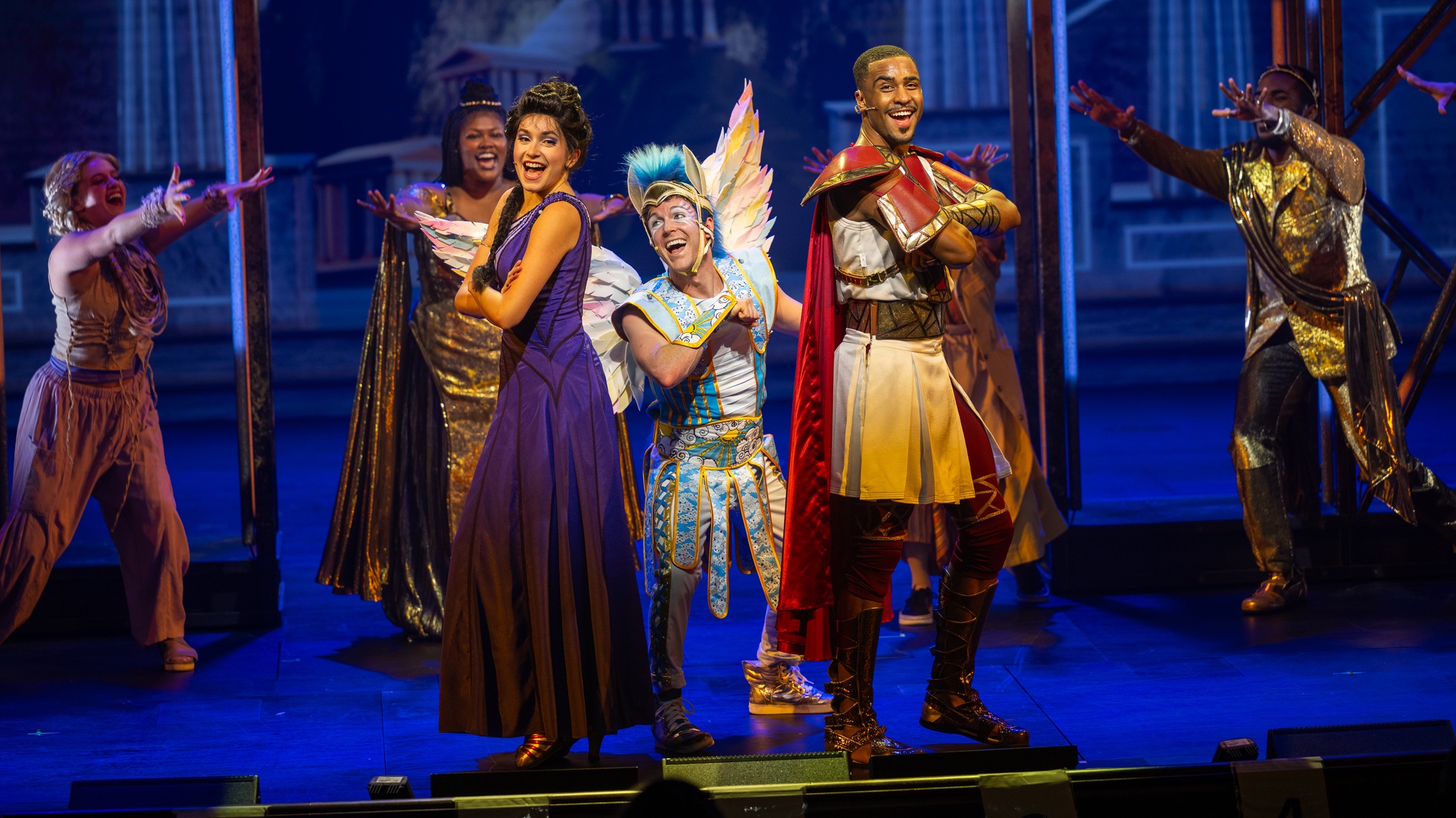
Specifically with Meg’s “I Won’t Say (I’m In Love),” this effect puts her in perspective with the Muses and adds immersion to the dialogue as she moves in front of them and eventually toward the audience with a single focus, all while the Muses continue to embrace the projection mapped across the stage elements.
And that’s exactly what the effect does. It disappears into the moment, supporting the narrative while also relying on a level of real-time technical precision rarely seen in live theater. If this is where cruise entertainment is headed, the next era of stage technology will be much more ambitious – and much more fluid – than most of the public realizes.
Follow TechRadar on Google News and add us as a preferred source to receive news, reviews and opinions from our experts in your feeds. Be sure to click the Follow button!
And of course you can also follow TechRadar on TikTok for news, reviews, unboxings in video form and receive regular updates from us on WhatsApp also.


