
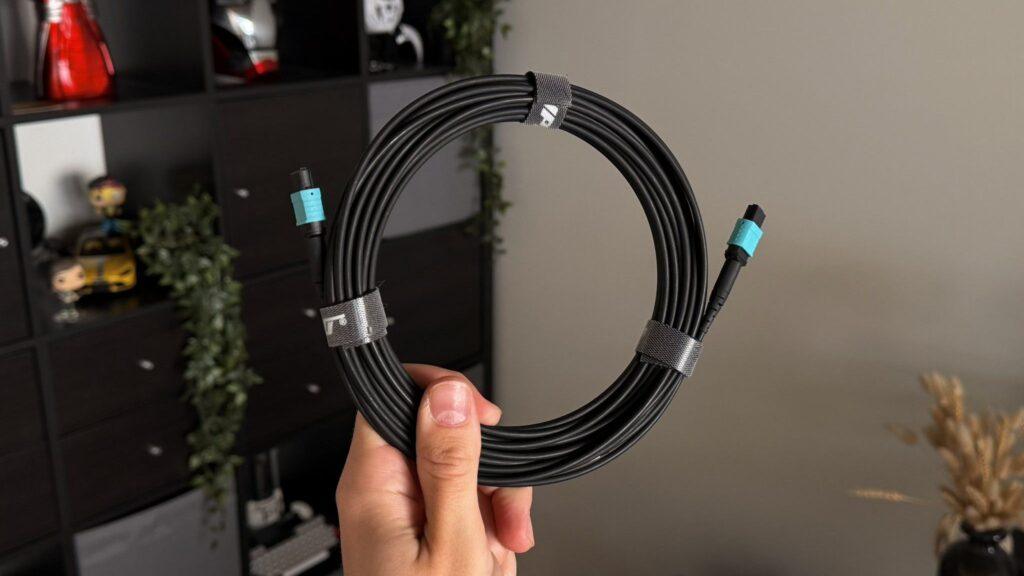
- A fiber HDMI cable has gone viral on X as an awesome solution for long cabling
- Tech enthusiast Ben Geskin notes, “What I really like is that it’s super thin and flexible, so it’s easy to hide in a clean setup.”
- It’s also easy to get behind walls, although it’s not cheap, and don’t get caught out by the expensive short cables here either.
Fancy HDMI cables have long been scorned for being a waste of money and a trap for the unwary, but there are expensive HDMI cables that do make a difference, particularly fiber optic products.
You will pay a lot for them, but the idea is that such products can be useful in certain situations, such as for very long cable runs.
Tom’s Hardware noted that a post by Ben Geskin, a technology enthusiast and X influencer, went viral with close to a million views. It shows off a ‘fully fiber optic shielded’ Ruipro 8K HDMI 2.1 cable, which impressed Geskin, who noted: “What I really like is that it’s super slim and flexible, so it’s easy to hide in a clean setup. It also has detachable connectors, which makes routing a lot easier. And it’s also more future-proof, as you can swap out the connector head for a future standard like HDMI 2.2 instead of buying a whole new cable again.”
Article continues below.
The cable supports 8K at 60 Hz and 4K at 120 Hz, eARC and has a bandwidth of 48 Gbps. The main selling point, of course, is the use of fiber optics instead of copper wire.
This active fiber cable won’t see your signal degrade over longer distances, as you will with a traditional HDMI cable, so if you want a very long run from your source to your display, this is obviously a winning proposition. It’s also less prone to signal interference in some configurations, as some Amazon reviewers point out.
Ruipro’s short fiber HDMI cables are ridiculously expensive for what they are, but the longer lengths, which are actually the point here, are better value, although still very expensive. A 30m (100ft) cable will cost you $170 in the US or £118 in the UK (at the time of writing).
Analysis: the long game
As noted, don’t be fooled into purchasing a short fiber optic HDMI cable, because there won’t be any difference between it and a standard cable (except for the amount of money you’ll pay, which will be well above the odds and then some). Only long cables make sense here, whether from Ruipro or other manufacturers.
If you want to connect a gaming PC in your study, for example, to a TV in the living room, with a long distance between those rooms, this is the type of solution that could be ideal. The cable is made to easily pass behind walls, and the connectors can be removed to make it much less complicated to route the cable where it is needed. As Geskin notes, it’s also thin and flexible, which again makes it easy to deploy (although I would be careful when bending fiber cable also a lot, to be fair).
On the topic of caveats and the differences between a fiber and copper HDMI cable, keep in mind that with fiber you need to plug it in the right way: one end is for the source and the other is for the display. Also note that on the display end you will need an additional USB port – a USB cable comes out of the HDMI connector and is required to power the Ruipro. This may not look as good on the back of your TV, but the overall setup you can achieve with one of these cables is a neat affair.
With HDMI 2.2 displays expected to arrive later this year, the ability to easily swap out the v2.1 connector for a new one will also be a big help (especially if you’ve routed it behind walls). Additionally, if a connector fails, it is also easy to fix by simply changing it.
The best graphics cards for all budgets
Follow TechRadar on Google News and add us as a preferred source to receive news, reviews and opinions from our experts in your feeds. Be sure to click the Follow button!
And of course, you can also follow TechRadar on YouTube and tiktok for news, reviews, unboxings in video form and receive regular updates from us on WhatsApp also.


