
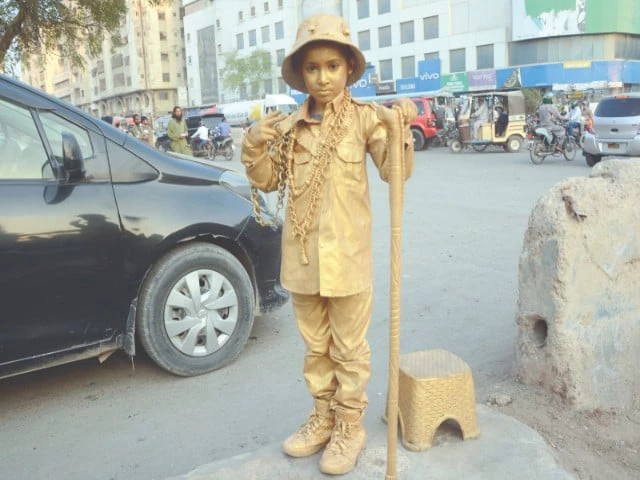
While some minors are part of begging networks, others are forced into the profession by parents struggling to make ends meet.
Street artist. Photo: Express
KARACHI:
Child street artists, some as young as eight, spend hours at city intersections and at traffic lights with their faces and clothes painted gold. To capture the attention of passersby and earn money for their families or caregivers, these children robotically stand still, appearing to any empathetic observer to be little more than statues of pain.
Most of these children are apparently associated with professional begging rings that have been using children on the streets of Karachi for years, while many others belong to impoverished families where parents depend on their children to earn a living. Standing in their clothing for hours at intersections and signs, children are exposed not only to physical and economic exploitation but also to potential skin risks.
Non-governmental organizations working on children’s rights consider this to be forced labor and exploitation, arguing that the government and local authorities should take action against individuals and groups who exploit these children. From time to time, the local administration removes these children from certain areas such as Clifton and Defense, but in many other parts of the city, children in such clothing still appear at intersections.
Recently, two children wearing the same attire were seen near Numaish Chowrangi, near Mazar-e-Quaid. The children, a boy and a girl, aged between 10 and 12, had their faces and clothes painted gold, as they posed like statues. Speaking to The Express PAkGazette, the children revealed that their parents dropped them off every night after sunset and they stayed there until midnight.
When asked if the paint caused skin irritation, the girl nodded and admitted that at first her skin felt irritated, but not anymore. When asked if standing for hours caused fatigue or pain, both children shook their heads. “We used to sell flowers in this place. Passersby gave us money after seeing us in this costume, but we don’t know how much we can earn daily because the money goes directly to our father,” said the children, whose father soon appeared and ended the interview.
According to social researcher GM Baloch, children wearing this attire at different intersections in the city seemed to be well trained. “Authorities must determine whether they are forced to do this work or do it voluntarily. Previously, similarly dressed adults, usually entertainers, performed in major cities around the world, playing instruments or standing in specific costumes, earning money from spectators. However, using children for this type of performance is alarming,” Baloch noted. Kashif Mirza, director of the Society for the Protection of Children, opined that the use of children as street performers constituted both physical and economic exploitation, violating the United Nations Convention on the Rights of the Child (CRC) along with the Sindh Child Protection Act, which required provincial authorities to remove children from such dangerous conditions.
“Authorities must take legal action against those who exploit children. Sindh’s Prohibition of Employment of Children Act 2017 explicitly prohibits putting children in hazardous work environments or using them for begging or similar activities. At the federal level, there are also several laws to legally protect children,” Mirza said.
Standing for hours with paint on your body can also pose serious risks to your skin. Renowned skin specialist Dr Shumail Zia told The Express PAkGazette that paints often contain harmful chemicals like arsenic and mercury, which are extremely dangerous for the skin. “Long-term exposure can cause changes in skin color, dark spots and inflammation. The risks increase even more during the winter months,” Dr. Zia said.


