
ISLAMABAD:
Pakistan confirmed on Friday that it has decided to open dedicated border channels for the passage of United Nations humanitarian assistance to Afghanistan, following formal requests from multiple UN agencies, a move the Foreign Ministry said reflects Islamabad’s “own commitment to humanitarian access” despite ongoing tensions with Kabul.
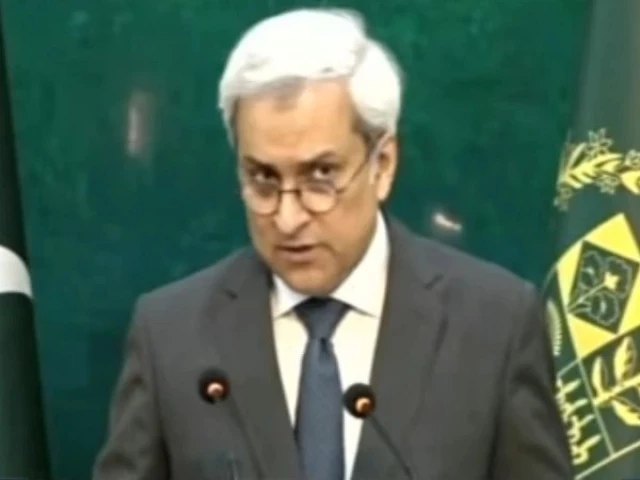
Foreign Ministry Spokesperson Tahir Andrabi, in his weekly press briefing, said Pakistan had approved a gradual opening of UN aid at the request of organizations such as the World Food Program (WFP), UNICEF and UNFPA.
“Consistent with our own commitment to humanitarian access and requests made by UN agencies, the government has officially approved the movement of humanitarian assistance to Afghanistan which will be carried out in three phases,” he told reporters.
He explained that in the first phase containers with food will be allowed; the second would cover pharmaceutical products and medical equipment; and the third would include “other essential goods related to education and health.”
The spokesperson stressed that the gradual mechanism was designed exclusively to ensure an orderly flow of aid and should not be interpreted politically. “We do not intend to classify them for any purpose other than to ensure that it is fluid and to determine how the movement of humanitarian aid to Afghanistan will flow,” he clarified.
Andrabi emphasized that while Pakistan was providing humanitarian aid for ordinary Afghans, the broader border closure remained firmly in place. “As for the utilization of border crossings for the resumption of trade and general movement… it will remain closed,” he said.
He reiterated that Pakistan’s restrictions were linked to security concerns related to terrorist infiltrations from across the border.
“Pakistan has nothing against the people of Afghanistan. The people of Afghanistan are our brothers and sisters. We mean no harm to them,” he said.
“While the border closure has a specific context and the rationale behind it remains in place… we remain positive and committed to the issue of helping the Afghan people.”
Responding to remarks by Taliban spokesman Zabiullah Mujahid, who said Afghanistan would not open its side of the border until Pakistan gave “firm guarantees”, the spokesman suggested Kabul may have misunderstood Islamabad’s move.
“My guess is that perhaps the Afghan spokesperson made that statement by not fully understanding Pakistan’s open border offer,” he said.
He added that the Afghan side may have assumed that Pakistan had opened the border to trade, while Islamabad’s decision strictly applied to UN aid shipments.
“It is very possible… that in reaction to this opening to UN humanitarian assistance, the Afghan spokesperson did not understand all the nuances,” Andrabi said.
The spokesperson also confirmed that the Turkish delegation, previously announced by President Recep Tayyip Erdogan as part of a mediation effort between Pakistan and the Afghan Taliban, had not yet arrived.
“Pakistan welcomed the announcement… We are ready to receive the Turkish delegation. That delegation has not arrived yet and I am not aware of any timetable for its arrival,” Andrabi said.
He rejected suggestions that Pakistan was unwilling to participate in mediation.
“It is not attributable to Pakistan’s cooperation that the Turkish delegation has not arrived yet. Pakistan was open and ready… perhaps due to lack of cooperation from the Taliban. This must be asked of the Taliban regime.”
On media reports claiming that Pakistan and the Afghan Taliban held talks in Saudi Arabia, the spokesperson said he had no information.
“We are not aware of these negotiations and I have no comment to offer on the matter,” he said, adding earlier that “I do not have any information about the talks you mentioned. If I receive any information, I will share it with you.”
Asked about a UN report suggesting greater engagement between the Taliban and India, the spokesperson said such cooperation had existed historically but was worrying only if it was directed against Pakistan.
“This kind of collusion has existed… and this is obviously disturbing to the extent that it is anti-Pakistan,” he said.
He added: “If the two countries cooperate on peaceful issues… Pakistan has no problem with that. Our problem starts when a third country views the relationship with Afghanistan in a zero-sum paradigm with Pakistan.”
Responding to a question about allegations that Pakistan had used Israeli spyware, Andrabi dismissed the reports out of hand.
“This is all media speculation. This is all disinformation spreading rumours. There is absolutely no cooperation between Pakistan and Israel on anything, let alone spyware or any such tools. Therefore, I would reject it, quite emphatically,” he said.
On the 33rd anniversary of the demolition of the Babri mosque, Andrabi delivered a lengthy statement expressing Pakistan’s concern.
He said the event “remains disturbing for all who oppose religious intolerance and discrimination”, adding that safeguarding Muslim heritage was “a shared obligation of the international community”.
He urged India to promote “tolerance and inclusion” and reaffirmed Islamabad’s commitment to protecting the rights of minorities at home.
The spokesperson also confirmed that Pakistani missions in Thailand and Myanmar were closely coordinating the return of nationals stranded or detained in the region.
“Both our missions are involved in resolving this matter…The presence of these Pakistanis in Myanmar is unfortunate,” he said, adding that Pakistan’s priorities were their safe return and preventing future trafficking scams.


