
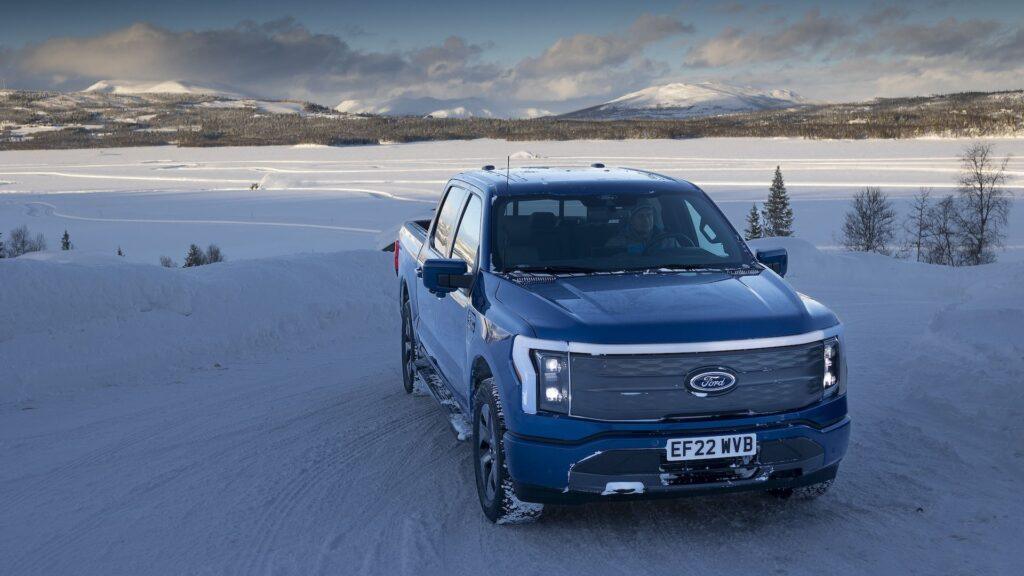
- Ford says all-electric F-150 Lightning is no more
- Poor sales contributed to the demise.
- Company says hybrid with range extender is on the cards
Ford was the first to bring a full-size, purely electric pickup truck to market, beating even Tesla and Elon Musk in the divisive and fiscally disappointing Cybertruck.
But like Musk’s steel-bodied workhorse, the F-150 Lighting also failed to light up the sales charts.
After indefinitely halting production of the purely electric pickup a few months ago due to an increase in demand for combustion engine trucks and therefore plant capacity, Ford announced this week that “production of the current F-150 Lightning ends this year.”
The Blue Oval didn’t delve into why it was pulling the plug, so to speak, only to mention that it has a second-generation model in the works that will opt for an extended-range electric vehicle (EREV) powertrain.
As such, Ford says the next-generation Lightning will run on pure electricity, harnessing the power of two electric motors for quiet, powerful performance, but backed by a “high-power generator that will enable an estimated range of more than 700 miles.”
That figure is more than double what the heavy and expensive F-150 Lightning could handle, which was arguably the main reason the model was doomed from the start.
Work-shy electric vehicles fail to attract customers
Ford’s electric truck ambitions were doomed from the start. After all, pickup trucks are usually purchased to transport large loads over long distances, whether towing a boat to shore or carrying construction materials.
Whatever the reason, the extra weight drains the batteries of modern electric vehicles and dramatically reduces range, something the American consumer was not willing to compromise on.
On top of this, the F-150 Lightning was much more expensive than originally planned, with the customer having to bear the cost of the huge battery packs needed to give it acceptable range.
Andrew Frick, president of Ford Blue, told reporters Monday that instead of spending “billions more on large electric vehicles that now have no path to profitability, we are allocating that money to higher-performing areas,” according to NPR.
“The American consumer speaks clearly and wants the benefits of electrification, such as instant torque and mobile power. But they also demand affordability,” he added.
It also didn’t help that the Trump administration eliminated the $7,500 tax credit for new electric vehicles, resulting in a perfect storm that killed the F-150 Lighting and several other purely electric vehicles from Ford, including a commercial pickup truck for Europe that was also eliminated.
PakGazette reported that Ford said it expected to lose about $5 billion on its electric vehicle business this year, about the same as it lost in 2024. A big reason it is returning to hybrid and gasoline powertrains.
Ford isn’t the only company feeling the pressure as demand for electric vehicles cools, with Porsche also revealing this week that its upcoming Boxster and Cayman sports cars are being reconfigured to house gasoline engines, after previously stating they would be pure electric vehicles, according to Autocar.
While it’s undoubtedly bad news for the EV movement as a whole, those companies that specialize in purely electric SUVs and pickups (like Rivian, Tesla, and the upcoming Slate model) will probably thank their lucky stars that a major player like Ford has exited the market.
Follow TechRadar on Google News and add us as a preferred source to receive news, reviews and opinions from our experts in your feeds. Be sure to click the Follow button!
And of course you can also follow TechRadar on TikTok for news, reviews, unboxings in video form and receive regular updates from us on WhatsApp also.


