
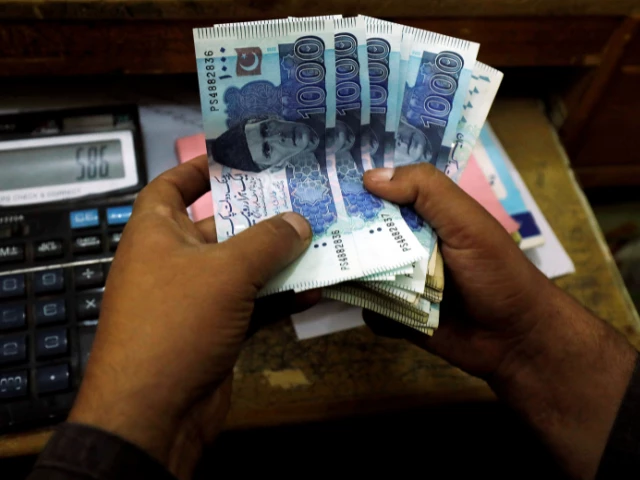
A trader counts Pakistani rupee notes at a currency exchange stall in Peshawar, Pakistan, December 3, 2018. REUTERS
ISLAMABAD:
The Federal Constitutional Court (FCC) has dismissed a series of petitions filed by students of medical colleges in Sindh, who had sought permission to pay their fees in Pakistani currency after getting admission under the foreign/overseas quota.
A three-member FCC bench headed by Chief Justice Amin-ud-Din Khan heard the petitions.
During the hearing, the students’ lawyer, Shahab Sarki, argued that the universities themselves had granted admission to the students under the foreign quota, even though they had completed their entire education in Pakistan.
It alleged that the Pakistan Medical and Dental Council (PMDC) had displayed show-cause notices on its website instead of properly serving them to students, and that universities had forcibly placed students under the foreign quota.
Lawyers for the students argued that students should not be penalized for the universities’ mistakes, adding that they could only be corrected at other universities.
PMDC lawyer Jahangir Jadun informed the court that the students themselves had applied for admission under the overseas quota. He claimed that both students and universities were responsible for admissions under incorrect quota.
“The students got admission to medical colleges under foreign quota in the academic year 2022-23. After paying fees in foreign currency for two years, they approached the Sindh High Court (SHC) seeking permission to pay their fees in local currency.
“However, the SHC dismissed their writ petitions,” he said. After hearing arguments, the FCC upheld the SHC and dismissed the students’ appeals.
The foreign quota in Pakistani medical colleges reserves a percentage of places (around 5-15%) for international or overseas Pakistani students.
It allows students to apply with foreign qualifications such as SAT-II or MCAT/UCAT, often commanding higher dollar fees, and creates a separate merit list for these candidates to ensure specific opportunities for non-Pakistani citizens in public and private institutions.
These admissions are regulated by PMDC, the regulator of medical education in Pakistan.


