
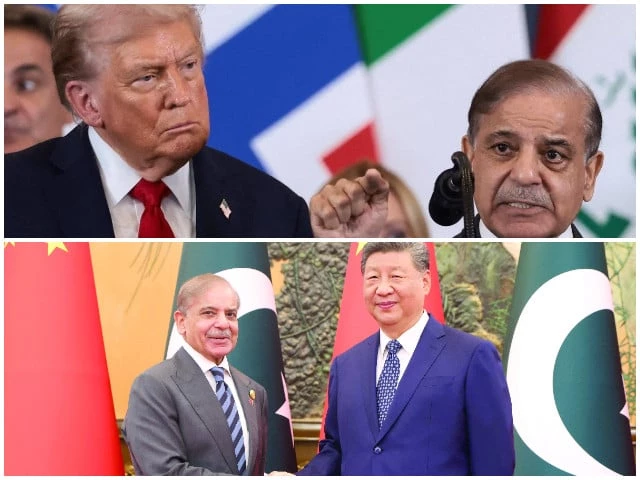
Pakistan ends 2025 not as a state that reacts to events, but as a state that increasingly shapes them
ISLAMABAD:
Few could have predicted at the beginning of 2025 that Pakistan’s foreign policy would end the year on such a dramatically different footing.
Pakistan, long perceived as a country navigating diplomatic isolation, economic fragility and regional pressure, closed 2025 having regained its strategic relevance in multiple scenarios.
At the heart of this shift was an unprecedented shift in relations between Pakistan and the United States, following Donald Trump’s return to the White House, a development that reshaped Islamabad’s global position and triggered a broader recalibration of its external commitments.
The most surprising foreign policy development of 2025 was the rapid and largely unexpected improvement in relations between Pakistan and the United States. Contrary to widespread expectations of indifference or renewed friction, President Trump took a markedly positive and transactional approach toward Pakistan soon after taking office.
In multiple public statements, Trump openly praised Pakistan’s civilian and military leadership, acknowledging the country’s role in regional security and counterterrorism. The turning point in the relationship was the capture of one of the masterminds of the Abbey Gate bombing at Kabul airport in August 2021.
The capture and extradition of the Daesh terrorist led Trump to openly praise Pakistan in his inaugural address to Congress. That counterterrorism cooperation revived communication channels between the two countries that were practically nonexistent during Joe Biden’s mandate.
Such direct praise from an American president, particularly one known for his blunt diplomacy, was unprecedented in recent memory and sent a strong signal to Washington’s political establishment.
Behind the scenes, diplomatic and military channels were quickly reactivated. High-level engagements resumed, intelligence cooperation deepened, and U.S. officials increasingly described Pakistan as a “trusted regional partner” rather than a problematic ally of the past.
The focus of the engagement extended beyond Afghanistan to South Asian stability, Middle East security and counterterrorism cooperation. Trump’s worldview, driven less by ideology and more by immediate strategic utility, benefited Pakistan.
Islamabad positioned itself as a net security provider in an unstable region, offering cooperation without seeking the kind of alliance commitments that had complicated ties in previous decades. By the end of 2025, relations between Pakistan and the United States had not only stabilized; had been substantially redefined.
The four day war and its consequences
If the US reset marked a diplomatic breakthrough, the four-day war between India and Pakistan in May became a turning point in Pakistan’s regional posture. The brief but intense military confrontation brought South Asia dangerously close to escalation, once again drawing global attention to the region’s volatility.
Pakistan’s response, combining military preparedness with skillful diplomacy, earned muted recognition from major international capitals.
After the Pahalgam attack in April, when India was threatening cross-border attacks, the outside world was wary of Pakistan’s ability to prevent, let alone inflict, any harm on India. But when India launched missile strikes deep inside Pakistan, Islamabad’s response took not only New Delhi but world capitals by surprise. Pakistan shot down at least seven Indian fighter jets, including four highly sophisticated French-made Rafales.
While the conflict highlighted the long-standing hostility between the two nuclear-armed neighbors, it also altered perceptions. Pakistan was not seen as an instigator but as a state capable of defending its interests, while avoiding uncontrolled escalation.
The postwar diplomatic phase was equally significant. Islamabad’s engagement with major powers, including the United States, China, the Gulf States and its European partners, reinforced the message that Pakistan remained indispensable for regional stability.
In contrast, concerns grew internationally about India’s increasingly assertive stance under Prime Minister Narendra Modi, particularly its willingness to test military thresholds.
A rising geostrategic profile
Following the Pakistan-India standoff, Pakistan’s geostrategic profile rose sharply. Regional and extra-regional actors began to reevaluate Pakistan’s role not only as a South Asian actor but as a bridge between South Asia, the Middle East and Central Asia.
This recalibration translated into tangible diplomatic achievements. Pakistan has stepped up strategic coordination with key Middle East partners, positioning itself as a stabilizing force amid the ongoing turmoil in Gaza, the Red Sea and the broader Gulf region.
Islamabad played an active diplomatic role in discussions on a peace framework for Gaza, leveraging its credibility with Western and Muslim-majority states. While the conflict itself remained unresolved, Pakistan’s commitment elevated its position as a responsible voice advocating for ceasefire, humanitarian access, and a political path forward.
Deepen ties with Gulf states.
One of the most consequential outcomes of Pakistan’s increased strategic relevance was the defense pact signed with Saudi Arabia in 2025. Beyond Riyadh, Pakistan strengthened ties with the United Arab Emirates and Qatar, reinforcing its role as a trusted security partner rather than a partisan player in Middle East rivalries.
These relationships were underpinned by Pakistan’s careful balancing act. For Pakistan, this engagement in the Gulf brought both strategic and economic dividends, strengthening its position at a time when Middle East security dynamics increasingly intersected with global power competition.
China: continuity and consolidation
While Pakistan’s relations with the United States grabbed headlines, its strategic partnership with China continued to steadily deepen in 2025. High-level political and military exchanges remained frequent, reflecting long-term mutual trust and alignment.
Progress continued under the China-Pakistan Economic Corridor (CPEC), with renewed emphasis on industrial cooperation, energy security and technology. Both sides worked to address previous implementation challenges, signaling a shift from big announcements to consolidation and delivery.
Importantly, Pakistan managed to improve ties with Washington without undermining its partnership with Beijing, an increasingly rare diplomatic balancing act in an era of great power rivalry.
Growing commitment to Russia
Pakistan’s rapprochement with Russia also gained momentum in 2025. High-level visits, defense consultations and energy discussions underlined Islamabad’s desire to diversify its strategic relations.
While ties between Pakistan and Russia remain limited compared to traditional partnerships, the coherence of high-level engagement marked a shift from episodic contact to structured dialogue. In a multipolar world, Islamabad increasingly positioned itself as a flexible actor open to cooperation across geopolitical lines.
The Afghan challenge: a persistent low point
Despite these achievements, 2025 also highlighted the limits of Pakistan’s foreign policy success, especially in its deteriorating relationship with Afghanistan. Instead of stabilizing, ties with Kabul worsened significantly over the course of the year.
Islamabad’s main concern – the presence of militant groups operating from Afghan soil – remained unresolved, while diplomatic engagement yielded little progress. Border tensions, mutual accusations and the absence of effective communication mechanisms deepened mistrust.
Unlike other fronts where Pakistan managed to recalibrate and compromise, Afghanistan remained a source of strategic frustration, underscoring the complexity of the post-disengagement regional landscape.
A year of strategic recovery
As 2025 draws to a close, Pakistan’s foreign policy record reflects a year of strategic recovery rather than dramatic transformation. The unprecedented improvement of Pakistan-US relations under President Trump, the recalibration of regional perceptions after the war, growing engagement with the Middle East, and sustained partnerships with China and Russia collectively restored Pakistan’s relevance on the global stage.
Challenges remain, especially on the western border, but the broader trajectory suggests a country that has learned to leverage geography, security capabilities and diplomacy more effectively.
In a turbulent international environment, Pakistan ended 2025 not as a state reacting to events, but as a state increasingly shaping them. Whether this momentum can be sustained through 2026 will depend on internal stability and the ability to convert strategic relevance into long-term economic and political gains.


