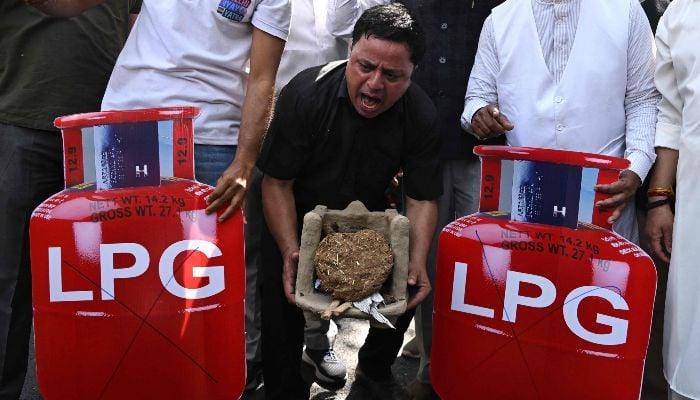
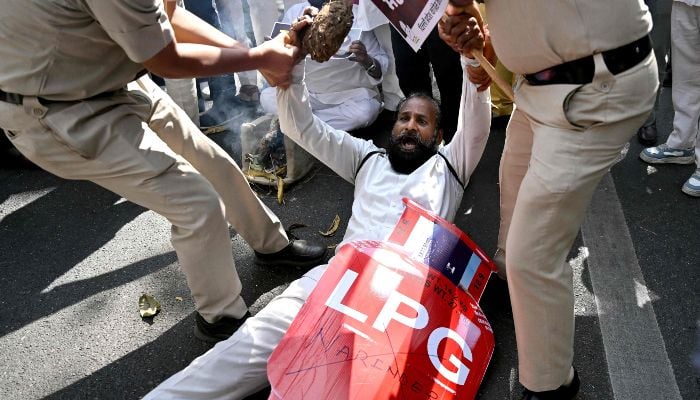
NEW DELHI: Rising black market cooking gas prices in India’s capital are pushing poorer families to turn to wood and coal, increasing health risks and worsening air quality in the highly polluted megacity.
India is the world’s second-largest buyer of liquefied petroleum gas (LPG), which is used for cooking and sourced mainly from the Middle East, and supplies have been strangled by the ongoing war.
Indian Prime Minister Narendra Modi has urged states to curb black marketing and avoid panic, highlighting that India’s energy supply remains stable.
In the low-income neighborhood of Madanpur Khadar, Sheela Kumari, a 36-year-old domestic help, says she was forced to abandon LPG cooking gas cylinders for cooking after prices doubled.
“We used to buy cylinders for INR 1,800-2,000 ($19-21), but now on the black market it has gone up to INR 5,000 ($53),” he said. AFPalmost as much as his full monthly salary of INR 6,000.
“It’s unimaginable for us,” he said. “The next best option for us was to go back to wood and coal.”
Kumari said a 14-kilogram cylinder lasts only 15 to 20 days for her family of six, even when they extend its use.
But he says a 10-kilogram bundle of firewood, which lasts several days, costs 30 rupees ($0.30).
“There are health consequences and my children cough,” she said. “But tell me a way out?”
“Too expensive”
Her neighbor, Munni Bai, 45, who suffers from asthma, had switched to using an electric stove and biogas from cow dung to help her breathe.
But now she said she was being forced to resume using alternative fuels.
“Gas is too expensive,” he said. “We can’t depend on it: we gave up coal and wood because of my health problem, but now it is difficult to sustain.”
But activists say the problem has more to do with access.
Many migrant workers lack the documentation needed for subsidized LPG and rely on informal markets, where hoarding has driven up prices.
“There is no major shortage yet, but hoarding has increased,” said Deepak, who uses only one name, from the Center for Defense and Research (CFAR).
“Many immigrants depend on black market cylinders and prices have multiplied by two or three.”
New Delhi, and its sprawling metropolitan region of 30 million people, regularly ranks among the world’s most polluted capitals, due to a deadly combination of emissions from power plants, heavy traffic, as well as the burning of garbage and crops.
Over the past few decades, the Indian government has pushed its “Ujjwala” or “light” clean energy scheme, to provide more than 100 million LPG connections to poor households.
Burning wood, charcoal and biomass indoors exposes families to high levels of smoke and toxic particles, increasing the risk of respiratory diseases.
Women and children, who spend more time near cooking areas, are especially vulnerable.