
Opposition lawmakers create ruckus in National Assembly, chant slogans against ruling coalition
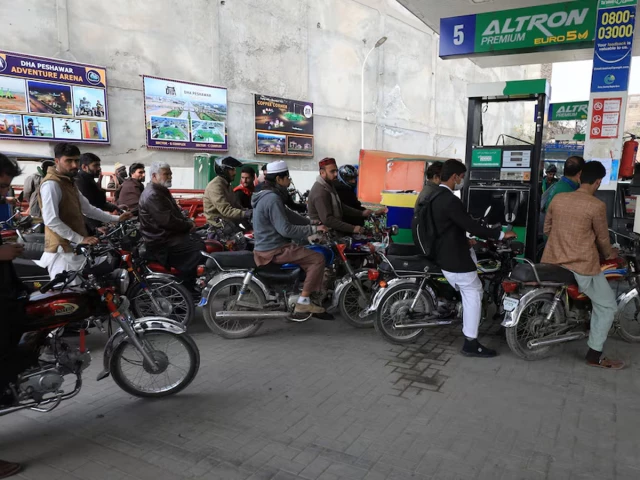
People wait their turn to fill up with fuel at a gas station in Peshawar. Photo: Reuters/ Archive
Opposition members staged a protest at the National Assembly on Friday against the government’s sharp increase in oil prices, with lawmakers chanting slogans as they surrounded the speaker’s podium in a show of defiance.
The government on Thursday further increased petrol prices by Rs 137 per liter to a record Rs 458.4 after Prime Minister Shehbaz Sharif decided to impose more taxes on consumers.
The new petrol price of Rs 458.4 per liter is also much higher than the increase in the international market as Prime Minister Shehbaz decided to increase the petroleum tax to a record Rs 160.61 per liter of petrol.
It was the second major hike in fuel prices in less than a month after Chief Minister Shehbaz increased diesel and petrol prices by Rs 55 per liter last month. The accumulated increase in the price of gasoline in one month stands at 63%, and that of high-speed diesel at 75%.
During the protest, some frustrated opposition members tore copies of the assembly agenda. They insisted on addressing the House on the oil price rise, but Vice President Syed Ghulam Mustafa Shah told them he would allow points of order only after question hour.
The protest continued despite the warning and opposition member Junaid Akbar Khan was temporarily given the floor. Criticizing the government, Khan said: “This incompetent and thieving government was imposed on Pakistan. Last night, this imposed government dropped a petrol bomb on the people.”
Khan also spoke against a state institution, prompting the vice president to respond sternly: “If you continue to speak against institutions in this way, I will not allow the session to continue.”
Other opposition members, including JUI’s Noor Alam Khan, called on the president to allow MPs to discuss rising prices of petroleum products, highlighting growing public frustration over rising fuel and electricity costs.
Following the protest, the session of the National Assembly was postponed until Monday.
Read: Tanker Contractors Threaten to Suspend Tanker Shipments Following Sharp Fuel Price Rise
The government raised prices after it failed to convince the International Monetary Fund (IMF) to allow it to provide more subsidies. The IMF capped maximum fuel subsidies at Rs 152 billion.
However, the most impactful action of the government was to increase the rate of petroleum tax to Rs 161 per liter of petrol to raise additional funds to cross-subsidize diesel prices. The government outsourced the state’s primary function of protecting its citizens to oil consumers.
Jamaat-e-Islami (JI) chief Hafiz Naeemur Rehman said “the brutal increase in the price of petrol and diesel is unacceptable” and announced a nationwide protest movement starting Friday in a post on X.
پٹرول، ڈیزل پورے English pic.twitter.com/eSFixCNf3V
– Naeem ur Rehman (@NaeemRehmanEngr) April 2, 2026
JI’s Munim Zafar, during a press conference in Karachi on Friday, demanded the government to reverse the increase in petrol price and reiterated the start of the protest movement across Karachi, with a rally scheduled in front of the Millennium Mall at 8 p.m.
Meanwhile, former Finance Minister Miftah Ismail also raised eyebrows over the government tax increase, stating that last night the government increased petrol prices by Rs 79 per litre, but at the same time decided to “increase taxes on petrol” by Rs 55 for a total increase of Rs 134 per litre. “And he keeps saying that he doesn’t want to be a burden on people and wants to ease the burden himself,” he said.
The new price of petrol is Rs 458.41 per litre. Last night it was increased by Rs 134 per liter. This increase includes an increase of Rs 55 in petroleum tax. So the government decided to increase the tax on petrol by Rs 55 while raising the prices.
So…
—Miftah Ismail (@MiftahIsmail) April 3, 2026
Former Sindh Governor Muhammad Zubair also questioned why Pakistan has “the most expensive petrol in the region”. According to him, petrol costs Rs 286 in India, Rs 280 in Bangladesh, Rs 322 in Nepal and Rs 406 in Sri Lanka, compared to Rs 459 in Pakistan.
Why does Pakistan have the most expensive gasoline in the region? The figures given in Pakistani rupees will confirm this
India: 286
Bangladesh: 280
Nepal: 322
Sri Lanka: 406
AND
Pakistan: 459Only one reason. We are the most incompetent and corrupt compared to all these countries.
– Mohammad Zubair (@Real_MZubair) April 3, 2026
“Only one reason: we are the most incompetent and corrupt compared to all these countries,” said the former governor.
The increase in gasoline and diesel prices is enormous. Pakistanis, especially the middle class, will not be able to afford it.
We still do not see any major reduction in public spending, except for temporary austerity of less than two months.
The government punishes people for their own incompetence– Mohammad Zubair (@Real_MZubair) April 2, 2026
He also noted that the government’s austerity measures have been deficient and represent only “temporary austerity of less than two months.”
Another former finance minister, Asad Umar, compared prices in India and Pakistan and said that petrol prices in Pakistan are currently 48% higher and diesel prices 92% higher than in neighboring India.
Petrol price in Pakistan today is 48% higher and diesel prices 92% higher than in India. The global price of oil has increased sharply, but the reason why petrol and diesel are expensive in Pakistan is the unwillingness to tax the rich and powerful and collect most of the taxes from the working middle class…
-Asad Umar (@Asad_Umar) April 3, 2026
He argued that the government’s “unwillingness to tax the rich and powerful” has left ordinary citizens to bear the burden, while “most taxes are collected from the working middle class.”
Former Khyber-Pakhtunkhwa finance minister Taimur Saleem Khan Jhagra also criticized
Explain this…
A government that wants relief has not only increased the price of petrol but has increased the tax on petroleum from Rs 105 to Rs 161 per litre. This is the highest petrol tax ever recorded in the history of Pakistan.
It collects Rs 24 per liter as customs duty.
And hilariously,… pic.twitter.com/45DHZXyznV
– Taimur Saleem Khan Jhagra (@Jhagra) April 3, 2026
Additionally, Natasha Dultana of the Pakistan People’s Party said the overnight increase in gasoline prices “without warning is just another blow” to the people. “How long are citizens expected to bear this burden?”
Gasoline prices rose overnight, without warning, just another blow to people already struggling to breathe under inflation. How long are citizens expected to bear this burden?
-Natasha Daultana (@NDaultana) April 3, 2026
Lawyer Saad Rasool predicted that the recent price increase “will push millions of working people below the poverty line.”
Former PTI minister Fawad Chaudhry felt that the country’s people had become “Naseem Shah, that’s why they fined him!”
پوری قوم نسیم شاہ بنی ہوئ ہے اس لئے جرمانہ لگایا ہے! وفاقی حکومت!! #PetrolHike
-Ch Fawad Hussain (@fawadchaudhry) April 3, 2026


