
The Arif Habib consortium submits the highest bid of Rs 135 billion; The government receives only 10 billion rupees, the rest will be reinvested in an airline
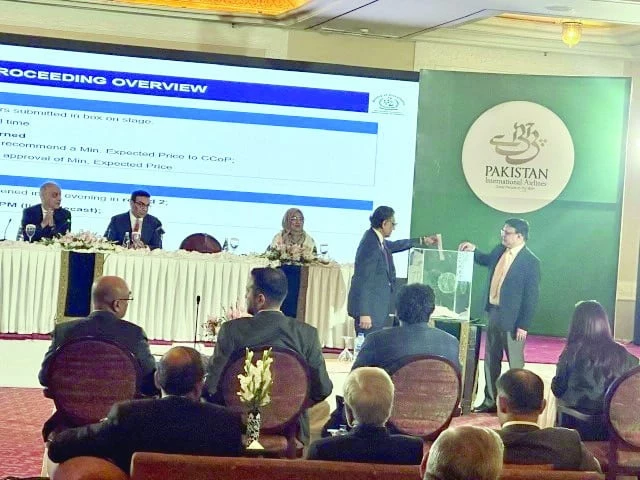
The government sells its 75% stake in PIA to the Arif Habib-led consortium for Rs 135 billion. Photo: screenshot
ISLAMABAD:
The government on Tuesday sold its 75% stake in Pakistan International Airlines (PIA) for Rs 10.1 billion in cash to the consortium led by business tycoon Arif Habib, marking the completion of the first major privatization transaction in two decades by getting rid of the white elephant.
The consortium of Arif Habib, Fawad Ahmed Mukhtar, Gohar Ejaz and Aqeel Karim Dhedhi, renowned Pakistani businessmen, submitted the highest bid of Rs 135 billion for 75% stake in the 13th round of open auction. It beat another cash-rich consortium led by Muhammad Ali Tabba.
Air Blue was disqualified from the open tender after offering Rs 26.5 billion, almost three-quarters less than the minimum price of Rs 100 billion.
The government had set a very low minimum price, even compared to the last failed attempt when it asked for Rs 85 billion for 60% of the shares when the entity had negative equity.
Of the Rs 135 billion, the government will receive Rs 10 billion ($36 million) and the remaining amount will be invested in Pakistan International Airlines (PIA) by the successful bidder, Muhammad Ali, the prime minister’s advisor on privatization, said after the auction.
It was the second attempt to sell PIA in more than a year and marks the first successful transaction since 2005, when the government sold K Electric, the country’s largest power distribution company.
Prime Minister Shehbaz Sharif had wanted the PIA to be sold for Rs 200 billion.
During the Cabinet Privatization Committee meeting, which approved the minimum sale price, one of the cabinet ministers advocated selling PIA at any cost to get rid of the bleeding entity.
The government took Rs 670 billion off PIA’s books, which will now be paid by taxpayers. For the current fiscal year, the government has estimated a debt servicing cost of Rs 35,000 crore, which will continue for at least six more years.
From the beginning, Arif Habib Group adopted an aggressive approach compared to the only competitor, which was initially conservative and added Rs 250 million in each of the first eight auction rounds.
After the eighth round, Muhammad Ali Tabba’s group sought a half-hour break for internal consultations before finally “congratulating Arif Habib” when he raised the price to 135 billion rupees.
To make the second attempt successful, the government had also waived 18% sales tax on aircraft leasing, provided a tax credit of Rs 36 billion to bidders and extended the deadline to clear the current liabilities of over Rs 33 billion of the Federal Board of Revenue (FBR) and the Civil Aviation Authority (CAA).
The bidders valued 100% of the company’s shares at 180 billion rupees or $640 million.
The privatization adviser said the winner would have to deposit two-thirds of the bid money within three months and the rest within a year. He said the government will not transfer shares equivalent to one-third of the price until the winning consortium pays all dues.
Muhammad Ali said the successful bidder will have three months to show interest in acquiring the remaining 25% stake in PIA at a 12% premium over the offer price. The advisor stated that the successful bidder would have the option of incorporating two new partners, including an international airline.
There is a high possibility of Fauji Fertilizer becoming the fifth partner in the consortium, according to officials aware of the development.
The government’s desire is that after four years the PIA will have 40 planes in operation and its passenger load will increase from 4 to 7 million passengers a year, Muhammad Ali said.
PIA employees should not be afraid as all good employees would be retained and compensated, said winner Arif Habib. He said existing employees will be given confidence and they should run the airline.
The government has also separated the medical responsibilities of PIA employees and deposited them in the PIA holding company, which are now taken care of by taxpayers.
The government has prohibited the new owner from laying off any employees for a maximum period of one year. The winner has also been given enough time to clear the obligations of the FBR and CAA.
“We are planning to add 18 more aircraft and depending on the traffic load, our plan is to take the total fleet number to 64,” Habib said. Currently, the PIA only flies 18 aircraft out of a fleet of 34.
Muhammad Ali said the PIA’s liabilities had started to accumulate again and there was a risk that after removing more than Rs 650 billion from the balance sheet, the amount could rise again at an alarming rate.
The Economic Coordination Committee (ECC) of the Cabinet on Tuesday approved Rs 2,000 crore or over $7 million to clear tax liabilities and make principal loan payments of Roosevelt Hotel, New York, owned by PIA Investment Limited.
The successful privatization transaction of PIA may open avenues for the sale of other entities.
The sale of PIA would also boost the confidence of local investors who shied away from investing further in Pakistan due to the unfavorable business environment.
The PIA currently has less than 6,900 permanent employees in addition to 2,900 contractual employees.
It has privileged access to many of the world’s busiest airports, including Heathrow, London. The national flag carrier has 170 peer slots in various global destinations including Gulf countries, North America and Europe.
“I have always maintained that whichever consortium emerged victorious, Pakistan would be the ultimate winner and today’s result fully justifies that belief,” Prime Minister Shehbaz Sharif said in his congratulatory message.
The Prime Minister said the strong participation of our leading business groups and some of Pakistan’s most experienced and respected investors is a powerful vote of confidence in our economy and its future.


