
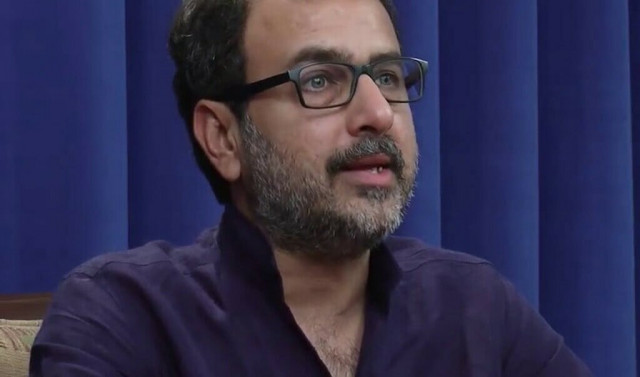
The Minister of Energy, Awais Leghari. Photo: Online
ISLAMABAD:
Energy Minister Awais Leghari admitted on Thursday that rising electricity prices had pushed consumers to install solar panels, even as the government’s key coalition partner, the Pakistan People’s Party (PPP), equated recent changes in net metering policy with “theft and fraud in broad daylight.”
Despite acknowledging that the tariff hike had kept people away from the national grid, the government, in another highly controversial move, has imposed an additional charge of between Rs 200 and Rs 675 per consumer on residential users to raise funds to offset the relief given to industrial consumers.
Addressing the launch ceremony of a program to replace conventional fans with energy-efficient models, the Energy Minister admitted that expensive electricity had forced people to adopt solar-based solutions and that changes to net metering regulations were painful.
However, the minister’s comments appeared to be little more than empty words, as the government simultaneously imposed another unjustified burden on ordinary consumers. To provide relief of Rs 4.04 per unit to only 3,01,384 industrial consumers, the government has imposed an additional burden of Rs 132,000 crore on residential users.
Under the revised structure, the government has imposed a monthly fixed charge of Rs 200 on protected consumers using up to 100 units, Rs 300 on protected consumers using up to 200 units, Rs 275 on non-protected consumers using up to 100 units, Rs 350 on 200 units, Rs 400 on 300 units, Rs 500 on 400 units and Rs 675 per month on consumers who use more than 100 units. 400 units.
Such a blatant abuse of authority has forced people to move from the national grid to off-grid solutions such as solar panels. The government has also been charging residential consumers an additional Rs 12 per unit as cross-subsidy and Rs 3.23 per unit as debt servicing cost, liabilities that arise directly from inefficiencies within the power sector.
Compared to a power price of around Rs 11 per unit, consumers are being charged up to Rs 60 per unit, a disparity widely seen as the main reason behind the growing exodus from the national grid.
The Energy Minister acknowledged that net metering “reforms” could cost the government political capital, but promised the changes would continue.
However, the PPP, whose support is crucial for the government to retain its majority in the National Assembly, launched a harsh attack against the abrupt changes to the solar net metering policy.
“It was a ‘daylight robbery and fraud,'” said PPP lawmaker Sharmila Faruqui while speaking in a call for attention notice presented by the party in the National Assembly.
PPP MNAs Syed Naveed Qamar, Aijaz Hussain Jakhrani, Dr Nafisa Shah, Dr Sharmila Faruqui and Mirza Ikhtiar Baig drew the attention of the Power Division Minister to a matter of urgent public importance related to the implications of the revised solar policy.
Responding to the criticism, Leghari told the House that of the total installed solar capacity in Pakistan of 20,000 to 22,000 megawatts, only around 6,000 megawatts were tied to net metering. As a result, he said, only 600,000 to 700,000 consumers – about 8 to 10 percent of total solar energy users – would be affected.
“There will be no impact on low-income consumers,” he assured the House.
However, just a day earlier, the Energy Minister had stated that only 1 percent of total consumers would be affected by the change in net metering policy. Under the new regulations, the government would buy electricity from solar panels at Rs 8.13 per unit, while selling electricity at rates of up to Rs 60 per unit.
Leghari rejected claims that the new regulations were anti-solar, arguing that reducing the profit margin of net metered consumers from 50 percent to 37 percent did not constitute an anti-people measure.
Responding to the minister’s remarks, Faruqui objected to the government “blaming net metering users for overloading the national grid.”
“These consumers are the ones who followed the government’s clean energy policy,” he said, adding that the authorities have made “a 180-degree turn in their policies.”
“Now they justify it by blaming those who were at the forefront of their politics,” he added.
Faruqui maintained that the Electricity Division was effectively shifting costs arising from “line losses, transmission losses, inefficiency, inconsistency, corruption and capacity payments” to ordinary citizens, once again calling the measure “absolute robbery.”
In his response, the minister said the wake-up notice was no longer relevant “as the prime minister has already said that net billing should stop and consumers will remain on net metering for now. But this change is only meant for owners of existing solar panels, that too until the National Electricity Regulatory Authority decides on a yet-to-be-filed review petition.”
Leghari, together with the Minister of Climate Change, Dr. Musadaq Malik, also launched the Prime Minister’s Fan Replacement Programme, which aims to replace 88 million conventional fans with energy-efficient models over a period of 10 years.
Under the plan, existing fans can be replaced at a cost of Rs 12,000, and the amount, including interest on loans, will be recovered through electricity bills. The program offers on-bill financing, allowing consumers to pay in installments over six to 18 months for new fans that use 70 percent less energy.
The Energy Minister said the country’s cooling load demand was 6,000 to 8,000 megawatts and the introduction of energy-efficient fans could significantly reduce demand during peak hours.
He further noted that Pakistan currently lacks stable demand for electricity due to growing use of solar energy and low industrial activity, with nationwide demand recorded on Thursday at just 8,000 megawatts.
However, despite acknowledging that winter demand was around 8,000 megawatts, Energy Division officials on Wednesday made a highly questionable claim to television hosts that the government had added 8,000 megawatts of capacity to the national grid to meet electricity demand during periods of low solar production.


