
Petrol price breaks records after Rs 137 hike, HSD rises 55% to Rs 520 per litre, oil tax hits record
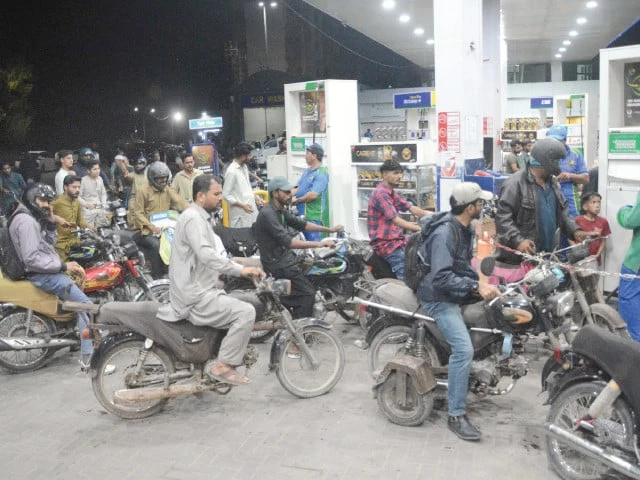
As the city runs on fumes, motorcyclists queue at a petrol pump in Karachi, waiting their turn amid rising fuel prices. Photo: Jalal Qureshi/Express
ISLAMABAD:
On Thursday, the government further increased the price of petrol by Rs 137 per liter, or 43%, to the highest-ever level of Rs 458.4 after the Prime Minister decided to impose more taxes on consumers.
The new petrol price of Rs 458.4 per liter is also much higher than the increase in the international market as the prime minister decided to increase the petroleum tax to a record Rs 160.61 per liter of petrol.
In one fell swoop, the prime minister increased the tax on petrol from Rs 106 to Rs 161 per litre, which is an increase of Rs 55 in taxes.
The PML-N-led government also increased the price of high-speed diesel to Pakistan’s highest level of Rs 520.35 per liter, an increase of Rs 185 per liter or 55%. But the prime minister abolished the petroleum tax on high-speed diesel and decided to maintain the carbon tax of Rs 2.5 per liter in addition to all import taxes.
The government raised prices after it failed to convince the International Monetary Fund (IMF) to allow it to provide more subsidies. The IMF capped maximum fuel subsidies at Rs 152 billion.
The failure to convince the IMF also highlights that Prime Minister Shehbaz remained unable to leverage his relations with US President Donald Trump to convince the IMF to allow the country to absorb the price shock.
It is also the failure of Finance Minister Muhammad Aurangzeb and his ministry, who could not convince the IMF and failed to meet their fiscal targets. Failure to meet fiscal targets consumed additional fiscal space available in the budget.
However, the most impactful action of the government was to increase the rate of petroleum tax to Rs 161 per liter of petrol to raise additional funds to cross-subsidize diesel prices. The government outsourced the state’s primary function of protecting its citizens to oil consumers.
It was the second major hike in fuel prices in less than a month after Chief Minister Shehbaz increased diesel and petrol prices by Rs 55 per liter or 20%. The accumulated increase in the price of gasoline in one month stands at 63%, and that of high-speed diesel at 75%.
Oil Minister Ali Pervaiz Malik and Aurangzeb announced the new rates in a pre-recorded video statement. The Prime Minister could not face the people and, unlike the last two occasions when he addressed the nation to tell them that he was not going to increase prices, this time he sent the two federal ministers to convey the message.
The Oil Minister said that last week gasoline prices increased by 6.5% to $136.4 and high-speed diesel by 20% to $285 in the international market. He announced the prices a day before the usual increase to avoid hoarding and rushing to the gas stations.
The Express PAkGazette reported on Thursday that the government assured the IMF that it was willing to increase fuel prices. It was one of the worst negotiated staff-level agreements, in which the government pretended to the IMF that everything was normal in the economy despite the worst fuel crisis in history since 1973.
Political and bureaucratic failures will now affect every household at a time when poverty in Pakistan is at the highest level in 11 years, income inequality at the highest level in 27 years and unemployment at the highest level in 21 years.
Regional tensions rose sharply after the US and Israeli attacks on Iran, which killed thousands of people. Iran, in retaliation, has closed the Strait of Hormuz.
The price of kerosene has been increased by Rs 34 per liter to Rs 468, while the price of light diesel has been increased by Rs 30 to Rs 395 per liter.
Global oil prices have risen sharply amid the closure of some major oil and gas fields due to Iran’s decision to harm US interests in the region and close the Strait of Hormuz.
In June last year, the IMF had asked Pakistan to set aside around Rs 390 billion for contingency needs. The money was set aside for unforeseen events such as wars and natural disasters, which the government did not use and instead placed a greater burden on high-speed gasoline and diesel users.
The government provided a subsidy of Rs 129 billion over the past three weeks by deducting employees’ salaries and slashing the Public Sector Development Programme.
The cost of the war will be paid by ordinary consumers, as government officials and bureaucrats will get free transportation service. Despite so-called austerity measures, the federal government has recently purchased new cars for its top bureaucrats.
The prime minister had announced austerity measures, but his cabinet ministers did not change their travel patterns. The ministers’ vehicles continue to be escorted by additional security vehicles even in the red zone, which is supposedly the most protected area in Pakistan.
These ministers head to the Prime Minister House from their offices with their full escorts.
The Federal Revenue Office administration is also using heavy cars in violation of transport policy and the Punjab government recently amended the policy for its top provincial bureaucrats.


