
Saying that the current situation provides the opportunity to review national preparation to deal with possible epidemics.
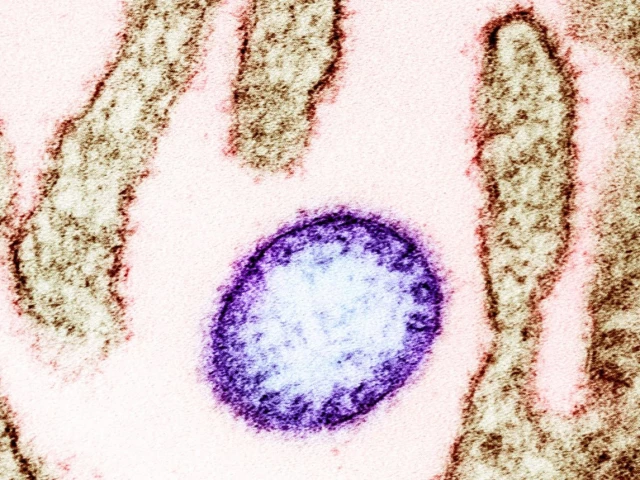
Colored transmission electron micrograph of a mature extracellular Nipah virus particle (purple) near the periphery of an infected VERO cell (brown). Image captured and enhanced in color at the NIAID Integrated Research Center at Fort Detrick, Maryland. Credit: NIAID/WIKIMEDIA COMMONS
KARACHI:
Infectious disease experts have allayed fears about the Nipah virus following some cases reported in India. They said only a limited number of cases are reported globally every year and Pakistan is currently not facing any direct threat from the virus as no case has been detected in any part of the country so far.
The experts expressed these views during a roundtable discussion on Nipah virus held at the Aga Khan University Hospital (AKUH).
AKUH Associate Medical Director and Infectious Diseases Specialist Dr Faisal Mahmood along with Infectious Diseases Section Head Dr Nosheen Nasir briefed the participants about the global virus situation, possible risks to Pakistan and preventive measures.
They reported at the conference that only 10 cases of Nipah virus were reported worldwide last year, while the cases detected in eastern India and Bangladesh do not pose a direct risk to Pakistan. They said the current situation provides an important opportunity to review national preparedness to deal with possible epidemics.
Read more: Pakistan beefs up border surveillance over Nipah virus threat as India confirms two cases
Dr Nosheen Nasir said Nipah virus is a zoonotic infection, transmitted from animals to humans, adding that human-to-human transmission is limited, which is why the number of reported cases remains low. He said most cases have been reported in eastern India, Bangladesh and Singapore. The virus was first identified in Malaysia in 1998, where it spread from pigs to humans and was named after the area where it was discovered.
He said two cases have been reported in India this year, which the World Health Organization has classified as surviving cases. No case has been reported in Pakistan so far. Dr. Nasir added that the early symptoms of the disease resemble those of the flu, while severe cases can cause encephalitis, seizure-like episodes and other neurological complications.
Dr Mahmood said there was no immediate need to test for Nipah virus in Pakistan as it was unlikely that cases could occur unreported. He added that there are currently no testing facilities for the virus available in the country; However, in the event of a suspected case, samples would be sent to the National Institute of Health (NIH), which has the capacity to diagnose rare infections.
Also read: Overall risk of Nipah outbreak in Pakistan remains low, NIH reports at high-level meeting
He said the virus could be transmitted through bats, saliva from infected animals and contaminated fruit. He highlighted the need to use N95 masks, but at the moment there is no need to establish separate wards for the disease. Although bats are present in Pakistan, he said, the spread of Nipah virus is not easy.
Experts further stated that there are no pig farms in Pakistan, although the virus has already been detected in horses in some countries. The disease can spread among people who live in close contact with infected animals, and if it emerged in Pakistan, rural areas would be more vulnerable.
Highlighting the need for preventive measures, experts advised people to wash hands regularly, wash fruits before consuming them and avoid eating partially cut fruits. They warned that the disease is not limited to the symptoms of the common cold and can also cause breathing difficulties.
Dr Mahmood said measles, chickenpox, HIV and hepatitis C currently pose much greater public health challenges in Pakistan. He warned that while measles and chickenpox spread quickly, they can be prevented through vaccination. He added that HIV is no longer limited to specific groups and is increasingly spreading among the general population, calling it a serious public health problem.


