
Threatens sanctions on Tehran’s trading partners; Death toll rises as repression generates global alarm
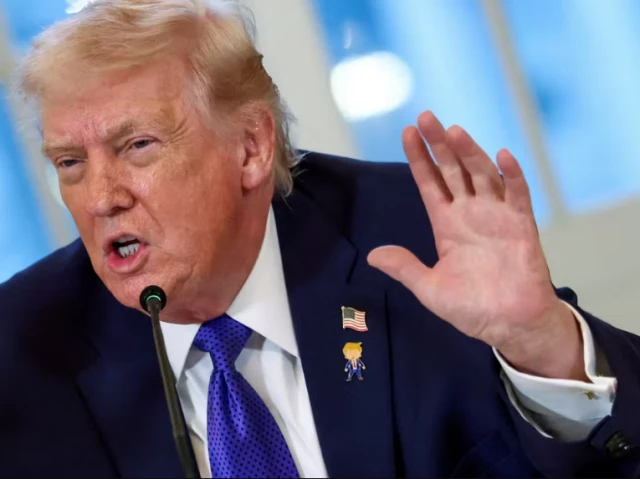
US President Donald Trump speaks during a meeting with oil industry executives at the White House in Washington, DC, US, on January 9, 2026. PHOTO:REUTERS
WASHINGTON/TEHRAN:
U.S. President Donald Trump dramatically increased pressure on Iran, urging protesters late Monday to continue demonstrating, saying “help is on the way” and threatening sweeping trade sanctions on countries that do business with Tehran and keep military action firmly on the table.
The US president, who said an Iranian official had approached for talks, canceled the meetings as a US-based human rights group said at least 1,850 protesters had been killed in more than two weeks of demonstrations. In Iran, one official put the death toll at about 2,000 people.
In posts on his Truth Social platform, Trump addressed what he called “Iranian patriots,” telling them to “KEEP PROTESTING – TAKE DOWN THEIR INSTITUTIONS,” while saying that “help is on the way,” without clarifying whether that assistance would involve direct U.S. intervention.
Trump said he had canceled all meetings with Iranian officials until what he described as the “senseless killing” of protesters stopped, adding that Tehran had crossed its red line and Washington may have to act before talks could take place.
He announced a 25% tariff on any country that trades with Iran, warning that the measure would apply to “any and all business” with the United States and calling the order “final and conclusive,” a move aimed at key Iranian partners including China, Turkey, Iraq and others.
White House press secretary Karoline Leavitt said airstrikes were among the many options available to Trump, and emphasized that diplomacy remained the first option even as Tehran maintained private contacts with US special envoy Steve Witkoff despite the absence of formal relations.
Iran’s supreme leader, Ayatollah Ali Khamenei, accused foreign powers of backing the unrest. Foreign Minister Abbas Araqchi confirmed that communication channels with the United States remained open and said Tehran was studying Washington’s proposals.
Meanwhile, protests spread across the country. An Iranian official told Reuters that about 2,000 people, including civilians and security personnel, had been killed during the unrest, which authorities blamed on “terrorists.”
However, human rights groups have reported hundreds of protester deaths since demonstrations broke out in late December. Iran Human Rights, based in Norway, said at least 648 people, including nine minors, had been killed. Some estimates exceed 6,000 deaths and around 10,000 arrests.
Iranian authorities attempted to project control by staging pro-government rallies across the country, and parliament speaker Mohammad Bagher Ghalibaf said Iran was facing economic, psychological and military pressure, as activists reported a near-total internet shutdown.
International pressure also intensified when EU foreign policy chief Kaja Kallas said additional sanctions were being discussed, while Britain, the Netherlands, Italy, Belgium, Finland and Spain summoned Iranian ambassadors over what they called excessive and brutal repression.
German Chancellor Friedrich Merz said Iran’s leadership appeared to be living its “last days and weeks” if it relied solely on violence, as France confirmed non-essential embassy staff had left and UN human rights chief Volker Turk said he was “horrified” by the bloodshed.
China condemned what it called unlawful unilateral sanctions, warned that tariff wars had no winners and vowed to protect its interests, while Russia warned against outside interference and Qatar warned that any military escalation between the United States and Iran would have catastrophic regional consequences.
Despite Tehran’s insistence that order is being restored, the combination of a rising death toll, economic pressure, diplomatic isolation and Trump’s increasingly confrontational stance has left Iran facing one of the most serious political crises in decades.


