
The worst of bitcoin’s 50% drop may already be behind us.
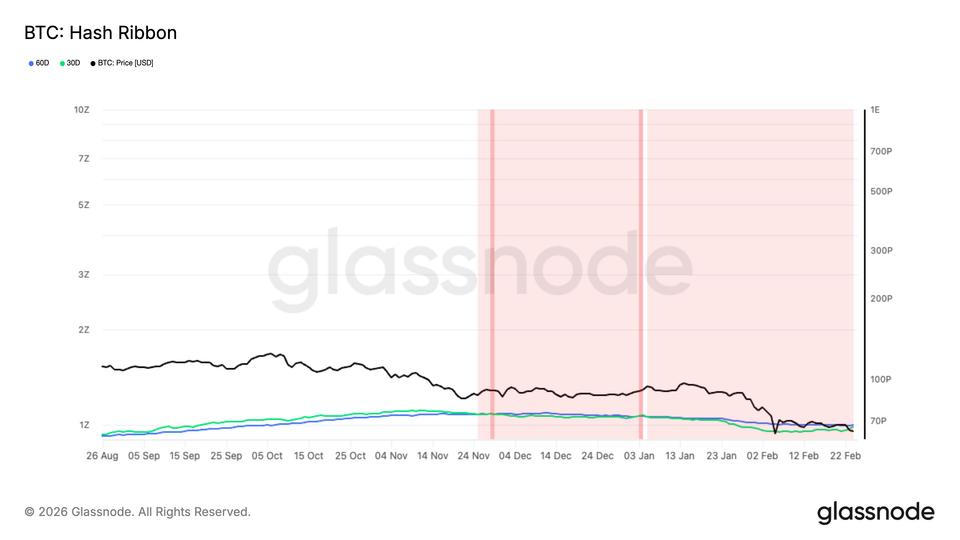
The Hash Ribbon indicator is close to signaling the end of a three-month mining capitulation. One of the longest capitulations ever recorded, according to Glassnode data.
The metric compares the 30- and 60-day moving averages of the hash rate and is based on the observation that bitcoin often bottoms out when miners are under maximum financial stress. Capitulation occurs when mining revenue falls below operating costs, forcing less efficient miners to shut down machines and sell BTC reserves to finance electricity, debt, and overhead. That combination lowers the hash rate and adds sustained selling pressure to the market.
A recovery signal is triggered when the 30-day hash rate moving average crosses back above day 60, indicating that miners are coming back online and network stress is decreasing and that time is approaching. Historically, when this crossover aligns with improving price momentum, it has marked strong accumulation zones.
Since late November, when the metric first inverted, bitcoin has fallen from around $90,000 to a low near $60,000 in early February, before recovering to around $65,000 at press time.
These major corrections are typical during stress events in miners. Since 2011, there have been about 20 mining capitulations, most coinciding with local or major funds, including January 2015, December 2018 and December 2022.
The hash rate, which is the total computing power secured by the network, is now recovering, indicating renewed confidence among miners.
At the same time, bitcoin is now trading below its estimated average production cost of $66,000, a level often associated with deep value, according to data from checkonchain. The last time this occurred was in November 2022, when BTC bottomed near $15,500.


