
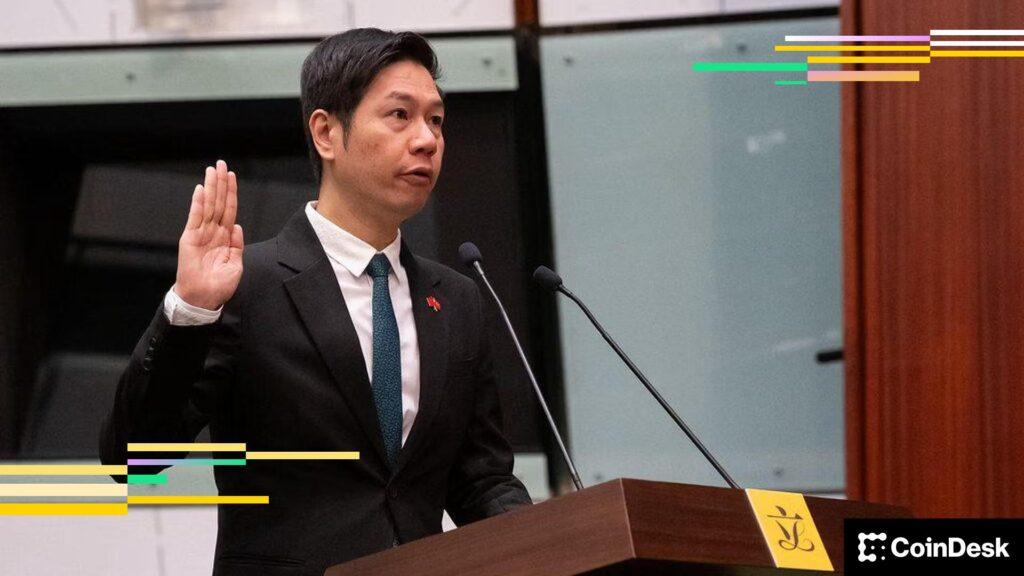
Johnny Ng is not interested in zero-sum cryptopolitics.
While regulators in Washington, Beijing and elsewhere in Asia chart their own paths for digital assets, the Hong Kong policymaker is focused on something entirely different: building connective tissue between markets, technologies and jurisdictions that rarely move in sync.
Representing the tech sector in Hong Kong’s Legislative Council (the city’s parliament), Ng, who will speak at CoinDesk’s Consensus Hong Kong conference next month, has become one of the city’s most vocal advocates for Web3 and digital assets.
Over the past two years, he has pushed for stablecoin legislation, supported cryptocurrency exchange licenses, and helped position Hong Kong as an early push for regulated cryptocurrencies. But he said his broader ambition is structural. It sees Hong Kong as a bridge, not a battleground, between East and West, and between traditional finance and crypto-native innovation.
“Crypto and Web3 are very much tied to the traditional financial system,” Ng said in an interview with CoinDesk at his legislative office in Hong Kong.
Hong Kong’s role, in his view, starts with its existing strengths: easy-to-understand common law, English-language courts, free capital flows and a dense concentration of global banks, asset managers, lawyers and auditors.
“Hong Kong is one of the largest international financial centers,” he said, arguing that this foundation allows the city to build a crypto center that is “secure and moving forward.”
That positioning becomes more powerful when viewed through the lens of the Greater Bay Area, an initiative by the Hong Kong government to increase trade between it and the major centers of neighboring Shenzhen and Macau, China’s other Special Administrative Region, he said.
While Shenzhen is best known as the world’s workshop, with factories producing the latest electronics, Ng repeatedly returned to the idea that Hong Kong does not need to replicate the engineering culture of Shenzhen or Guangzhou. You need to connect to it.
Hong Kong brings with it Common Law and open capital markets. Continental cities bring scale, manufacturing depth and a young, technically skilled workforce.
“In Shenzhen, the average age of people is very young, less than 30,” Ng said, describing a city of engineers and technologists with the ability to turn ideas into products.
“Hong Kong can be a bridge,” he said, explaining how capital, legal structure and global market access can be linked to mainland innovation. “We can think something and then do something thanks to their human capital.”
Ng even points to the history of cryptocurrencies to make his case. Ethereum founder Vitalik Buterin was frequently in Zhuhai, Shenzhen, and Hong Kong during the early years of the Ethereum blockchain. Ng maintains that the region has long been fertile ground for protocol-level experimentation. What Hong Kong adds is regulatory clarity and financial credibility.
That bridge-building mentality also shapes Ng’s global perspective. In 2023, during a period of aggressive enforcement actions against cryptocurrency companies by US regulators, Ng made international headlines by publicly inviting Coinbase and other exchanges to consider Hong Kong.
I hereby offer an invitation to welcome all global virtual asset trading operators, including @coinbase come to HK for the implementation of official trading platforms and future development plans. Please feel free to reach out to me and I will be happy to provide any assistance. pic.twitter.com/bcIi1IjMlc
— Johnny Ng (@Johnny_nkc) June 10, 2023
At the time, the move was widely interpreted as a competitive signal. Ng now puts it differently.
“I’m not going to see competition with any country,” he said. “Cryptocurrencies cannot be easily divided by country or economy. It is one world.”
Instead of rivalry, Ng argued that the industry needs regulatory coordination and predictability across jurisdictions.
“I want the Hong Kong government to make more connections with different jurisdictions, with governing bodies together,” he said, pointing to the need for clearer standards that allow cryptocurrencies to link more directly to real-world economic activity.
It’s a new year and Hong Kong’s Legislative Council is starting another session, which will meet again after the fall elections. Looking ahead, Ng said the next phase is about plumbing. Custody and OTC regulations are coming this year, along with potential changes that could allow for greater trading volume for professional investors.
Ng also sees convergence coming from another direction: artificial intelligence. Hong Kong, he argued, occupies a unique position, able to work with both Western and Chinese data sets and being a place where AI companies from around the world work together.
For Ng, Hong Kong’s bet is not that it can surpass other cryptography or artificial intelligence centers in development or power. It is that, by remaining open, regulated and connected, it can be placed at the center of a system that is still under construction.


