
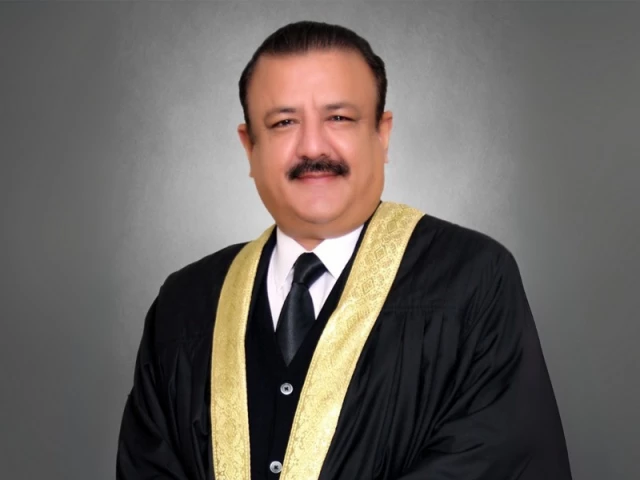
Division bench commits CJ Dogar, Justice Azam rules Justice Jahangiri’s appointment illegal
Justice Tariq Mehmood Jahangiri. Photo courtesy: IHC
On Thursday, the Islamabad High Court (IHC) officially canceled the notice of Justice Tariq Mehmood Jahangiri over issues related to his law degree.
A division bench, headed by Chief Justice Sardar Muhammad Sarfraz Dogar and Justice Muhammad Azam Khan, ruled that Justice Jahangiri did not have a valid title at the time of his appointment and declared his appointment “illegal”.
The court ordered him to immediately leave his post and ordered the Ministry of Justice to formally remove him from the judiciary. “He held an invalid law degree at the time of his appointment and confirmation as a judge,” the court noted.
The IHC also disposed of all the miscellaneous petitions related to the matter. Justice Jahangiri had left the court about half an hour before the verdict was announced.
The controversy over Justice Tariq Mehmood Jahangiri’s law degree began last year when a letter, purportedly from the controller of examinations of the University of Karachi, began circulating on social media. In July, a complaint about his allegedly false title was made to the Supreme Judicial Council (SJC), the main forum for judicial accountability, which investigates allegations of misconduct against judges.
Read: Judge Jahangiri accuses IHC CJ Dogar of misconduct
Even yesterday, in his petition, Justice Jahangiri held that the IHC order was passed “without affording it an opportunity of hearing, while persons who were not parties to the case were heard on the issue of maintainability.” He argued that this violated his fundamental right to due process guaranteed by Article 10A of the Constitution.
The petition claims that the writ petition before the Islamabad High Court challenges his appointment as a judge on the basis of an alleged “invalid LLB degree”, an issue which, according to Justice Jahangiri, involves “disputed factual issues which cannot be adjudicated by a higher court without recording evidence”. It held that such matters fall within the jurisdiction of a trial court and that “the superior court lacks authority to record evidence in quo warranto proceedings.”
The petition further notes that the IHC, while declaring the order maintainable, relied on a report submitted by the University of Karachi “without examining its validity or allowing Justice Jahangiri to challenge it.” He added that the procedures and decisions of the University of Karachi regarding his degree, including actions taken by its Unfair Means Committee, its Union and subsequent statements, “are already being challenged before the Sindh High Court, where those procedures have been stayed.”
Justice Jahangiri also highlighted that the alleged facts relating to his degree relate to examinations conducted decades ago and that the allegations leveled against him are “purely factual in nature and require a full trial”. He denied the allegations and stated that “his credentials have remained on record throughout his legal career, including during his registration as a lawyer and subsequent judicial appointments.”
Through the petition, filed by advocate Uzair Bhandari, Justice Jahangiri sought leave to appeal, convert the petition into an appeal, set aside the IHC order of December 9 and dismiss the writ petition as non-maintainable.
Read more: Judge Jahangiri challenges IHC order in law degree case before FCC
Earlier this year, lawyer Mian Dawood also filed a petition in the Islamabad High Court (IHC) challenging Jahangiri’s appointment.
The case has had a long legal history. On September 16, the same IHC division bench first heard the petition and issued an interim order restraining Justice Jahangiri from performing his judicial duties until the maintainability of the petition could be determined. The order, issued without notice to the judge, sparked debate within the legal community over whether a higher court could suspend a sitting judge.
On September 29, the Supreme Court intervened, annulling the restraining order. A five-member constitutional bench, headed by Justice Aminuddin Khan, ruled that a high court cannot restrain a judge from discharging judicial functions while hearing a quo warranto petition. The ruling clarified that it addressed only the legality of the interim order, not the merits of the allegations, and directed the IHC to decide all preliminary objections and proceed in accordance with the law.
Justice Jahangiri was also among the six IHC judges who wrote to the SJC last year, alleging interference in judicial matters by spy agencies. The letter sparked a broader debate about judicial independence and led to calls for a formal investigation.


