
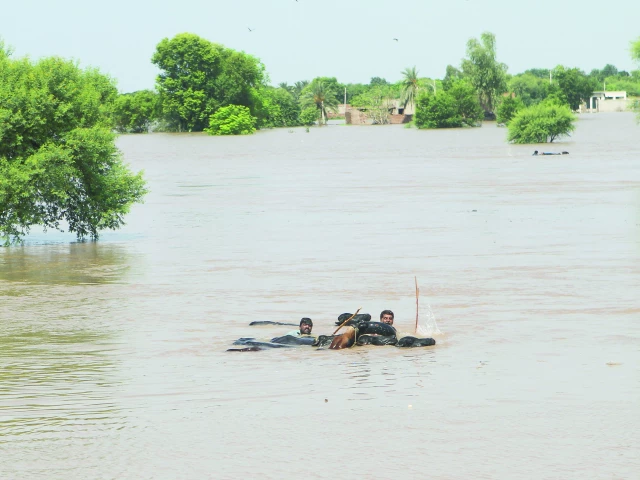
Residents guide their buffaloes in a flooded area following monsoon rains and rising water levels of the Chenab River on the outskirts of Multan. Photo: REUTERS
LAHORE/ISLAMABAD:
Without hinting at Pakistan, India has released water in the Chenab river, where the water flow reached 58,300 cusecs on Monday. Officials say India deliberately emptied its dams to damage Pakistan’s wheat crop.
They allege that India will now refill its dams, potentially reducing the Chenab’s flow to zero, a move described as “water terrorism” aimed at damaging wheat production.
In May this year, India unilaterally suspended the Indus Waters Treaty (IWT), a 1960 water-sharing agreement brokered by the World Bank that allocated three eastern rivers to India and three western rivers to Pakistan.
The three eastern rivers, which have a total average annual flow of 33 million acre-feet are the Beas River, the Ravi River and the Sutlej River.
The three western rivers, which have a total average annual flow of 135 million acre-feet, are the Indus River, the Chenab River and the Jhelum River.
Meanwhile, Pakistan’s annual per capita water availability has declined due to rapid population growth, according to a report presented to the National Assembly on Monday by the Ministry of Water Resources.
Pakistan’s population increased by 40 million between 2017 and 2023, resulting in a decrease of 154 cubic meters of per capita water availability.
By 2030, Pakistan’s population is projected to reach 288 million and per capita water availability is expected to decline to 795 cubic meters per year due to continued population growth.
Annual per capita water availability has decreased to 679 cubic meters in Khyber-Pakhtunkhwa; 760 cubic meters in Punjab; 1,169 cubic meters in Sindh and 928 cubic meters in Balochistan.


