
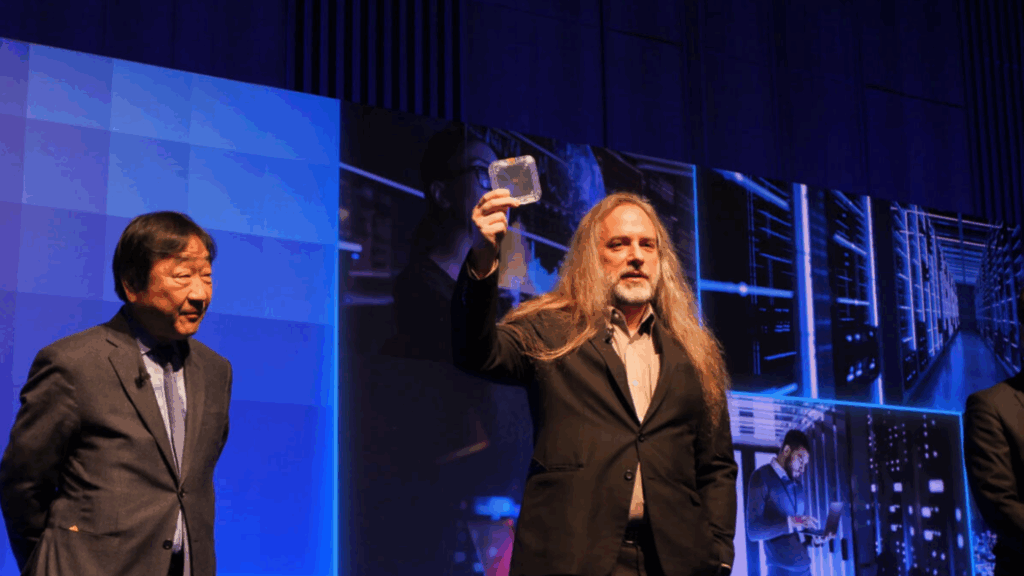
- Intel and SoftBank collaborate to develop next-generation stacked Z-Angle memory
- Prototypes are expected in 2028, with commercial launch planned for 2029.
- Power consumption expected to drop by 40-50% compared to HBM
Intel and SoftBank-backed Saimemory have confirmed a partnership to develop Z-Angle Memory, a stacked DRAM architecture aimed at AI and high-performance computing workloads.
Reports of Asian Nikkeis and Wallstreet.cn They describe the technology as a vertical memory design that aims to surpass current high-bandwidth memory in capacity and efficiency.
Reports claim that the architecture is based on Intel’s previous research on next-generation DRAM bonding, which demonstrated functional multilayer DRAM stacks under a US-backed research program.
Claims about capacity, power and cost
Prototypes are reportedly expected in early 2028, with commercial availability planned for 2029.
Saimemory aims to double or triple the capacity of current HBM products while reducing energy consumption by approximately 40 to 50%.
It says a key requirement for this technology is cost competitiveness, although no pricing details have been revealed.
SoftBank is reportedly investing around 3 billion yen (around $19 million) during the prototype phase, and Intel will contribute technology instead of capital.
The memory targets large-scale AI data center deployments, where bandwidth density and power usage increasingly impact operating costs.
For Intel, the collaboration signals renewed involvement in advanced memory development after it exited the DRAM business decades ago.
The effort also aligns with broader attempts to regain relevance in critical semiconductor segments while expanding foundry operations.
For SoftBank, the project supports ambitions to strengthen domestic semiconductor capabilities and reduce dependence on South Korean suppliers.
Japan once dominated global DRAM production, but abandoned the market as competitors consolidated their power, leaving a large gap that Saimemory now aims to address.
The 2029 market target puts Z-Angle Memory several product cycles behind Samsung and SK Hynix, which already dominate HBM’s supply.
By the time Saimemory reaches volume production, existing suppliers are expected to have moved even further toward new generations of HBM.
The push from SoftBank executives for priority supply shows that the project is still in an early stage and that technical ambition alone cannot overcome scale, performance and ecosystem challenges.
As interesting as it may seem, it’s hard to forget the story of Intel Optane and 3D XPoint, which ended with clear financial losses instead of sustained adoption.
In July 2022, Intel closed its Optane memory business and recorded an inventory write-off of $559 million, formally acknowledging the technology’s failure.
Micron, which inherited parts of the previous DRAM ecosystem through Elpida after its bankruptcy in 2012, was also affected by the broader collapse of alternative memory strategies.
Z-Angle Memory is technically different, but it enters a market where previous claims of architectural alteration resulted in the loss of hundreds of millions of dollars.
Follow TechRadar on Google News and add us as a preferred source to receive news, reviews and opinions from our experts in your feeds. Be sure to click the Follow button!
And of course you can also follow TechRadar on TikTok for news, reviews, unboxings in video form and receive regular updates from us on WhatsApp also.


