- Iran issues NOTAM for closure of airspace over the Strait of Hormuz.
- Iran will conduct exercises for three days within a five nautical mile radius.
- NOTAM says space will be restricted from ground level to 25,000 feet.
TEHRAN: Iran issued a Notice to Airmen (NOTAM) announcing live-fire military activity in the airspace near the Strait of Hormuz, hours after US military assets arrived in the Middle East, reflecting rising tensions in the region.
The aviation warning, released Tuesday, said Iranian forces will conduct live-fire exercises from Jan. 27 to 29 within a five-nautical-mile radius around the strait.
The notice said airspace in the designated area, from ground level to 25,000 feet, will be restricted and considered hazardous for the duration of the activity.
The Strait of Hormuz is a strategic bottleneck for global trade, through which millions of barrels of crude oil pass every day. Any disruption there often triggers repercussions on international energy markets and raises geopolitical concerns.
The NOTAM comes amid increased U.S. military activity in the region, as the U.S. Air Force Central (AFCENT) has announced a multi-day readiness exercise across its area of responsibility, intended to demonstrate rapid deployment and sustainment capabilities.
Officials in Washington have said all options remain on the table for dealing with Tehran, including the possibility of military action, as the United States and Israel seek to counter Iran’s influence.
Iranian authorities have responded with warnings that any attack would prompt a “prompt and complete” response.
The notice to air navigation will affect civil and military flights that pass through the area during the exercise period. Aviation authorities often issue NOTAMs before live-fire drills to alert pilots and airlines about potential risks and temporary airspace closures.
US warships arrive in ME
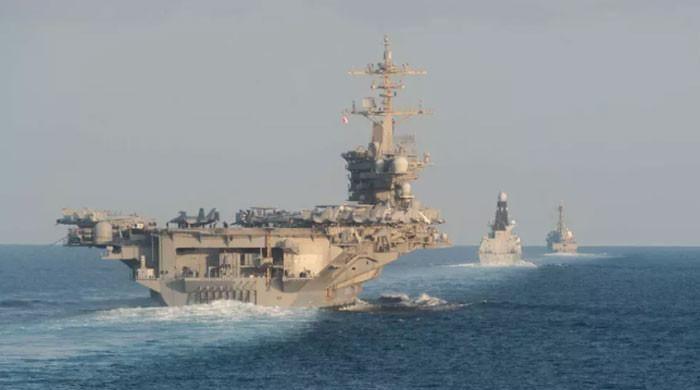
The USS Abraham Lincoln aircraft carrier and several guided missile destroyers have crossed into the Middle East region, which falls under the US military’s Central Command, officials said. Reuters.
US President Donald Trump said Thursday that the United States had an “army” heading toward Iran, but he hoped not to have to use it.
Warships began deploying from the Asia-Pacific region earlier this month, as tensions between Iran and the United States rose following the crackdown on protests across Iran.
Trump had repeatedly threatened to intervene if Iran continued killing protesters, but demonstrations across the country have since subsided. The president said he had been told that murders were decreasing and that he believes there is currently no plan for prisoner executions.
In the past, the US military has sent forces to the Middle East at times of high tensions, moves that were often defensive.
However, the US military carried out a major build-up last year ahead of its June strikes against Iran’s nuclear program.
In addition to the aircraft carrier and warships, the Pentagon is also moving fighter jets and air defense systems to the Middle East.
Meanwhile, Israeli Prime Minister Benjamin Netanyahu said Tuesday that “Trump will decide what he decides; the State of Israel will decide what he decides.”
But, he added, if Iran were to attack Israel, “we will respond with force that Iran has never seen.”
Iran warns US against attack
Iranian President Masoud Pezeshkian criticized US “threats” in a phone call with Saudi Crown Prince Mohammed bin Salman, saying they were “aimed at disrupting the security of the region and will achieve nothing but instability.”
The United States also maintains several bases in the Middle East, prompting a Revolutionary Guard commander to issue a warning to Iran’s neighbors on Tuesday.
“Neighboring countries are our friends, but if their soil, their sky or their waters are used against Iran, they will be considered hostile,” said Mohammad Akbarzadeh, political deputy of the IRGC naval forces, quoted by the Fars news agency.
A senior Iranian official said last week that Tehran would consider any attack a “total war against us.”
“This military buildup – we hope it is not intended for a real confrontation – but our military is ready for the worst-case scenario. That is why everything is on high alert in Iran,” the senior Iranian official said, speaking on condition of anonymity.
“This time we will treat any attack – limited, unlimited, surgical, kinetic, whatever you call it – as an all-out war against us, and we will respond in the harshest way possible to resolve this,” the official said.
Saudi Arabia and the United Arab Emirates assured Iran that they will not allow their airspace, territory or territorial waters to be used for hostile military actions against the Islamic republic.
The US Army’s Al Dhafra Air Base is located south of Abu Dhabi, the capital of the United Arab Emirates, and has been a critical hub for the US Air Force in support of key missions against the Islamic State, as well as reconnaissance deployments throughout the region.