
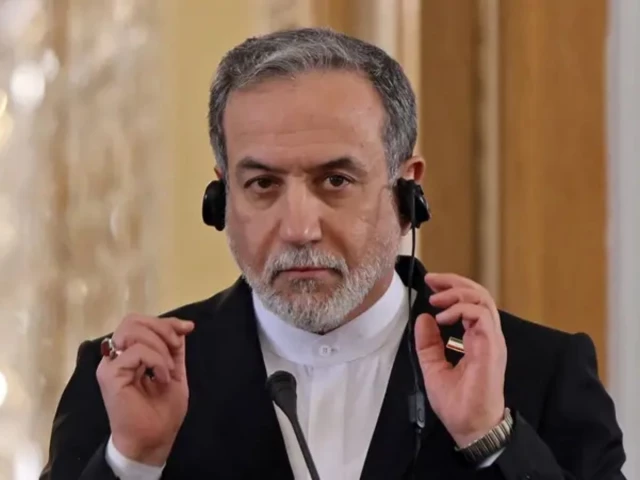
Iranian Foreign Minister Abbas Araghchi attends a press conference in Tehran on January 18, 2026. PHOTO: AFP
Iran’s Foreign Minister Abbas Araghchi said Saturday that Tehran’s leaders “never refused to go to Islamabad” for possible peace talks that Pakistan has offered to host to end the ongoing US-Israeli war against the Islamic republic.
“Iran’s position is being misrepresented by the American media,” Araghchi wrote in X.
“We are deeply grateful to Pakistan for its efforts and we have never refused to go to Islamabad. What matters to us are the terms of a conclusive and lasting end to the illegal war imposed on us,” he emphasized.
He also shared a video showing Iranians waving Pakistani flags in an apparent show of appreciation for Pakistan and its people. The Iranian official ended his post with “Pakistan Zindabad” written in Urdu.
Araghchi’s statement comes a day after the Wall Street Journal (WSJ), citing anonymous mediators, reported that the “current round of efforts by regional countries led by Pakistan to reach a ceasefire” between the United States and Iran had reached a “dead end.”
Deputy Prime Minister and Foreign Minister Ishaq Dar was quick to appreciate Araghchi’s “clarification”.
“I really appreciate your clarification, my dear brother,” Dar said in X in response to Araghchi’s post.
Foreign Ministry spokesman Tahir Andrabi called Araghchi’s statement a “timely reminder” that “speculation helps no one.”
“Stick to official statements and verified media readings for clear and accurate information,” he said.
Iran’s clarification also follows media reports that Tehran has yet to formally respond to dialogue proposals despite backchannel exchanges in recent days.
Pakistan has positioned itself as a facilitator in the peace process, leveraging its ties with the United States, its working relationship with Iran and its strategic partnership with China.
Prime Minister Shehbaz Sharif had initially offered on March 24 that Pakistan was “ready and honored” to host “meaningful and conclusive talks” between the United States and Iran.
Last week, Islamabad hosted a quadrilateral meeting of foreign ministers and reiterated its offer.
On March 31, Pakistan and China also issued a five-point initiative to restore peace in the Middle East, calling for an immediate cessation of hostilities.
On Friday, an Iranian official in Tehran also denied reports that Iran had refused to participate in the dialogue in Islamabad.
Rather, it pointed out a different set of limitations. The official said the terms conveyed by Washington were unacceptable.
“The conditions or the 15-point proposal presented by the United States are too difficult to accept,” the official said, calling the situation “highly complex.”
He noted that Iran’s immediate focus was on the war and not on the negotiations. Additionally, he cited deep distrust in US intentions.
“Recent US deployments to the region do not align with its stated intentions to engage in talks and therefore Iran does not have any trust in the US,” he said.
Recalling the attack on two Iranian leaders seeking an initiative to reduce tensions, the official said: “There are serious concerns that anyone participating in the negotiations could also be attacked.”
However, the official praised Pakistan for its efforts and said that “the Pakistani leadership was certainly doing everything possible for the cessation of hostilities.”


