
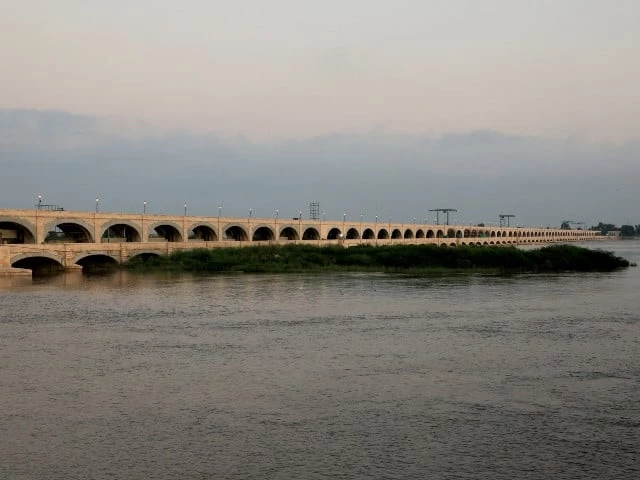
View of the Sukkur Dam, formerly known as Lloyd Dam, as flood water passes, following monsoon rains and rising levels of the Indus River in Sukkur, Sindh province. Photo: REUTERS
ISLAMABAD:
Pakistan’s Indus River System Authority (IRSA) approved a projected water deficit of up to 15 percent by early Kharif 2026, while pegging provincial water withdrawals at 67.451 million acre-feet (MAF), as officials warned of persistent supply pressures despite improved storage in reservoirs.
The decision was taken at an IRSA Advisory Committee meeting on Tuesday, chaired by IRSA Chairman Amjad Saeed, to finalize water availability criteria for the Kharif season (April-September).
Officials said Rim-Station inflows are projected at 103.30 MAF, including 24.48 MAF for Early Kharif and 78.81 MAF for Late Kharif.
The committee approved a 15% shortfall for early Kharif (April to June 10), subject to review in the first week of May 2026.
The deficit for the late Kharif was approved at 5%.
Provincial allocations include Punjab with 33,357 MAF, Sindh with 30,403 MAF, Khyber Pakhtunkhwa (CRBC) with 0.823 MAF and Balochistan with 2,868 MAF, compared to last year’s total usage of 60,558 MAF and a 10-year average of 62,252 MAF.
The committee noted that Rabi inflows in 2025-26 (October-March) amounted to 21,782 MAF, slightly below the projected 22,016 MAF, reflecting a shortfall of 1%. However, system storage stood at 2.307 MAF on March 31, significantly higher than last year’s 0.384 MAF and the 10-year average of 1.351 MAF.
The Pakistan Meteorological Department forecast normal to above-normal rainfall from April to June, especially in the western and northern regions, but warned that temperatures would remain above normal across the country.
IRSA also raised the alarm over declining storage at Tarbela Dam, where live capacity fell from 5,827 MAF in May 2022 to 5,580 MAF in March 2026, an overall reduction of almost 48 percent due to sedimentation. Officials directed WAPDA to submit a detailed mitigation plan.
The committee endorsed operational schedules for the Tarbela T4 hydropower plant, which is expected to come online after May 7, while emphasizing close coordination to manage reservoir constraints during ongoing construction on the T5 project.


