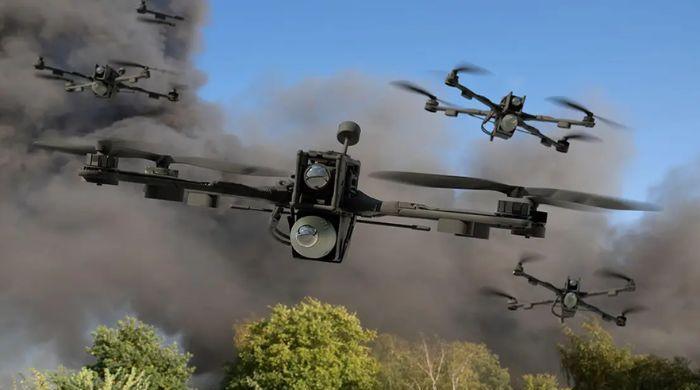
Artificial intelligence (AI)-powered weapons are dominating battlefields around the world, including the Russia-Ukraine war, the US-Israel war against Iran, and the Israel-Palestine war, where AI technologies have reportedly played a major role.
Reports suggest that the US War Department used Anthropic’s Claude AI in Operation Epic Fury against Iran. Experts have warned that the increased use of artificial intelligence weapons could sideline human intervention.
AI-powered weapons shorten the military destruction chain and operate faster than the “speed of thought.”
For the uninitiated, the kill chain here refers to the process of identifying the target and legal approval for the execution of the attack.
The United States and Israel launched nearly 900 strikes against Iran in the first 12 hours of operations.
Academics who study AI have warned that this “decision compression” process could minimize human involvement and limit it to approving automated aircraft.
David Leslie, professor of ethics, technology and society at Queen Mary University of London, said: “This is the next era of military strategy and military technology.”
He warned that over-reliance on AI could lead to cognitive download.
Ukraine has also heavily integrated AI into its military operations against Russia, particularly drone warfare.
The growing role of AI in military operations is evident in the recent dispute between Anthropic and the Pentagon. Anthropic deployed its AI models across the War Department in 2024 to accelerate war planning and improve intelligence analysis.
However, the San Francisco-based company opposed the use of its tools in autonomous AI weapons without human supervision and also expressed concern about the Pentagon’s use of its technology for large-scale domestic surveillance.
Anthropic was blacklisted by federal agencies after it stood firm in the face of Pentagon demands.