
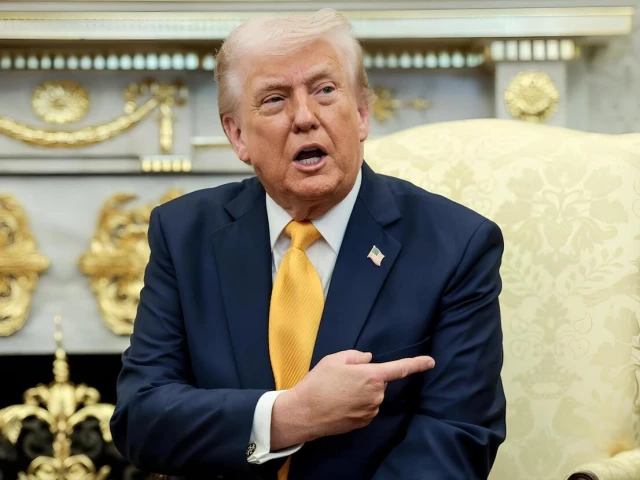
US President Donald Trump speaks during a meeting with Japanese Prime Minister Sanae Takaichi (not pictured) in the Oval Office of the White House in Washington, DC, United States, March 19, 2026. PHOTO: Reuters
ISLAMABAD:
With U.S. President Donald Trump’s deadline fast approaching, Pakistan has mounted an unprecedented diplomatic push to salvage a last-minute deal between the United States and Iran, even as officials admit the effort hangs by a thread.
The past 48 hours have seen the most intense round of diplomacy since the outbreak of hostilities, with Islamabad working around the clock alongside other key players to prevent further escalation of the conflict.
While no progress has been announced, the flurry of commitments has at least ensured the exchange of proposals and counterproposals between Washington and Tehran through Pakistani intermediaries.
However, officials familiar with the clandestine contacts said the latest exchanges underscore the magnitude of differences that remain between the two sides, suggesting that bridging the gap may not be possible in the immediate term.
Significantly, the latest diplomatic push has also drawn China and Russia, two close allies of Iran, into the evolving process.
Their participation is seen as an attempt to address Tehran’s longstanding trust deficit with Washington and lend greater credibility to any potential framework.
According to diplomatic sources, senior officials from the three great powers have been in close contact over the past two days. Media reports suggested that Pakistan’s military leadership engaged with senior US officials, including US Vice President JD Vance and the Middle East envoy, as well as Iran’s foreign minister, in a bid to keep the dialogue alive.
In parallel with these efforts, Sergey Lavrov held a telephone conversation with his Iranian counterpart, while the foreign ministers of China and Russia also coordinated their positions amid the rapidly evolving situation.
Despite the high-level activity, there has been no detailed official information from Islamabad. So far, the Foreign Office has limited itself to a generic statement, confirming that diplomatic efforts are ongoing but refraining from commenting on specific details.
“There have been several reports about a 45-day ceasefire offer or a 15-point exchange. We do not comment on these individual, specific incidents,” Foreign Ministry spokesman Tahir Andrabi said when asked about the reported proposals.
The spokesperson’s comments came in response to an international media report that claimed both Washington and Tehran had shared a framework aimed at ending hostilities. According to the report, which cited a source familiar with the development, the proposals were exchanged with the two sides overnight through Pakistani channels.
Separately, another report indicated that discussions were underway over a possible 45-day ceasefire as part of a phased approach that could eventually lead to a permanent cessation of hostilities.
However, officials cautioned that such ideas are still at a preliminary stage and have not yet achieved formal acceptance.
Tehran, for its part, has expressed a cautious but firm stance. Iranian officials said they had conveyed their response to recent proposals through intermediary channels, outlining a set of conditions.
Foreign Ministry spokesman Esmaeil Baghaei said negotiations could not continue under pressure or threats. “Negotiations are incompatible with ultimatums and threats to commit war crimes,” he said, adding that previous proposals, including a 15-point framework, were rejected as “excessive.”
According to Iranian media, Tehran’s response consists of a detailed set of demands, including an end to hostilities throughout the region, guarantees for safe navigation through the strategically vital Strait of Hormuz, reconstruction assistance and lifting sanctions.
Iran has also stressed that any deal must ensure a permanent end to the conflict rather than a temporary ceasefire, reflecting its deep skepticism of short-term deals.
The renewed diplomatic push comes against the backdrop of an escalation of hostilities that has raised alarm over the potential disruption of shipping through the Strait of Hormuz, a critical artery for global energy supplies.
The conflict has already injected volatility into international oil markets, and traders are closely monitoring developments that could affect the flow of crude through the narrow waterway.
Meanwhile, Pakistan has positioned itself as a key facilitator in the crisis, leveraging its long-standing ties with Washington as well as its working relationship with Tehran.
Officials say Islamabad’s role has been to maintain open lines of communication and ensure that both sides continue to interact, even indirectly.
In a significant development, Iran’s Foreign Minister Abbas Araghchi recently clarified that Tehran had never rejected the option of holding talks in Islamabad, indicating openness to Pakistan’s offer to host negotiations.
Diplomatic observers believe Pakistan’s participation has been instrumental in keeping the process alive at a time when direct contact between the United States and Iran remains limited.
However, despite intense efforts, the prospects for an immediate breakthrough remain uncertain. With the deadline approaching and positions still entrenched, much will depend on whether the latest exchanges can generate enough momentum to avoid a complete collapse of diplomacy.


