
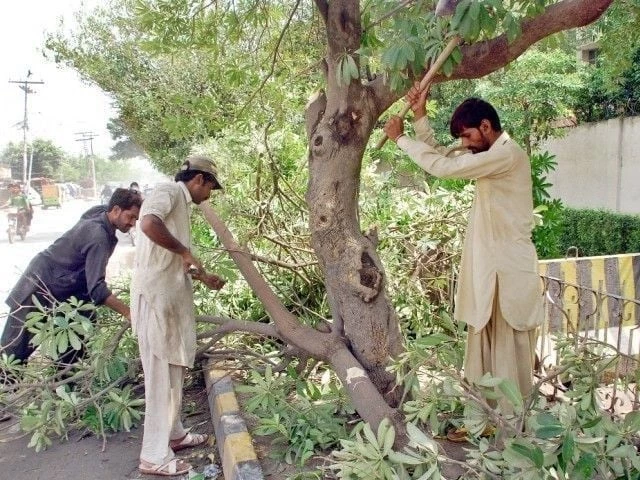
Many residents fear that the vision is steadily eroding and that concrete will replace green spaces.
ISLAMABAD:
Pakistan’s capital Islamabad was once known for its lush greenery, but the cutting down of trees across the city for infrastructure has sparked local anger and even lawsuits.
Built in the 1960s, Islamabad was planned as a green city, with wide avenues, parks and tree-lined areas.
Many residents fear that the vision is steadily eroding and that concrete will replace green spaces.
Muhammad Naveed took authorities to court this year for “large-scale felling of trees” for infrastructure projects, accusing them of felling “many mature trees” and leaving the land “barren.”
The World Wildlife Fund (WWF) blamed major infrastructure works, including the construction of roads and monuments, for the massive felling of trees and natural vegetation in Islamabad.
Between 2001 and 2024, the capital lost 14 hectares of tree cover, equivalent to 20 football fields, according to Global Forest Watch, although the figure does not take into account the increase in tree cover during the same period.
For Kamran Abbasi, a local merchant and resident since the 1980s, he has the feeling that “they are cutting down trees everywhere.” “It’s not the same anymore,” he told AFP.
“Trees are life. Thousands are cut down to build a bridge.”
Meanwhile, the air quality in Islamabad continues to deteriorate.
Pollution is a long-standing problem, but plants can help by filtering dirty air, absorbing harmful gases and cooling cities.
“Forests act as powerful natural filters…cleaning the air and water, and reducing the overall impact of pollution,” Muhammad Ibrahim, director of WWF-Pakistan’s forestry programme, told AFP.
There were no days of good air quality in Islamabad last month, and all but two were classified as “unhealthy” or “very unhealthy” by monitoring organization IQAir.


