
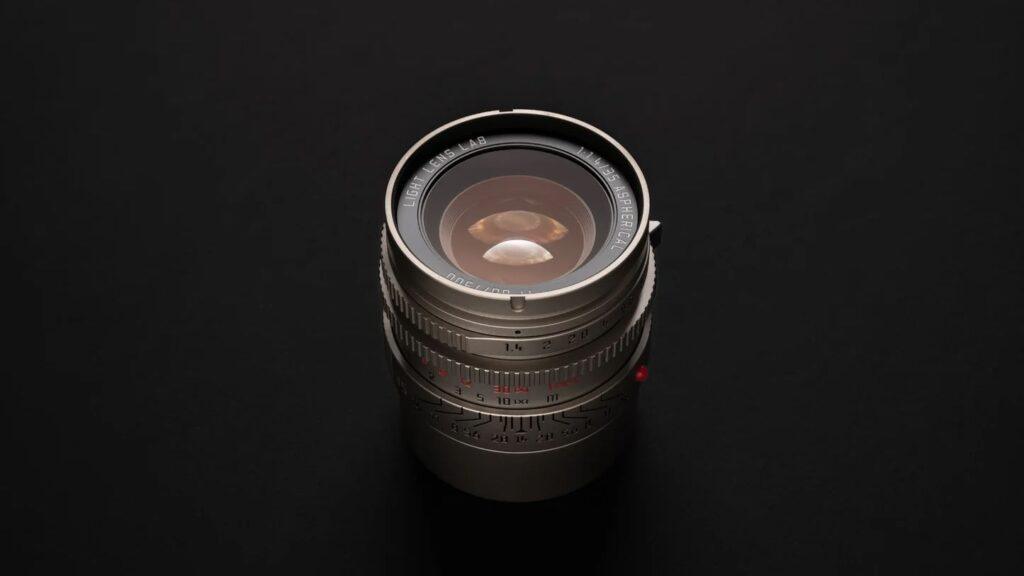
- First video interview with Light Lens Lab founder Mr. Zhou
- 20-minute discussion looks at stories of popular LLL lenses
- LLL’s lens roadmap and other upcoming projects are also covered
Since its founding in 2018, Light Lens Lab has earned a stellar reputation among Leica fans for its M-mount lenses for Leica cameras.
Some LLL lenses are a love letter to rare Leica lenses that very few people can see, let alone touch or use, painstakingly recreated down to the smallest detail, including the choice of metal and the signature optical quality.
Others are vintage Leica lenses reimagined with reworked optical constructions to improve image quality.
But what all LLL lenses have in common is that they are shape more affordable than the real thing, while giving users the closest possible experience to these desirable Leica M lenses.
Take for example the Leica Summilux 35mm f/1.4 (‘11873’), a rare dual aspherical lens produced in the early 1990s, limited to a production run of less than 2,000 units. It would cost you around $25,000 / £20,000 / AU$40,000, but LLL has recreated the lens with a 98% match and is selling its creation for a fraction of the price, around $1,500 / £1,043 on its online store.
YouTuber Bobby Tonelli describes the original as the ‘Holy Grail’ of Leica lenses and compares it to LLL’s homage on his YouTube channel; Let’s say you’re very impressed with LLL’s affordable alternative.
Recently, Tonelli was able to do something no one had done before: arrange a video interview with Light Lens Lab founder Mr. Zhou.
Their 20-minute discussion (linked below) discusses the story behind Light Lens Lab, delves into some of the high-profile LLL lenses available for purchase, their lens roadmap, and other upcoming projects, including reworking a classic Chinese TLR camera and making their own film. The chat is worth watching.
Look
‘We want to get to that level’
The story behind Light Lens Lab is quite touching. This is not a soulless business, but one born of fandom. In his own words, Mr. Zhou is a big fan of Leica and once owned over 200 Leica bodies and M-mount Leica lenses. He was a regular member of Leica groups in China, where the idea of tearing down and recreating Leica lenses was born.
His first project was another 35mm lens, an 8-element from 1953. He did not have the design ability to remake the lens, but his patent had completely expired, the patent documents were publicly available, and he was able to follow Leica’s prototype to create a complete replica with great attention to detail.
The more he used Leica lenses, the more impressed he was with the performance and quality of such a small optic, the type he chooses to recreate. Zhou says, “In such a small package, to achieve the highest quality possible, Leica did it very well and it’s hard to beat.”
“That is why I have always tried to follow the path taken by Leica and why, in terms of workmanship and quality, we have achieved wide recognition.”
Other projects included a rare $50,000 Elcan lens (again, Leica had published the Elcan optical patent) plus a 1966 Noctilux, which took four years to make. One obstacle was that two of the glass types of the original were long discontinued, but with the help of the Shanghai Institute of Optics and Fine Mechanics, Zhou was able to match the original 70-year-old formula by remelting/remaking this special glass.
The results? Equally small and lightweight lenses of similar, if not better, optical quality that exhibit essentially the same characterful look, including bokeh.
Certain Leica lenses can be expensive and hard to find, so it’s no wonder so many Leica fans appreciate Light Lens Lab’s dedication to remaking rare Leica optics. I have yet to try an LLL lens, but I’ve read enough online reviews from discerning Leica fans to believe the hype.
And Zhou doesn’t stop with vintage Leica lenses. He is remaking modern Leica lenses, again selling his creations for a fraction of the cost, and has set aside an ‘ACDK’ series (Angineux, Cooke, Dallmeyer and Kintoptic): lens types with a distinctive look; If you’re a movie lover, you’ll be familiar with Cooke’s legendary look.
Zhou also revealed another long-term project: reworking a traditional Chinese TLR film camera with a modern design for better mechanics and optics, as well as making his own film, very similar to what Leica did recently and, of course, following in Fujifilm’s footsteps.
Manufacturing of lenses, cameras and films. “We want to reach that level,” Zhou says, and I honestly support him.
Follow TechRadar on Google News and add us as a preferred source to receive news, reviews and opinions from our experts in your feeds. Be sure to click the Follow button!
And of course you can also follow TechRadar on TikTok for news, reviews, unboxings in video form and receive regular updates from us on WhatsApp also.
The best compact cameras.


