
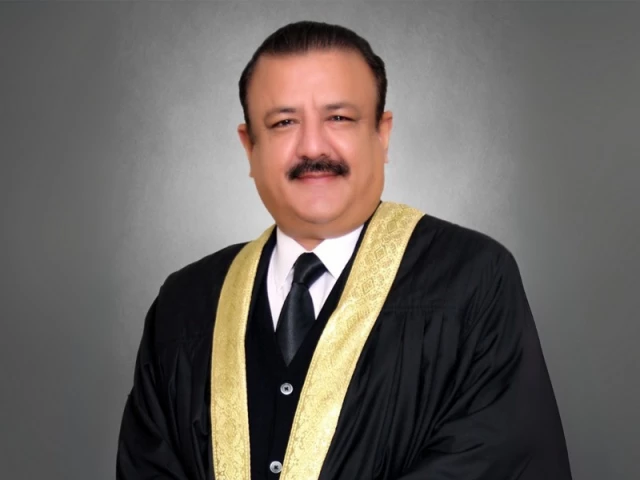
Justice Tariq Mehmood Jahangiri. Photo courtesy: IHC
ISLAMABAD:
Justice Tariq Mehmood Jahangiri accused Islamabad High Court Chief Justice Sardar Muhammad Sarfraz Dogar of misconduct by saying he was facing “immense pressure” to quickly dispose of the quo warranto petition against him.
Justice Jahangiri had filed an application before the Islamabad High Court through lawyer Akram Sheikh, requesting to refer the case against his disqualification to the full court comprising all judges except the transferred judges, including CJ Dogar.
“Although the matter remained sub judice before the Hon’ble Chief Justice, he discussed the pending matter with the plaintiff, among others. During such discussions, the Hon’ble Chief Justice acknowledged that tremendous pressure had been placed on him to quickly adjudicate the case against the plaintiff,” the petition reads.
It is also revealed that CJ Dogar suggested, directly and indirectly, that if the petitioner (Justice Jahangiri) tendered his post-dated resignation and handed it over to the Chief Justice for safekeeping, this would enable the Chief Justice to satisfy those pressuring the Chief Justice and enable him to prorogue the court proceedings.
“[The] The Chief Justice, by attempting to negotiate the outcome of a sub judice matter and making that outcome contingent upon the plaintiff’s resignation, has disqualified himself from holding a decision-making position in the present matter. Therefore, the Honorable Chief Justice should recuse himself from hearing the case,” the suit reads.
It is submitted that such conduct by the Chief Justice is a clear violation of the code which prohibits any judge from discussing a matter sub judice with any of the parties in the case. The president of the Supreme Court, as a result of the pressure exerted on him, instead of respecting the code, has chosen to pressure his colleague to resign, he adds.
Similarly, Justice Jahangiri also filed a complaint of misconduct against the IHC Court before the Supreme Judicial Council. The judge also requested CJ Dogar’s recusal for this reason.
Justice Jahangiri, while filing the complaint of misconduct against the IHC JJ, alleged that he had been disingenuous “as the order announced in the court on 16.09.2025 was diametrically opposite and completely inconsistent with the one issued by the bench in a misleading manner, despite assurances, in open court, that the maintainability of the petition would be decided first and the matter would remain pending till the decision of the Supreme Judicial Council.”
Similarly, even though the order of the Sindh High Court dated October 3, 2025 clearly states that the declaration of Karachi University is suspended, the Chief Justice falsely stated on December 2, 2025 that the interim order is only limited to further proceedings by the university.
Similarly, it is further alleged that the Chief Justice wrongly marked the attendance of the plaintiff’s counsel on December 2, when the plaintiff was not represented as no notice had been issued to him till December 9. “Contrary to article III of the Code, the conduct of the president of the Supreme Court has not been free of impropriety and apparent bias in his conduct.”
“He has not renounced acting in a case in which his own interest is involved” and in which his opinion is influenced by personal benefit. “The Chief Justice has an interest in penalizing the plaintiff for challenging his transfer, seniority, appointment as Chief Justice and his subsequent actions as Chief Justice of IHC, especially because if the plaintiff’s challenge to the Chief Justice’s seniority is successful, the plaintiff will be senior to the Chief Justice.”
The complaint alleges that Justice Dogar has used the influence of his position as Chief Justice to fix the case before him and gain undue advantage against a judge who has dared to challenge his transfer and appointment: to ensure that he can manipulate the proceedings and outcome of the quo warranto petition.
Furthermore, it has abused its position to settle the matter before a Division Bench without any basis for departing from the rule that such petitions be heard by Single Benches, to deny the Claimant a forum of appeal within the IHC.
It is also claimed that the Chief Justice failed to maintain harmony within his court and the “integrity of the institution of justice” due to his own conduct. The passing of the order dated 16.09.2025, which prevents the plaintiff from carrying out his judicial duties and even considering such petitions against colleagues, seriously undermines the harmony within the IHC. This goes against the convention that judges exercise equal judicial power and must maintain courtesy among themselves in the performance of their duties.
The complaint further contended that Article 189 of the constitution makes the decisions and orders of the Supreme Court binding on all lower courts, including the IHC, and the Code requires judges to act in accordance with the constitution, but the chief justice acted in violation of the Constitution.
“Though the Supreme Court had indicated in its order dated 30.09.2025 that the objection/maintainability must be decided first, it proceeded to call for registration of the grade of the appellant, which relates to the merits of the case, before deciding the objection at a later date.”
It is submitted that the Chief Justice, in discussing a sub judice matter with the applicant and admitting that he is under pressure to promptly: resolve the case against the applicant; and negotiating results in a sub judice matter and making it conditional on the plaintiff’s resignation has flagrantly violated Articles IV and XV of the Code.
“The conduct of the respondent Chief Justice constitutes misconduct. The respondent Chief Justice, through his conduct, has eroded public confidence in the judiciary and has refused to recuse himself from a case in which he has a clear conflict of interest, despite the same having been repeatedly pointed out.
“The respondent Chief Justice has exercised his judicial power in a patently biased manner and in violation of the Code,” the misconduct complaint against the IHC Chief Justice reads.
An IHC division bench headed by Justice Dogar has disposed of Justice Jahangiri’s hearing requests today (Thursday).
Justice Jahangiri also challenged the IHC’s interim order declaring the quo warranto petition regarding his dismissal maintainable.
The judge engaged the services of three lawyers: Akram Sheikh, Barrister Salahuddin Ahmed and Uzair Bhandari.
Furthermore, Justice Jahangiri on Wednesday moved the Federal Constitutional Court (FCC) seeking quashing of an Islamabad High Court (IHC) order that declared maintainable a plea questioning the legitimacy of his law degree.
He also requested the dismissal of the plea, which also questions the appointment of the IHC judge, “as unsustainable.”


