
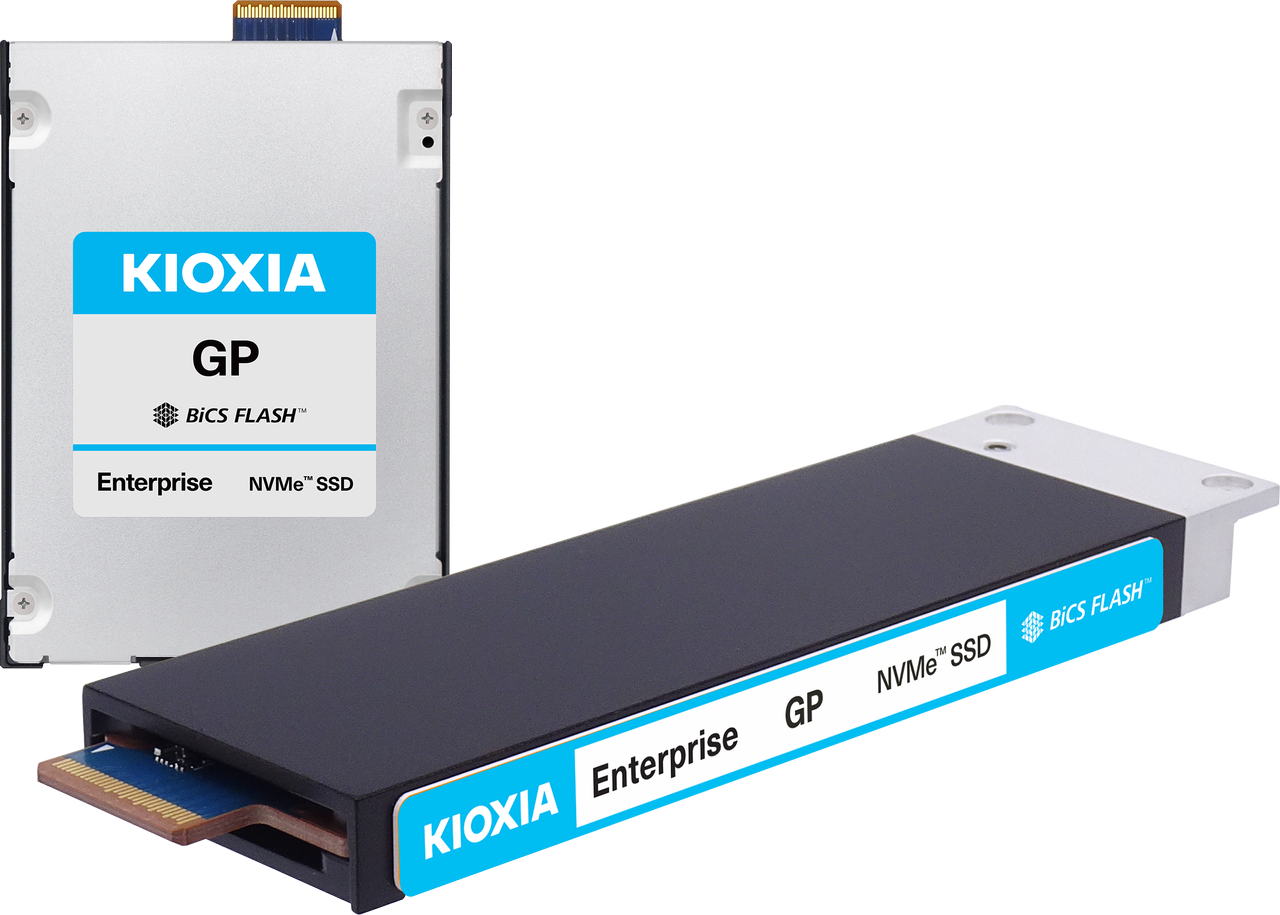
- Kioxia GP Series SSD provides GPUs with faster memory access beyond the limits of HBM
- Storage class memory closes the performance gap between DRAM and conventional NAND flash storage.
- XL-FLASH prioritizes low latency and millions of random IOPS over sequential speed
Kioxia has introduced a new type of solid-state drive designed to function as a direct memory expansion for GPUs.
The new Kioxia GP series, announced at Nvidia GTC 2026, does not replace existing storage, but rather an additional level in the memory hierarchy.
Its primary function is to provide a larger set of quickly accessible data for GPUs, effectively acting as an overflow for expensive, limited-capacity, high-bandwidth memory.
Article continues below.
Memory-Hungry AI Models Drive Change
The drive takes advantage of storage class memory (SCM), a category of technology that sits in the performance gap between traditional NAND flash memory and system DRAM.
This concept was popularized years ago by Intel’s now-discontinued Optane technology, which aimed to close the same gap but failed.
Kioxia’s version, called XL-FLASH, prioritizes low latency and high I/O operations per second over raw sequential performance, enabling finer-grained access to data as small as 512 bytes.
This development is a direct response to a fundamental problem in today’s AI infrastructure: GPU memory simply is not large enough for the models it is asked to run.
As AI models scale to trillions of parameters and context windows expand to millions of tokens, the demand for memory to store things like the KV cache has surpassed the physical limits of HBM.
Nvidia’s Storage-Next initiative, which supports this SSD, was created to address this exact bottleneck by encouraging storage vendors to create drives that GPUs can connect directly to.
“Kioxia fully supports the NVIDIA Storage-Next initiative and will offer specially designed SSDs to effectively address the need for GPU-accessible memory,” said Makoto Hamada, senior director of Kioxia Corporation’s SSD division.
While the GP series is targeting millions of IOPS to feed data to GPUs, the industry as a whole is pursuing even more ambitious performance goals.
The concept of reaching 100 million IOPS is a known industry pipe dream, which may require inventing entirely new classes of memory.
Other companies are also targeting the market niche that Optane left behind.
For example, the InnoGrit N3X SSD uses Kioxia’s XL-Flash in SLC mode for extreme endurance.
This drive can reportedly support up to 50 full drive writes per day for five consecutive years.
Kioxia itself has previously stated its intention to move towards even higher performance figures.
The company is targeting 10 million IOPS using SLC NAND, suggesting the GP series is just one step in a longer race to eliminate storage latency from processors.
It remains to be seen whether the Kioxia GP Series SSD will succeed where previous SCM attempts have stumbled.
Follow TechRadar on Google News and add us as a preferred source to receive news, reviews and opinions from our experts in your feeds. Be sure to click the Follow button!
And of course you can also follow TechRadar on TikTok for news, reviews, unboxings in video form and receive regular updates from us on WhatsApp also.


