
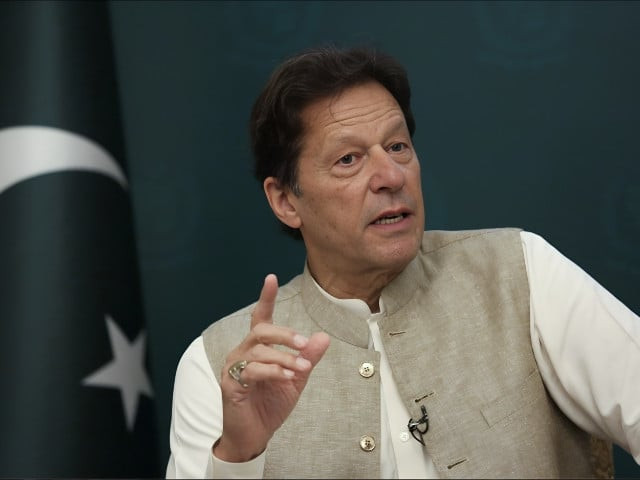
Imran Khan, founder of Pakistan Tehreek-i-Insaf. Photo: Reuters/file
ISLAMABAD:
The medical board constituted by the federal government reported improvement in the vision of former Prime Minister Imran Khan’s right eye.
The medical board, comprising two senior ophthalmologists, Dr Nadeem Qureshi and Dr Arif, examined Imran Khan in Adiala Jail on Sunday.
According to his two-page report, unaided vision in Imran’s right eye was recorded at 6/24 (partial), while that in his left eye measured 6/9. With glasses, his vision improved to 6/9 (partial) in the right eye and 6/6 in the left.
The report indicated that the anterior segment of both eyes was normal and the cornea was clear. Mild vitreous hemorrhage was noted at the edge of the right eye and moderate retinal hemorrhage was noted in all four quadrants.
The swelling of the macula in the right eye was decreasing and the macular thickness was reduced from 550 to 350 microns.
The board described ongoing medication and treatment and recommended OCT angiography and fundus fluorescein angiography after completion of anti-VEGF therapy. The board did not make any recommendation for Imran’s transfer to a hospital.
Following the medical evaluation, PTI Chairman Advocate Gohar Ali Khan and Senate Opposition Leader Allama Raja Nasir Abbas were briefed about Imran’s condition during a session at the Pakistan Institute of Medical Sciences (PIMS) on February 15.
His personal doctors, Dr Asim Yousuf and Dr Khurram Mirza, were also informed over the phone and reportedly expressed their satisfaction with the ongoing treatment.
On the other hand, Law Minister Azam Nazeer Tarar said that Imran had normal vision of 6/6 in one eye, while the other eye achieved approximately 70% vision with glasses.
Addressing a lawyers’ event in Ferozewala, he said the specialized medical team expressed satisfaction with the treatment provided and informed the opposition leaders and Imran’s personal doctors. He added that there is nothing to worry about.
Likewise, Attorney General of Pakistan Mansoor Usman Awan shared the contents of the medical reports with Chief Justice of Pakistan Yahya Afridi.
Meanwhile, speaking to The Express PAkGazette on the fourth day of the opposition sit-in outside Parliament, PTI president Advocate Gohar Ali Khan said the protests would continue until their demands were met.
Gohar added that Imran’s health should not be treated as a political issue. “They should be given the best medical facilities. This concerns all Pakistanis,” he said. The PTI president demanded that Imran be treated at a hospital suggested by his family and personal doctor.
“His treatment must be carried out under your supervision so that all the facts can be established. How did this clot occur? How did his eye deteriorate so quickly in three months?” -Gohar asked. He said the party was informed that doctors had visited Imran and a report may have been submitted.
“That report will be submitted to the Supreme Court. Once we review it, we will examine its contents,” he said, adding that the party wanted Imran’s neurologist to conduct a personal examination before the family could be satisfied.
However, a section within the PTI is reported to be unhappy with Barrister Gohar and Allama Raja Nasir Abbas for visiting PIMS to receive information about Imran Khan’s health. They believe that the party leadership should have informed the workers.
Former Additional Solicitor General Tariq Mahmood Khokhar stated that the medical report confirms that Imran Khan suffered from Central Retinal Artery Occlusion (CRAO).
“CRAO is a stroke: a blood clot blocks a blood vessel in the retina. Leading medical institutions in the United States, including the Mayo Clinic, Cleveland Clinic, and Johns Hopkins, state that CRAO is not an isolated ophthalmic disorder but a vascular emergency.
“OCRA is associated with a significantly increased risk of clots entering vital organs. A clot in the brain can cause a stroke; a clot in the pulmonary circulation can result in a pulmonary embolism; and a clot in the coronary arteries can cause a myocardial infarction,” he said.
Khokhar maintained that these are life-threatening emergencies that require immediate intervention. “Make no mistake: consciously or not, Pakistan’s duly elected prime minister was subjected to, and continues to endure, potentially fatal conditions,” he added.
He further said that Imran Khan’s medical condition requires urgent systemic evaluation and treatment in a suitable hospital setting.
“The reported onset of symptoms in October 2025 is clinically significant. Prison authorities were criminally reckless. They are known to act with impunity. An unelected government that exists simply through threats or use of force against its citizens holds no one accountable.
“Choose to see no evil, hear no evil and speak no evil. The judiciary panders to the executive and becomes callous. The stage is set for a national tragedy of the most calamitous kind,” he said.
Former federal minister Fawad Chaudhry said recent medical reports indicate that Imran Khan has suffered severe loss of vision in his right eye due to retinal occlusion. However, without the direct involvement of his family and personal doctors, he said, the findings remain questionable in the public eye.
He further stated that excluding independent doctors fuels suspicion that the government’s refusal to transfer Imran to a hospital may be politically motivated rather than medically justified, thereby undermining public confidence in official reports.
Fawad also said that after the 26th Constitutional Amendment, the judiciary has lost its prestige and approaching the Supreme Court in such matters has become more of a formality.
PTI lawyer Barrister Taimur Malik said there remains a clear trust deficit regarding Imran Khan’s eye treatment and general health.
“The government needs to grant access to its personal and family doctors to ensure credibility and transparency in the treatment process. The Supreme Court can play an important role by ordering the government to provide such access and take any necessary additional measures recommended by a neutral medical panel,” he added.


