
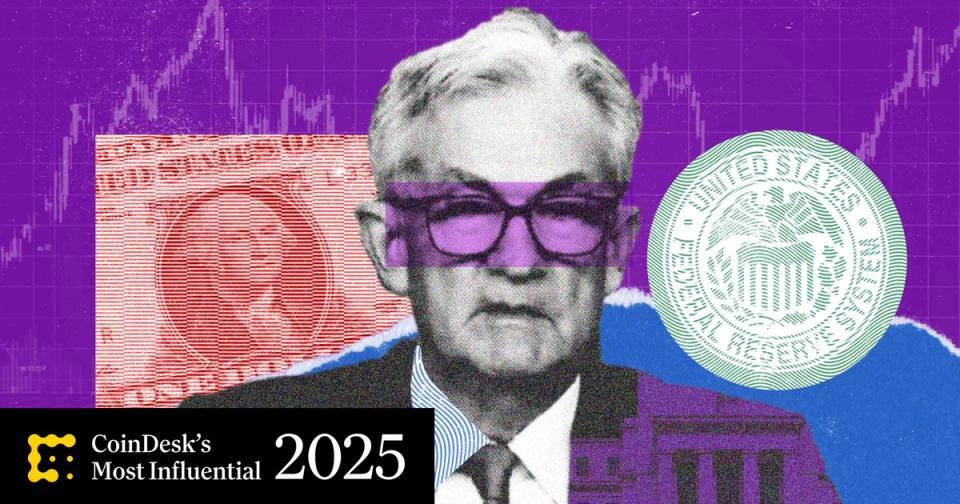
When his term as chairman of the Board of Governors of the Federal Reserve System ends in May 2026, Jerome Powell will have served in all or part of three presidential administrations: Trump I, Biden and Trump II.
This feature is part of CoinDesk List of the most influential of 2025.
Powell will likely be remembered primarily for his battles with US President Donald Trump, the man who first nominated him for president in early 2018 (President Biden re-nominated him for another four-year term in 2022), but his most lasting legacy may be his response to the COVID-19 pandemic of 2020. That flood of liquidity into the financial system may or may not have eased the pain of the general public during the lockdown era, but it surely helped to create one of the largest rallies in financial assets (including cryptocurrencies), as well as seeding the country’s first major inflation since the 1970s.
Towards the end of 2025, that inflation (although it has receded greatly from its worst levels in 2022, when it was in the near double digits for much of the year) continues to create problems for monetary policymaking.
In fact, the Federal Reserve’s last monetary policy meeting of the year, which will be held on December 9 and 10, will be remembered as one of the most controversial in the central bank’s history. Signs of an economic slowdown, as evidenced by recent weak employment and manufacturing reports, would typically cause the Federal Reserve to act hastily and almost unanimously to ease monetary policy by reducing its benchmark federal funds rate.
However, inflation remains stubbornly above the Federal Reserve’s 2% target. In the weeks leading up to the meeting, several Fed officials made no secret in their public comments of their disagreement not only with further easing in December, but even with the October rate cut.
Debate is fine, but the central bank has been a collegial group for decades, and dissenters from mainstream opinion are so rare that even a single member voting against a policy decision would be front-page news. Powell’s Fed’s final decision to cut rates by another 25 basis points last week generated three dissents: two from members who preferred to keep policy stable and one who wanted to cut 50 basis points.
Cryptocurrencies and the Federal Reserve: They recover and collapse
The link between Fed policy and cryptocurrency markets is no secret: all things being equal, the prices of speculative assets like cryptocurrencies tend to perform better when monetary policy is loosened and tend to struggle when policy is tightened.
That was certainly the case in 2020, when the Powell Federal Reserve’s massive response to the COVID-19 pandemic helped propel bitcoin on its epic run from around $3,000 to $65,000 13 months later.
It was certainly also the case in 2022, when bitcoin plummeted to $15,000 late in the year as Powell’s Federal Reserve (finally gaining faith in inflation) serially raised its benchmark interest rate from 0.00% in January to 4% in December (the rate eventually peaked at 5.25% in mid-2023).
Bitcoin’s rise this year to an all-time high above $125,000 was accompanied by two rate cuts by the Federal Reserve. However, its price collapse in recent weeks began just after the Federal Reserve’s Oct. 28-29 meeting, at which Chairman Powell said market expectations for further central bank easing were too dovish.
The reaction was swift: bitcoin fell from more than $113,000 to $107,000 a day later and to $80,000 three weeks later. There has been a modest rebound since at least the December rate cut became a reality. Still, markets have considerably tempered expectations for further easing in January.
Continuing
Powell’s term as Federal Reserve chair ends in May 2026, and President Trump has made clear that he has no intention of renominating him. In fact, recent leaks from the White House suggest that Trump could name Powell’s successor before the New Year.
In effect, the move would create a shadow Fed chair that Powell would have to deal with in the final months of his term.
And while Powell’s reign as Federal Reserve chair will end next spring, he could, if he chooses, remain as a member of the Board of Governors. His fourteen-year term in that organization will not end until 2028.


