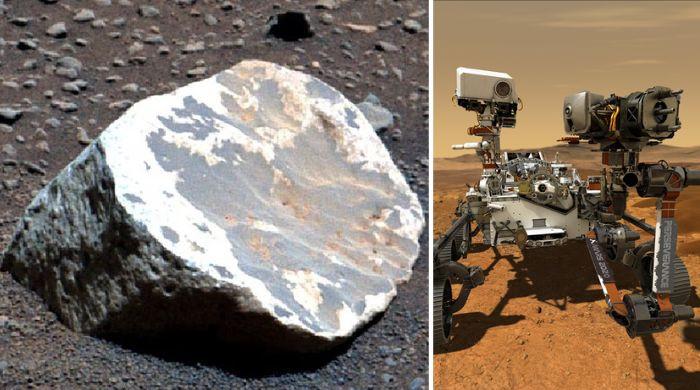
The National Aeronautics and Space Administration’s (NASA) Mars rover Perseverance has discovered signs of tropical rain on the red planet.
The rover discovered strange “bleached” rocks, indicating the planet was warm and wet for millions of years, according to photo analysis by scientists at Purdue University in Indiana.
Many argue that it is one of the most important tests of the conditions that once supported life on Mars.
Briony Horgan, a professor of planetary science at Purdue University, said: “The rocks are evidence of an ancient warmer, wetter climate.”
Experts say it provides an opportunity to study how Mars ended up in its current arid state when it once received rainfall similar to that of Earth’s tropical regions, such as the Amazon rainforest.
Analysis of the fragments in the rocks revealed that they were made of kaolinite, a mineral that usually forms in tropical conditions, thus confirming the heavy rains that the red planet once received.
Professor Horgan said: “This is truly incredible. It indicates a potentially habitable environment when life could once have thrived.”
The new study, published in the journal Earth and Environment CommunicationsHe stated that there is no evidence that the rocks originated from or were transported from elsewhere.