
ISLAMABAD:
The National Judicial Policy Development Committee (NJPMC) has been informed that a total of 82,599 undertrial prisoners (UTP) are currently detained in different jails in the country.
The NJPMC met on Wednesday under the chairmanship of Chief Justice of Pakistan (CJP) Yahya Afridi. The meeting was attended by the presidents of all the high courts. Interestingly, Federal Constitutional Court (FCC) Chief Justice Amin-ud-Din Khan is yet to join the NJPMC.
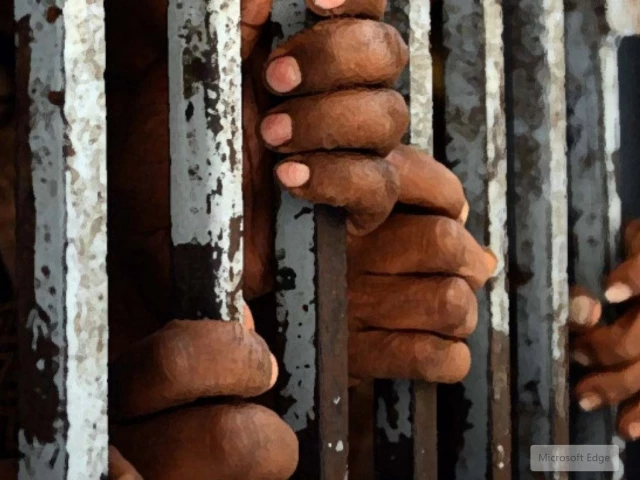
During the meeting, the commission was informed that the total number of UTPs throughout the country is 82,599. Of them, 2,470 prisoners under trial are detained for more than three years.
The NJPMC unanimously decided to expedite UTP cases, pending for more than three years, and ordered the trial courts to decide such cases within three months.
According to data shared with the committee, a total of 50,780 UTPs are detained in Punjab and 1,609 of them are confined for more than three years. In Sindh, 21,294 UTPs are detained and 708 of them have been in prison for more than three years.
A total of 9,007 UTPs are detained in Khyber Pakhtunkhwa (KP), of which 146 are detained for more than three years. Likewise, 1,518 UTPs are detained in jails in Balochistan and only seven are imprisoned for more than three years.
To discourage false and frivolous cases, the NJPMC constituted a committee headed by the Chief Justice of the Balochistan High Court (BHC) and comprising the Registrars of all High Courts to suggest measures to establish a legal framework on the pattern of the Litigation Costs Act, 2017, as applied in the Islamabad Capital Territory.
The committee may co-opt High Court Justice Miangul Hassan Aurangzeb for this matter.
The government is reported to be in the process of developing a structured redressal mechanism to address complaints of non-compliance with the legal requirement of production of arrested persons before a magistrate within 24 hours, which is expected to be finalized within two weeks.
The committee underlined the need for strict compliance with all legal requirements, which must be observed in both letter and spirit.
Furthermore, it was resolved that the Attorney General of Pakistan (AGP), Mansoor Awan, will keep the committee regularly informed about the progress and implementation of the framework through regular updates.
Thanking the Islamabad High Court (IHC) for the speedy disposal of high-impact tax cases, the NJPMC expressed satisfaction with the overall compliance of its directions by the high courts.
The committee decided that each high court will constitute designated tribunals to deal with cases arising under the Recognition and Enforcement (Foreign Arbitration Agreements and Arbitration Awards) Act, 2011.
The NJPMC appreciated the steps taken by the FBR to discourage frivolous litigation, including sifting out meritless appeals and streamlining appellate practices.
The committee also thanked Pakistan Revenue Automation Limited (PRAL) for the progress made in developing high court Litigation Management System (LMS) dashboards on the SC pattern.
The committee thanked all the high courts in general and the district judiciary in particular for their exemplary performance in resolving a large number of cases within the stipulated deadlines.
Lauding the efforts of the district judiciary in reducing the backlog, the committee unanimously recommended recognition of best judicial officers by providing them with certificates, mementos and consideration for international exposure visits.
The committee was informed that the total number of cases pending in the five high courts is 1,274,780, while 754,006 cases are decided in a year.
The committee praised the progress made by the IHC in advancing prison reform initiatives.
Chief justices were asked to convene meetings of their respective provincial justice committees to conduct a comprehensive review and finalize the Action Plan on Prison Reforms.
The committee emphasized the importance of coordinated supervision and timely implementation to ensure significant and sustainable improvements in prison administration and prisoners’ rights, according to an official statement.
Meanwhile, the Supreme Judicial Council (SCJ) decided to move forward with three misconduct complaints filed against high court judges.
A meeting of the SJC was held on Wednesday to consider 59 complaints. Of these, the SJC ordered the filing of 50 complaints and postponed six complaints. However, the city council decided to continue processing three complaints in accordance with the law.
According to a statement, the council unanimously decided to postpone finalizing the draft rules until the next meeting.
For eight complaints, the council was reconstituted and IHC Chief Justice Sardar Muhammad Sarfraz Dogar was replaced by Peshawar High Court (PHC) Chief Justice Syed Muhammad Attique Shah.
These eight complaints are likely to be related to IHC judges.
Earlier, the Judicial Commission of Pakistan (JCP) also deferred the agenda regarding the appointment of two additional judges of the BHC in view of a constitutional issue regarding the appointment of representative of the Balochistan Bar Council.
Members emphasized the need for thorough consideration of the issue before proceeding. The first meeting of the PCB (central committee) deliberated on the proposed framework for formulating rules governing interviews of candidates at the time of their appointment as judges.
After a preliminary discussion, the commission resolved to adjourn the agenda to allow members to conduct more in-depth deliberations on the proposed regulatory framework.


