
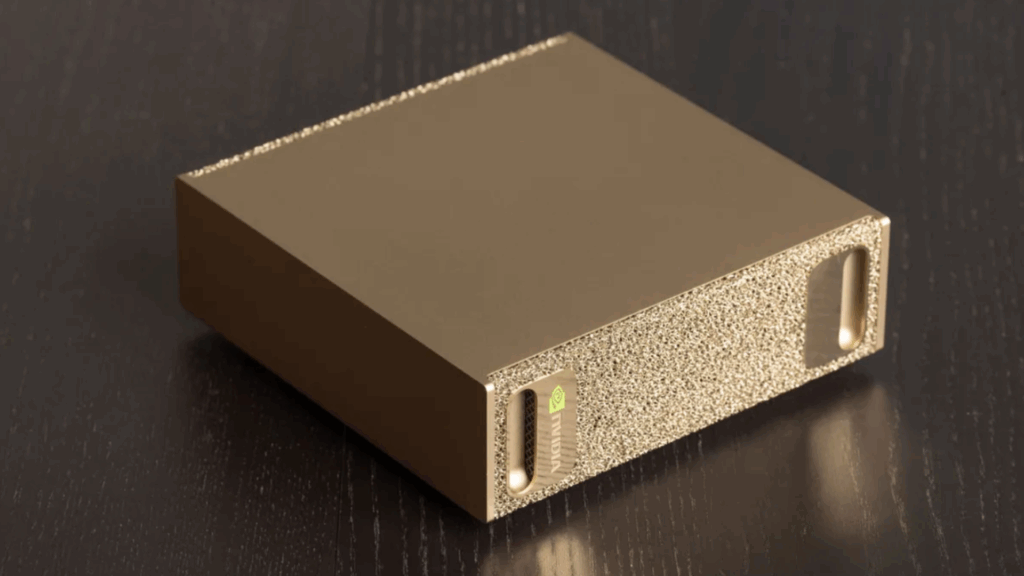
- Nvidia DGX Spark runs larger AI models locally using a massive 128GB unified memory efficiently
- Native CUDA support makes Spark ideal for advanced AI workloads on desktop
- Its combination of Arm CPU and Blackwell GPU avoids expensive professional graphics cards
The long-awaited Nvidia DGX Spark has finally arrived as a very small desktop system built around the GB10 Superchip.
It features a shared 128GB of LPDDR5X memory, a specification that immediately separates the system from typical desktop computers and even the most compact workstations.
And according to an initial review of Toms HardwareThe system delivers solid results only when its AI-oriented capabilities are fully utilized.
Focus on hardware design and connectivity.
The Spark’s hardware design is based on a single package that combines an Arm-based CPU with a Blackwell GPU.
This integration allows Nvidia to support larger local models without requiring professional-class graphics cards at extreme costs.
While Apple and AMD systems offer large shared memory configurations, they lack direct support for the Nvidia software ecosystem, which continues to dominate many AI development workflows.
The physical design emphasizes density and airflow rather than visual style or modular expansion.
With a volume of just over a liter and dimensions of approximately 150 by 150 by 50 mm, the unit fits comfortably among any modern mini PC, but the similarities end there.
In addition to a USB-C power input, the unit provides three 20Gbps USB-C ports with DisplayPort Alternate Mode, one HDMI 2.1a port, and one 10Gb Ethernet connection.
Notably, it includes two QSFP ports driven by an integrated ConnectX-7 network interface capable of reaching up to 200 Gbps, allowing multiple units to be connected for distributed computing experiments, a capability rarely associated with a mini PC.
The system runs DGX OS, a custom Ubuntu 24.04 LTS distribution closely aligned with Nvidia’s software stack.
It can function as a locally connected computer with a monitor and keyboard, or as a headless system accessed remotely over a network.
Nvidia’s Sync utility simplifies remote access from Windows and macOS machines, allowing AI tools to run continuously in the background.
These usage patterns resemble how mobile workstations or shared computing nodes are accessed, rather than how everyday desktops are typically used.
The DGX Spark benefits from a 128GB unified memory pool with native CUDA support, a rare combination in compact systems designed for local AI work.
This setup allows larger models to run entirely in memory, avoiding frequent movement of data between system RAM and GPU memory, and as a result, reducing some of the practical limits seen on discrete GPUs with smaller VRAM pools.
That same capacity also introduces clear trade-offs. The entry price remains high relative to compact desktops, especially for users who don’t run AI-demanding workloads every day.
The system is not compatible with Windows, which restricts the software’s compatibility for users outside of Linux-centric environments.
Its GPU is also not suitable for gaming or general graphics tasks, reinforcing its limited range.
DGX Spark assumes that local experimentation with AI is a primary and ongoing requirement, but if this is not your priority, it loses practical value.
Follow TechRadar on Google News and add us as a preferred source to receive news, reviews and opinions from our experts in your feeds. Be sure to click the Follow button!
And of course you can also follow TechRadar on TikTok for news, reviews, unboxings in video form and receive regular updates from us on WhatsApp also.


