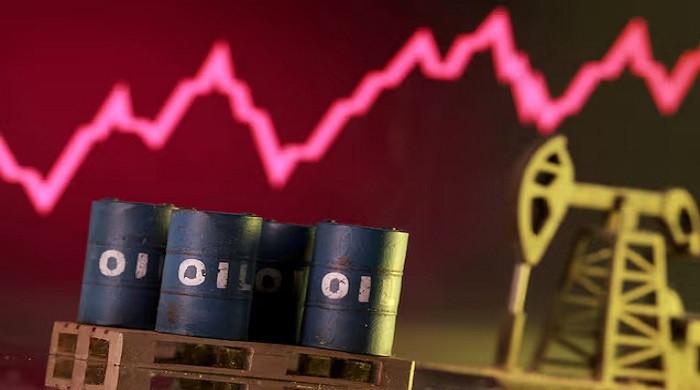
- Oil exceeds $100 a barrel, Brent is advancing by leaps and bounds.
- Wall St, Nikkei futures sink and yields rise on inflation risk.
- The dollar is in demand as a source of liquidity, the euro is collapsing.
Stock futures fell sharply in Asia on Monday as the inflationary pulse of rising oil prices threatened to raise living costs, and perhaps interest rates, around the world, while investors’ hunger for liquidity kept demand for the US dollar.
Brent jumped 17% to $108.73 a barrel, after rising 28% last week, while US crude rose 19% to $108.33 a barrel.
Iran named Mojtaba Khamenei to succeed his father, Ali Khamenei, as supreme leader, signaling that hardliners remain firmly in charge in Tehran, a week into its conflict with the United States and Israel.
With no sign of an end to hostilities in the Middle East and oil tankers still hesitant to cross the Strait of Hormuz, investors were bracing for a long period of higher energy costs. EITHER
“The global economy remains dependent on the concentrated flow of oil and natural gas from the Middle East through the Strait of Hormuz,” said Bruce Kasman, chief economist at JPMorgan.
“The short-term scenario is a short-term rise towards $120 per barrel, followed by a moderation as the conflict soon subsides,” he added. “But in the absence of a clear and decisive policy resolution, Brent crude oil prices are expected to settle at a high level of $80 per barrel until mid-year.”
Such an outcome could reduce global economic growth by an annualized 0.6% during the first half of this year and increase consumer prices by an annual rate of 1%, it said.
Kasman warned that a broader, sustained conflict could push oil above $120 a barrel and risk a global recession.
Wall Street led the decline in early trading, as S&P 500 ESc1 futures lost 1.6%, while Nasdaq futures plunged 1.7%.
Japanese Nikkei futures NKc1 sank to 52,400, a sharp drop from Friday’s cash close of 55,620.
In bond markets, the risk of rising inflation outweighed safe haven considerations, with 10-year Treasury note futures TYc1 falling 13 ticks, while three-year futures fell 22 ticks.
Investors sought liquidity in dollars while avoiding the currencies of countries that are net energy importers, including Japan and much of Europe.
The dollar strengthened 0.3% to 158.35 yen, while the euro fell 0.7% to $1.1537.
Gold fell 0.6% to $5,140 an ounce, with traders speculating that investors would have to book profits where they could to cover losses elsewhere.