
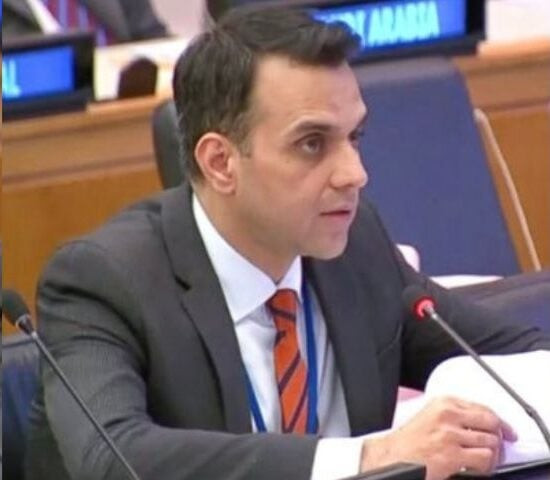
Ambassador Usman Iqbal Jadoon, Deputy Permanent Member of Pakistan to the UN. Photo app
UNITED NATIONS:
Welcoming Syria’s cooperation with the Technical Secretariat of the Organization for the Prohibition of Chemical Weapons (OPCW), Pakistan has underlined the need for independent verification to eliminate suspected chemical weapons in Syria that were developed under the Assad regime and any risk of proliferation.
“We look forward to your continued cooperation, in full compliance with the CWC and Security Council resolutions, to close the Syrian chemical weapons file as soon as possible,” Pakistan’s acting permanent representative to the United Nations, Ambassador Usman Jadoon, told the UN Security Council on Thursday.
The 15-member Council had met to discuss Syria’s “chemical weapons dossier”, focusing on issues related to the use, monitoring and compliance with international obligations on chemical weapons.
As highlighted by the Technical Secretariat, the Pakistani envoy said it was also important to close the gap between “what the Syrian Arab Republic must provide and the capabilities it has at its disposal.”
“Continued international support to Syria and the Technical Secretariat therefore remains of vital importance,” he said.
At the same time, Ambassador Jadoon said that Pakistan supports the unity, sovereignty and territorial integrity of Syria, which are essential for lasting peace and stability, while supporting an inclusive, Syrian-owned and led political process.
The Pakistani envoy noted that Syria’s security situation is seriously affected by Israel’s military occupation of parts of Syrian territory and its continued attacks on Syrian sites and facilities, which have also impeded the OPCW’s technical work.
Pakistan, he said, appreciates the commitment of the Syrian authorities to fully implement the CWC, secure suspected chemical weapons sites and address outstanding issues, while reaffirming Islamabad’s opposition to the use of chemical weapons by anyone, anywhere and under any circumstances.
At the beginning of the debate, Director and Deputy High Representative for Disarmament Affairs, Adedeji Ebo, told the Council that since 2014, the OPCW has been unable to verify the accuracy of Syria’s original chemical weapons declaration.
He said Syria’s new government is now cooperating with the OPCW Technical Secretariat to clarify the full scope of the program, including more than 100 additional sites beyond the 26 declared locations. Some sites are in hazardous areas, presenting risks to inspection teams.
Welcoming the government’s “commendable” cooperation, Ebo emphasized that there is a “critical opportunity” to obtain long-awaited clarifications and eliminate all chemical weapons, and urged Council members to “show leadership” and provide sustained international support.


