
Pakistan has criticized India for its continued violations of the Indus Waters Treaty, expressing serious concern on Thursday over fluctuations in the flow of the Chenab River and announcing that it had written to India seeking an explanation.
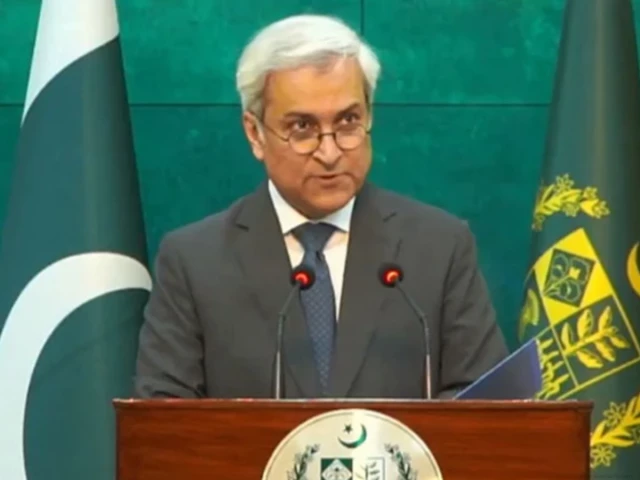
At a weekly press conference, Foreign Ministry spokesperson Tahir Hussain Andrabi addressed what he called “abrupt variation” in the river’s flow, an issue that has attracted media attention in recent days.
On December 8, it was reported that India had released a surge of water into the Chenab River. The flow of the Chenab river had reportedly increased to 58,300 cusecs after India released water from its dams.
“Pakistan views these variations with extreme concern and seriousness,” Andrabi said. “They allude to the unilateral release of water in the Chenab River by India, without prior notification.”
Andrabi said Pakistan’s Indus Waters Commissioner had contacted his Indian counterpart to seek clarification as per procedures outlined in the Indus Waters Treaty.
“Any manipulation of river flows by India, especially at a critical time in our agricultural cycle, directly threatens the lives and livelihoods, as well as the food and economic security of our citizens,” Andrabi said.
He urged India to respond to questions raised by Pakistan’s Indus Water Commissioner, avoid any unilateral changes in the river’s flow and fulfill its commitments under the treaty.
The Indus Waters Treaty, he said, is a “binding international agreement” that has served as “an instrument of peace, security and stability in the region.”
Violations of the treaty, Andrabi said, threaten the “inviolability of international treaties and compliance with international law” and pose serious risks to “regional peace, the principles of good neighborliness and the norms governing interstate relations.”
Read: Chenab river rises as India releases water from dam and flow reaches 58,300 cusecs
“The international community must take note of India’s continued disregard for a bilateral treaty and advise it to act responsibly and in accordance with international law and established norms, as well as its own obligations,” he said.
“Pakistan remains committed to the peaceful resolution of disputes and issues with India, but will not compromise the existential water rights of the people of our country,” Andrabi added.
In April, India suspended the Indus Waters Treaty after an attack on tourists in Pahalgam in occupied Kashmir that killed 26 people, an incident that New Delhi blamed on Islamabad without providing evidence. Pakistan called any attempt to withhold its share of water under the treaty an “act of war,” noting that the agreement contained no provision for unilateral suspension.
During the briefing, the Ministry of External Affairs spokesperson also addressed an incident this week in which Bihar Chief Minister Nitish Kumar removed the hijab of a female doctor, sparking widespread criticism.
Read more: US relies on Pakistan for success of force in Gaza
Andrabi noted that the episode was followed by “public ridicule” by an Uttar Pradesh minister, who defended Kumar before retracting his comments.
“The forced removal of a Muslim woman’s hijab by a senior political leader and the subsequent public ridicule of this act are deeply disturbing and deserve strong condemnation,” he said. “The action risks normalizing the humiliation of Muslim women in India. The conduct also demonstrates a lack of public respect for India’s religious minorities, particularly its Muslim citizens,” Andrabi added.
“We urge all responsible stakeholders and the Indian government to recognize the seriousness of this incident and reaffirm their commitment to protecting minority rights, respecting religious freedom and preserving human dignity,” he said.
Separately, the Ministry of Foreign Affairs addressed the role of diplomats in court proceedings, emphasizing that it is not appropriate for ambassadors to attend court cases. “While diplomats enjoy certain immunities, they should not be involved in ongoing legal cases,” the spokesperson said.
Also read: Norway defends the presence of the envoy at the SC hearing
When asked which ambassadors are prohibited from attending the court, the spokesperson clarified that no ambassador has the right to participate in a case without prior approval from the Ministry of Foreign Affairs. “Attendance of diplomats in court is strictly subject to official authorization.”
Andrabi was referring to when Norwegian ambassador Per Albert Ilsaas attended the Supreme Court hearing of husband and wife lawyer duo Imaan Zainab Mazari-Hazir and Hadi Ali Chattha, causing a stir on social media.
The Foreign Ministry summoned the Norwegian envoy and urged him to “adhere to established norms of diplomatic engagement” following his “unjustified” assistance.
The spokesperson also said they had no information about reports of the army chief’s planned visit to the United States, referring to an article published by Reuters, which stated that Field Marshal Asim Munir is expected to meet with US President Donald Trump to discuss the Gaza peacekeeping force.


