
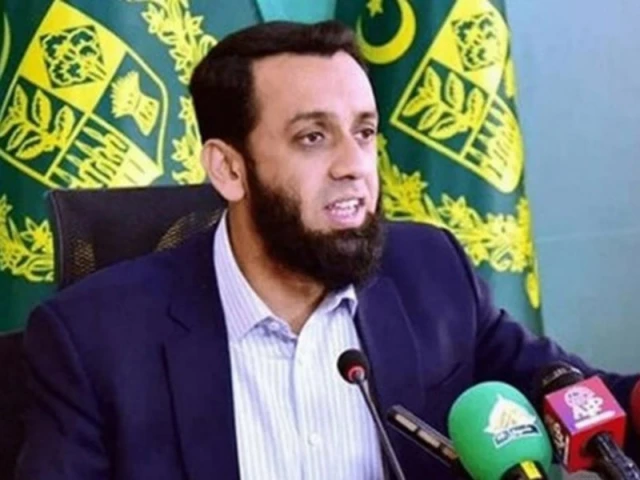
Tarar says Qatar, Saudi Arabia and Turkiye requested a ceasefire; Says Ghazab Lil Haq will resume if attacks continue
Minister of Information, Attaullah Tarar. Photo: Archive
ISLAMABAD:
Pakistan and Afghanistan on Wednesday announced a temporary pause in hostilities ahead of Eidul Fitr, in what appears to be a rare de-escalation after days of escalating cross-border tensions.
The ceasefire, announced separately by Islamabad and Kabul, will remain in effect from midnight on March 18 and 19 to midnight on March 23 and 24, with both sides warning that any violation could trigger an immediate resumption of military operations.
Information Minister Attaullah Tarar said the decision was taken in view of the upcoming Islamic festival and as a gesture of goodwill, as well as in response to requests from “brotherly Islamic countries,” including Saudi Arabia, Qatar and Turkiye.
“In view of the upcoming Islamic festival of Eidul Fitr, on its own initiative as well as at the request of brotherly Islamic countries… the Government of Pakistan has decided to announce a temporary pause amid the ongoing ‘Operation Ghazab-lil-Haq’ against terrorists and their supporting infrastructure in Afghanistan,” the minister said in a statement.
He added that the pause was offered “in good faith and in accordance with Islamic rules” but made it clear that the truce was conditional.
“In case of any cross-border attack, drone attack or terrorist incident inside Pakistan, Operation Ghazab Lil Haq will immediately resume with renewed intensity,” the statement warned.
On the other hand, the Afghan Taliban regime also confirmed a temporary cessation of what it called “Defensive Operations (Rad-ul Zulm)”.
Taliban government spokesman Zabihullah Mujahid, in a statement published on X, said the suspension was announced on the occasion of Eidul Fitr and in response to mediation efforts by the same group of countries in the region.
“The security and defense forces of the Islamic Emirate of Afghanistan hereby announce a temporary suspension of ‘Defensive Operations (Rad-ul Zulm)’ upon the arrival of the blessed Eidul Fitr,” Mujahid said.
He appreciated the “goodwill and constructive efforts” of Saudi Arabia, Turkiye and Qatar, while reiterating that Afghanistan’s sovereignty and security remain non-negotiable.
“In case of any threat, the Islamic Emirate will respond decisively,” he added.
The synchronized announcements suggest behind-the-scenes diplomacy by key regional players aimed at preventing further escalation between the two neighbors, whose ties have deteriorated sharply in recent months due to cross-border militancy and military attacks.
While both sides have framed the pause as temporary and conditional, it nevertheless offers a brief window for a reduction in tension during the religious holiday, and observers are cautiously watching whether it could pave the way for a broader compromise.
The move came two days after Pakistan launched new airstrikes in Kabul. However, the Taliban regime accused of attacking a rehabilitation center.
In an interview with a private television channel, Director General of Inter-Services Public Relations (ISPR), Lieutenant General Ahmed Sharif Chaudhry, rejected the allegations and stated that the main target of the recent attack in Kabul was a warehouse containing ammunition, weapons and drones belonging to the Afghan Taliban.
The DG ISPR stated that the explosions caused by the detonation of the ammunition were witnessed throughout the city. He added that the operation was carried out in response to 53 attacks carried out by the Afghan Taliban against Pakistani checkpoints. He dismissed reports of civilian casualties as propaganda, stating that Taliban fighters often do not wear uniforms and instead wear civilian clothes, and that the Taliban also use drug addicts for suicide attacks.
The DG ISPR further alleged that the drones recently used by the Afghan Taliban against Pakistan were being supplied by India. He stressed that Pakistan has no conflict with the Afghan people, who, he said, are being held hostage by terrorists.
Lieutenant General Ahmed Sharif Chaudhry claimed that Pakistan is waging a war against terrorism and claimed that India is behind the terrorist activities. Referring to the attack on the Tralai mosque, he said that innocent people were martyred and that the attacker came from Afghanistan, where he had received training. He also mentioned the attack on Wana Cadet College and claimed that the five slain attackers were Afghan nationals. He added that attacks are being carried out against police, civilians and mosques, and that terrorist organizations operating against Pakistan have their leadership based in Afghanistan.
He named Noor Wali, Bashir Zeb and Gul Bahadur as present there.
He said the Afghan Taliban started the conflict and Pakistan simply responded. “When we attack terrorist hideouts, they bring their militias there,” he added, noting that Pakistan has carried out attacks in 81 locations, all targeting infrastructure that supports terrorism against Pakistan.
DG ISPR said Pakistan did not impose war on Afghanistan; rather, the war on terrorism has been imposed on Pakistan. He noted that thousands of Pakistanis have been martyred in this fight and that the country has been fighting terrorism for decades. He further alleged that the Afghan Taliban regime is harboring terrorists, even inside government buildings.
He asserted that Pakistan is ready for dialogue but first demanded that it be handed over to terrorists and terrorist sanctuaries inside Afghanistan be dismantled. “The Afghan Taliban must decide whether to prioritize terrorism or peace, whether to support the TTP or Pakistan,” he said. He criticized the Taliban for previously asking Pakistan to show patience, adding: “You can’t kill Pakistani children and expect us to sit down and talk.”
He reiterated that Pakistan has never shied away from dialogue and has engaged with the Taliban in multiple forums. He questioned whether any country in the world could guarantee the Taliban’s commitments and noted that narcotics also play a role in terrorism.
He questioned the Taliban’s interpretation of Islam and asked where they allow terrorism, suicide attacks or inhumane treatment of women. He said that no one can under any circumstances be allowed to carry out terrorism inside Pakistan.
The military spokesperson added that cross-border smuggling had also hurt Pakistan, but noted that there has been a reduction in cross-border terrorism and smuggling. He said ongoing operations are forcing those responsible for terrorism to pay the price. “Pakistan is a responsible state, but they attack our markets and mosques,” he said.
He added that Pakistan understands that the Afghan people are also helpless under the Taliban regime. He stated that Taliban fighters and terrorists are now constantly on the move and do not stay in one place for more than one night. He further stated that during the operations, 44 Afghan Taliban checkpoints were taken and that the Taliban regime is now worried about its own survival.
He concluded by saying that more than 200 counter-terrorism operations are carried out daily in Pakistan and alleged that terrorists are using Indian social media accounts to spread propaganda.


