
Jointly call for a ceasefire and peace talks; urges civil protection and safe shipping as Beijing looks to broader Middle East
ISLAMABAD:
Pakistan and China on Tuesday jointly proposed a five-point initiative aimed at restoring peace and stability in the Gulf and the broader Middle East.
The plan calls for an immediate ceasefire, urgent diplomatic engagement to prevent further escalation, and the restoration of normal maritime traffic through the Strait of Hormuz.
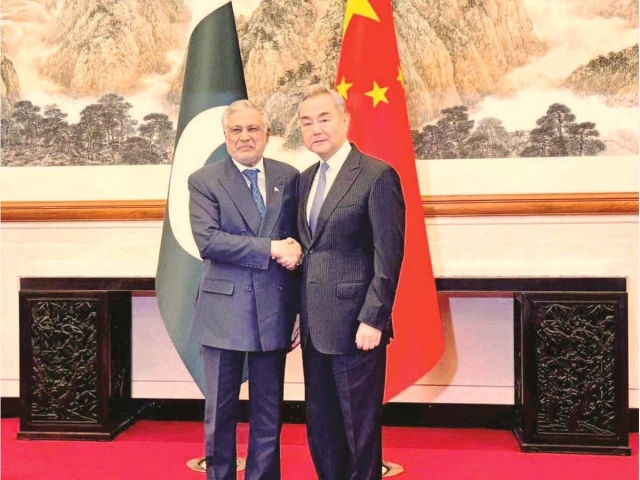
The “Five Point Plan” was announced in a joint statement following a meeting in Beijing between Chinese Foreign Minister Wang Yi and Pakistani Deputy Prime Minister and Foreign Minister Senator Ishaq Dar.
Dar traveled to China two days after hosting a meeting of foreign ministers from Saudi Arabia, Turkey and Egypt as part of Pakistan’s diplomatic efforts to end the conflict. China’s support for the plan highlights Beijing’s increasingly proactive role in seeking a solution to the crisis.
the plan
According to the joint statement, both sides stressed the need for an immediate cessation of hostilities, urging all parties to prevent the conflict from spreading and ensure unimpeded humanitarian access to war-affected areas.
They also called for the early resumption of peace talks, stressing that dialogue and diplomacy remain the only viable ways to resolve disputes. The statement emphasized the importance of safeguarding the sovereignty, territorial integrity and security of Iran and the Gulf states, while urging all parties to refrain from the use or threat of force during negotiations.
Highlighting concerns over civilian security, the two countries underlined the need to protect non-military targets. They called on all parties to strictly comply with international humanitarian law and stop attacks on civilians and critical infrastructure, including energy facilities, desalination plants and peaceful nuclear facilities.
They also expressed concern about disruptions to global trade, highlighting the need to ensure the security of sea routes, particularly in the Strait of Hormuz. They called for the safe passage of commercial ships and the restoration of normal maritime traffic as soon as possible.
Reaffirming their commitment to multilateralism, both countries emphasized the primacy of the United Nations Charter, urging the international community to support efforts aimed at achieving a comprehensive and lasting peace framework in line with international law.
China’s fundamental role
The Foreign Ministry in Islamabad said the initiative reflects a shared commitment by Islamabad and Beijing to promote de-escalation in a region facing heightened tensions. Diplomatic sources suggested China could play a key role in pushing Iran toward possible face-to-face talks with the United States in Islamabad.
Dar’s visit to Beijing gained significant momentum among domestic and international commentators. Analysts noted that the joint statement shows that Pakistan and China are “on the same page” regarding the crisis.
“The upshot of the five-point declaration between China and Pakistan on the war is that China’s response when asked to get involved was definitely not ‘no.’ The declaration is an opportunity for Beijing to intervene,” wrote Vali Nasr, a Johns Hopkins professor and author of ‘Iran’s Grand Strategy,’ in X.
Professor Dr. Ishtiaq Ahmed, a geostrategy expert, noted that the declaration closely aligns with the interests of the Gulf. “By establishing a ceasefire first, Beijing and Islamabad align themselves with Gulf preferences and create a foundation that others can publicly support, even if it is not immediately implemented,” he said.
Dr. Ahmed added that the “most consequential point” concerns the Strait of Hormuz: “By focusing on safe passage and normal shipping, the proposal links the conflict to global energy markets. It aligns with the interests of the United States, China and the Gulf and creates a clear area where pressure for restraint can quickly increase.”
Former Finance Minister Asad Umar described the proposal on X as an “excellent development,” noting that it marks the first time China has taken a direct initiative to influence a global crisis of this magnitude. Quoting Allama Iqbal, he added: “See the sun rising in the East.”
Michael Kugelman, a leading U.S. foreign policy expert, said the move signals Beijing’s support for the U.S.-Iran peace process that Islamabad has sought to push forward. However, he added, “it is also likely to be a reflection of Pakistan’s view that China needs to be brought in to gain greater acceptance from the Iranians.”
Mushahid Hussain Syed, president of the Pakistan-China Institute, called the framework “critically important.” He noted that it closely aligns with Iran’s position while emphasizing the supremacy of the UN and international law, indicating that China is now ready to act as a mediator.


