
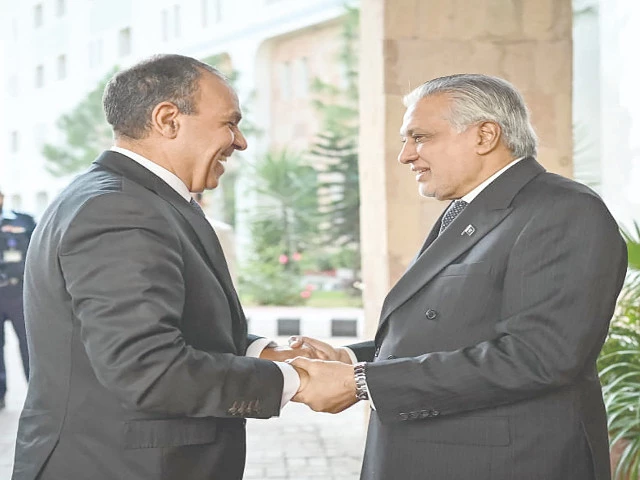
Foreign Minister Ishaq Dar greets his Egyptian counterpart Badr Abdelatty upon his arrival at the Ministry of Foreign Affairs in Islamabad. Photo: AFP
ISLAMABAD:
Pakistan and Egypt agreed on Sunday on a series of key decisions to strengthen economic cooperation, expand defense ties and closely coordinate peace efforts in Gaza. Those were the findings that emerged during Egyptian Foreign Minister Dr. Badr Abdelatty’s two-day official visit to Islamabad.
Dr Abdelatty, who visited Islamabad on November 29-30 at the invitation of Deputy Prime Minister and Foreign Minister Senator Ishaq Dar, held wide-ranging talks that officials described as “substantive, forward-looking and strategically relevant” given the rapidly changing Middle East environment.
During the delegation-level talks at the Ministry of Foreign Affairs, both sides examined the entire spectrum of relations. including political, economic, defense, cultural and educational. However, the highlight of the talks was a renewed push to activate dormant institutional mechanisms and build a structured roadmap for economic and private sector participation.
One of the main outcomes of the visit was the decision to facilitate access to visas for Pakistani companies, starting with 250 companies in the first phase and expanding to 500 in the second. In parallel, both sides agreed to establish the Pakistan-Egypt Business Council as well as the Pakistan-Egypt Business Forum, which will meet in the second quarter of 2026 along with the bilateral Joint Ministerial Commission.
Officials said the aim is to institutionalize B2B ties, increase investments and tap untapped trade potential between the two countries, particularly in textiles, agriculture, food products and pharmaceuticals. Dr. Abdelatty also announced that Al-Azhar University would double scholarships for Pakistani students, which would be a significant boost in educational cooperation.
In a sign of deepening strategic commitment, the Egyptian Foreign Minister held a meeting with the Chief of the Army Staff, Field Marshal Syed Asim Munir, at General Headquarters. Discussions focused on defense cooperation, training, military exchanges and regional stability. Both sides reaffirmed that the armed forces of Pakistan and Egypt would maintain close high-level engagement.
The officials noted that the defense component of the visit was particularly important given Egypt’s growing regional security role and Pakistan’s historic defense cooperation with Cairo. The timing of the visit took on additional importance amid the ongoing efforts of the Gaza peace plan, where both Pakistan and Egypt have emerged as important diplomatic players.
Pakistan appreciated Egypt’s “critical humanitarian and diplomatic role”, including its shuttle diplomacy, management of the Rafah crossing and efforts to reach ceasefire agreements.
Pakistan and Egypt are part of the Arab-Islamic countries that supported President Trump’s Gaza peace plan. Egypt will act as a central player for the proposed International Stabilization Force (ISF) for Gaza. Pakistan could potentially be part of the force, but made clear that Islamabad would not join any effort to disarm Hamas.
Both foreign ministers reiterated their support for the establishment of an independent and sovereign Palestinian state based on the pre-1967 borders with Al-Quds Al-Sharif as its capital.
Diplomatic sources said that with Egypt working on mediation formulas and Pakistan pushing for multilateral humanitarian mechanisms, the two countries are now aligning positions more closely than before.
Dr Abdelatty also met President Asif Ali Zardari, who praised the historic relationship between the two countries and expressed Pakistan’s desire to elevate ties across the board. The president highlighted Egypt’s leadership amid regional uncertainty and emphasized the need for continued coordination on humanitarian issues, particularly in Gaza.
The Egyptian Foreign Minister also interacted with prominent members of Pakistan’s business community, highlighting investment opportunities and inviting Pakistani companies to explore Egypt’s expanding markets.
Officials in Islamabad said the visit helped “restore momentum” in a relationship that had occasionally stalled despite shared history, mutual political goodwill and converging regional interests.
With agreements on business facilitation, economic roadmaps, defense cooperation and coordinated diplomatic positions on Gaza, the visit marked one of the most important results-driven engagements between the two countries in recent years.
Both sides reaffirmed their commitment to building a partnership aimed at regional peace, economic resilience and long-term cooperation.


