
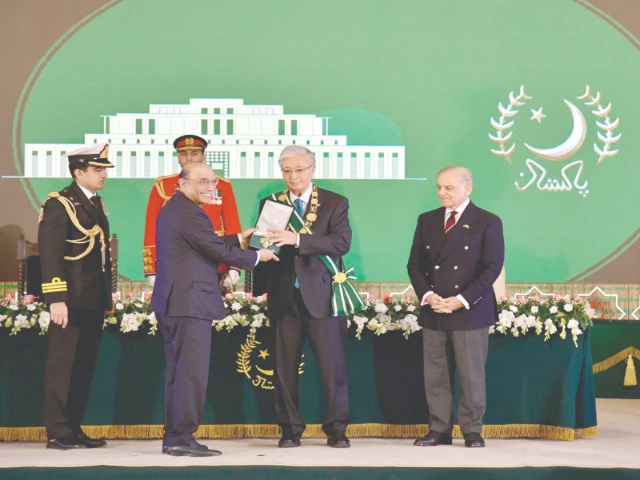
President Asif Ali Zardari confers Nishan-e-Pakistan on his Kazakh counterpart Kassym-Jomart Tokayev during a special investiture ceremony held at Aiwan-e-Sadr in Islamabad, as Prime Minister Shehbaz Sharif looks on. Photo: APP
ISLAMABAD:
Pakistan and Kazakhstan on Wednesday agreed to upgrade their bilateral relations to Strategic Partnership, marking a major diplomatic milestone during Kazakh President Kassym-Jomart Tokayev’s state visit to Pakistan after 23 years.
The understanding was formalized through a Joint Declaration signed in Islamabad during President Tokayev’s two-day visit (February 3-4) at the invitation of Prime Minister Shehbaz Sharif. The leaders described the visit as historic, opening a new chapter of cooperation rooted in long-standing cultural and fraternal ties.
Both sides reaffirmed their commitment to sovereignty, territorial integrity and non-interference, noting that Pakistan was one of the first countries to recognize the independence of Kazakhstan in 1991. They expressed satisfaction over the steady growth of bilateral relations since the 1992 declaration on the principles of relations.
Under the Strategic Partnership, Pakistan and Kazakhstan agreed to deepen cooperation in eight priority areas: political dialogue, security and defence, trade and investment, transport and logistics, education and information technology, culture and tourism, climate change and environmental coordination, and collaboration in regional and international forums.
Commerce and Connectivity
The two countries committed to significantly improve trade, investment and regional connectivity, with the goal of reaching a bilateral trade volume of $1 billion over the next year. They also agreed to promote a multinational transport corridor linking Central and South Asia.
“We have agreed on the Belarus-Russia-Kazakhstan-Uzbekistan-Afghanistan-Pakistan transport corridor to improve regional connectivity,” Prime Minister Shehbaz Sharif said during a joint press conference with President Tokayev.
The prime minister encouraged business communities on both sides to invest in joint ventures, noting that despite strong political relations, the existing trade volume of $250 million last year does not reflect the full potential of the partnership. “With joint efforts, both sides can achieve significant progress,” he added.
Memorandums and Agreements
The leaders witnessed the exchange of 37 memorandums of understanding (MoU) in sectors including finance, trade, industry, transportation, energy, health, culture, security, education, media, science, technology, climate change and agriculture. President Tokayev highlighted transport and logistics as a priority area, emphasizing projects to expand trade flows and improve connectivity, including the Pakistani ports of Karachi and Gwadar as potential gateways to Central Asian trade.
Both sides also agreed to explore the resumption of direct air connections to promote business, tourism and people-to-people contact.
Working Committee
Pakistan and Kazakhstan agreed to set up a working committee of senior ministers and officials to draw up a roadmap to expand bilateral trade and economic cooperation over the next five years. Both leaders expressed confidence that the outcomes of the visit, including the signing of the Joint Declaration and 37 MoUs, would open new avenues of cooperation.
Commemorative plaques and infrastructure
During the visit, Prime Minister Shehbaz Sharif and President Tokayev unveiled plaques of the Mutual Sports and Educational Centers. The prime minister also offered Pakistan’s deep-sea ports in Gwadar and Karachi as trade outlets for Central Asian states, emphasizing plans to expand rail and road links through Turkmenistan and Afghanistan. “This project will be a game-changer and will transform economic integration not only between our two countries but across the region,” he said at the Pakistan-Kazakhstan Business Forum.


