
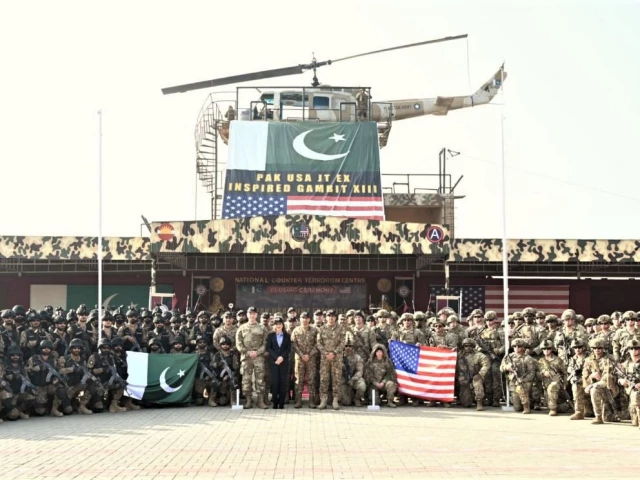
Its objective is to improve military cooperation through the exchange of counterterrorism experiences and the development of interoperability.
Pakistan Army and US Army are conducting a joint military exercise titled ‘Inspired Gambit-2026’ from January 8 to 16. Photo: ISPR
The armies of Pakistan and the United States are carrying out a joint military exercise titled ‘Inspired Gambit-2026’ aimed at enhancing counter-terrorism cooperation between the two forces, the army’s media wing said on Thursday.
According to a press release from Inter-Services Public Relations (ISPR), the two-week-long exercise from January 8 to 16 focuses on counter-terrorism operations and marks the 13th iteration of the bilateral training series, which has been held regularly since 1995.
He said a visiting ceremony was held at the National Counterterrorism Center, attended by US chargé d’affaires Natalie Baker and senior US military dignitaries. The ISPR said the Rawalpindi Corps commander was also present.
The ISPR said the guests were briefed about the scope, objectives and conduct of the exercise and participants from both armies demonstrated a “high level of professionalism and operational proficiency, which was appreciated by the visiting dignitaries.”
He added that the exercise was designed to enhance bilateral military cooperation through the exchange of anti-terrorism experiences, the refinement of anti-terrorism exercises and procedures and the development of interoperability between the two forces.
Exercise Inspired Gambit – 2026 will take place from January 8 to 16, 2026 between the Pakistan Army and the United States Army. The two-week-long exercise focused on counter-terrorism (CT) marks the 13th iteration of this bilateral training series, held since 1995.… pic.twitter.com/NsAXYBQFQo
– PTV News (@PTVNewsOfficial) January 15, 2026
Pakistan’s armed forces regularly conduct joint exercises with foreign armies to exchange professional knowledge and strengthen combat readiness. In this regard, Pakistan Navy and Turkish Navy held their first bilateral amphibious exercise in August last year, marking an important milestone in strengthening maritime collaboration and interoperability between the two friendly navies.
The exercise included a wide range of training activities, including combat shooting techniques, amphibious operations drills, convoy escort procedures, and military operations in urban terrain.
Live-fire drills and close combat scenarios were also conducted to improve tactical coordination and operational readiness in littoral environments. The exercise culminated with a comprehensive amphibious drill in a designated coastal area, validating the operational readiness of both navies.
New heights in Pakistan-US relations
US-Pakistan diplomatic engagement reached new heights after US President Donald Trump helped broker a ceasefire between Pakistan and India during their brief war.
Since then, the leaders of both nations have exchanged cordial gestures and praised each other’s leadership on international platforms. Prime Minister Shehbaz Sharif even nominated President Trump for the Nobel Peace Prize in recognition of his mediation efforts.
Trump, in turn, frequently appreciated Prime Minister Shehbaz and Pakistan’s military leadership, particularly describing Chief of Army Staff Field Marshal Asim Munir as his “favorite field marshal.”
Building on the positive momentum, Islamabad is now seeking to translate goodwill into tangible economic benefits by pursuing a more favorable trade deal with Washington, including tariff concessions and greater market access for Pakistani exports.
In October last year, US Secretary of State Marco Rubio said the United States saw an opportunity to strengthen its strategic relationship with Pakistan as part of a broader, pragmatic foreign policy approach.
Rubio said New Delhi understands that the United States must collaborate with multiple partners to pursue common interests.
“We see an opportunity to expand our strategic relationship with Pakistan, and that is our job: to find as many countries as we can work on issues of common interest,” Rubio said. “Indians are very mature when it comes to diplomacy. They have relationships with countries that we don’t have, and we have some that they don’t. That is part of a mature and pragmatic foreign policy,” he added.
Rubio emphasized that the growing engagement with Pakistan does not come at the expense of Washington’s “deep, historic and important” friendship with India. He described both relationships as vital to maintaining regional stability and advancing US strategic interests in South Asia.


