
Punjab uses clean air program with artificial intelligence systems at the center of forecasting, implementation and public response
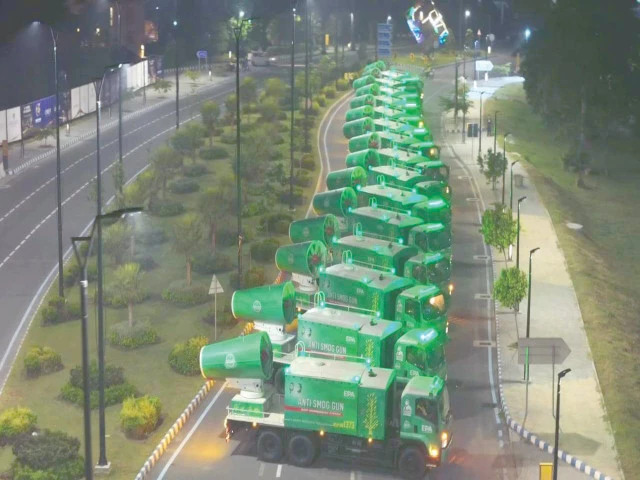
Anti-smog gun. Photo: AGENCIA ANADOLU
LAHORE:
Lahore, once celebrated as Pakistan’s “garden city,” now suffocates each winter under a gray blanket of smog: its skies are laden with a toxic haze that has become the city’s defining feature.
Every November, as the monsoon fades, a suffocating layer of smoke and dust envelops Lahore, India’s capital New Delhi, and much of northern South Asia.
The combination of crop burning, vehicle exhaust and industrial emissions raises air pollution to deadly levels, forcing authorities to close schools, businesses and roads.
This winter, as air quality plummets again, the government of Punjab, Pakistan’s most populous province, is banking on an unconventional ally to fight back: artificial intelligence.
Officials say they are implementing one of the most technologically advanced clean air programs in the region, with artificial intelligence systems at the center of forecasting, enforcement and public response.
According to Marriyum Aurangzeb, Punjab Environment Minister, around 100 AI-powered air quality monitoring stations have been established across Punjab, home to nearly 130 million people.
These smart stations continually analyze pollution data using machine learning algorithms to predict sudden increases in air quality before they occur. The information enters a 24-hour “smog war room”: a real-time climate intelligence center that integrates satellite transmissions, ground sensors and international databases.
Aurangzeb told Anadolu that in major industrial and urban centers, 8,500 cameras, drones and thermal sensors are linked to this artificial intelligence dashboard, which tracks emissions from factories and brick kilns. “Each emission source is geotagged, QR-encoded, and algorithmically assessed for compliance,” he said.
From smoke to smart data
Punjab has also created a specialized Environmental Protection Force (EPF) digitally connected to the AI command centre. When sensors detect a spike in emissions, nearby EPF units receive automatic alerts and drones and smart devices are dispatched to check violations and seal polluting sites.
Another innovation is the deployment in Lahore of AI-guided anti-smog weapons, programmed to activate automatically when particle levels exceed safe limits.
Early pilot tests showed a 70% improvement in air quality in the Kahna area of Lahore within a few hours of operation, Aurangzeb said.
Citizens are also part of the digital ecosystem. Through AQI Punjab App, Green Punjab App and Helpline 1373, residents can report pollution sources directly. The system automatically triages complaints and assigns them, with a reported closure rate of 96%. Using satellite data from NASA and Pakistan’s space agency SUPARCO, the AI network also detects incidents of crop burning in real time and compares them with agricultural loan databases to determine law enforcement.
According to the government, the system has helped reduce stubble burning by 65% in a year, while in Punjab’s industrial belt, it says 95% of factories now operate under emissions control systems.
“There is no miracle solution” to combat smog
But while AI may be transforming law enforcement, experts warn that technology alone cannot solve Pakistan’s deep-rooted pollution crisis.
Air pollution kills about 128,000 Pakistanis every year, according to Fair Finance Pakistan. Analysts say real progress requires cleaner fuels, modern refineries and a shift away from outdated industrial practices.
Imran Saqib Khalid, a climate governance expert in Islamabad, said Lahore’s smog cannot be solved without addressing its primary sources.
“Vehicle emissions contribute significantly to air pollution in Lahore, which can be addressed through the use of high-quality fuel, along with an improved public transport system,” he told Anadolu.
Pakistan, he said, lacks modern refineries capable of producing cleaner fuel. “Although we have started importing better quality fuel, it is not enough to meet our needs.”
Khalid also pointed out the country’s thousands of brick kilns, many of which burn low-quality coal or even old tires. “Even so-called ‘zigzag technology’ furnaces do not meet national environmental standards due to poor fuel quality,” he said, adding that zigzag combustion, although efficient in theory, “cannot give results without fuel reform.”
“Air pollution is a complex problem, but it has already been addressed in other parts of the world. It will take time and effort; there is no silver bullet,” he said. “It cannot be achieved by surface-level measures such as smog guns and smog towers.”
Environmentalists acknowledge that the use of AI in Punjab marks a new seriousness in the fight against smog, but say lasting improvements require systemic reforms.
Yasir Hussain, a Karachi-based environmentalist, said the government’s approach this year shows more coordination than previous efforts, but still lacks long-term impact.
“Artificial rain and smog weapons have no permanent or long-lasting effect,” he said. “Within an hour, pollution levels return because much of the gas and particles come from vehicles, industrial units, brick kilns and stubble burning.”
He believes the electric vehicle policy introduced this year could make a difference over time. “This government has taken some measures to mitigate smog, but there is a long way to go,” he added.


