
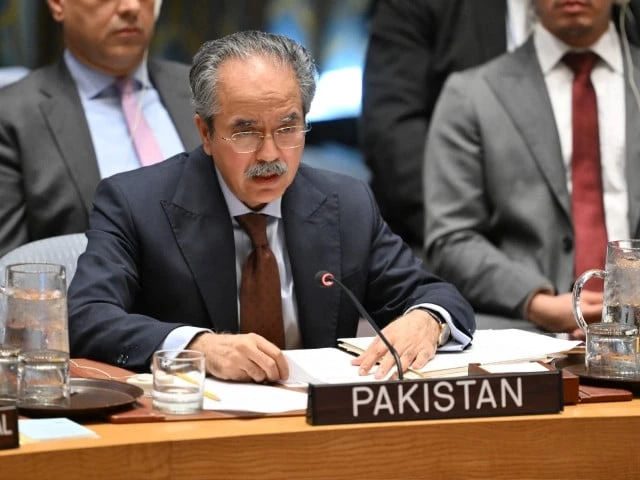
Pakistan’s ambassador to the United Nations Asim Iftikhar Ahmad speaks during a meeting of the United Nations Security Council. Photo: AFP
Ambassador Asim Iftikhar Ahmad, Pakistan’s permanent representative to the UN Security Council, on Tuesday condemned the deadly attack on a religious gathering in Sydney and said Pakistan stands in solidarity with Australia and unequivocally rejects terrorism in all its forms and manifestations.
Two gunmen opened fire on Sydney’s Bondi Beach on Sunday, killing 11 people and wounding several more in a “terrorist incident” targeting a gathering for the Jewish festival of Hanukkah in Australia.
The envoy also emphasized Pakistan’s strong support for the Gaza ceasefire framework, outlining the principles of its implementation in accordance with international law.
Addressing the Council, the envoy also reiterated Pakistan’s strong support for the ceasefire framework in Gaza, acknowledging the facilitation efforts of the United States, Qatar, Egypt and Turkey. He said these diplomatic efforts culminated in the adoption of Security Council Resolution 2803, which Pakistan supported along with a group of eight Arab and Islamic countries.
UN Security Council Resolution 2803 calls for full compliance with the ceasefire plan in Gaza and renewed political efforts toward a two-state solution.
Israel and Hamas signed the ceasefire and hostage and prisoner exchange agreement on October 10, 2025, the first phase of a US-brokered peace plan aimed at ending two years of devastating war in Gaza that has claimed more than 67,000 Palestinian lives and reshaped Middle East politics.
The agreement, brokered by the United States, Qatar, Egypt and Turkey, commits both sides to stopping hostilities, facilitating the release of Israeli hostages and Palestinian prisoners and allowing large-scale humanitarian aid into Gaza.
As the situation in the occupied Palestinian territories remains dire despite the October 10 ceasefire between Israel and Hamas, Pakistan has called for measures to ensure compliance with the truce agreement to stop the bloodshed, ensure humanitarian aid and pave the way for the reconstruction of Gaza.
Read: Pakistan calls for compliance with Gaza ceasefire plan
Referring to the UN Secretary-General’s latest report on Resolution 2334, Pakistan warned that Israeli settlement activity had reached alarming levels. Israeli authorities advanced more than 6,300 housing units in the occupied West Bank, including East Jerusalem, with significant activity in Area C and sensitive areas such as E1. The envoy said settlement expansion in 2025 was at its highest level since the UN began systematic monitoring.
“These actions, reinforced by the ICJ’s July 2024 advisory opinion and identified in Resolution 2334, have no legal validity and violate international law, as they entrench the occupation and undermine the viability of the two-state solution,” Ahmad said.
Calling for concrete steps forward, the representative urged the full and good faith implementation of Resolution 2803: an immediate cessation of settlement activity in line with the resolution, respecting the ceasefire, the withdrawal of Israeli forces from Gaza, unhindered humanitarian access, and the start of reconstruction without annexation or forced displacement.
He also drew attention to accountability and called for a time-bound political process leading to an independent Palestinian state on the pre-1967 borders, with Al-Quds Al-Sharif as its capital.
Read more: Pakistan asks to resolve disputes
He concluded his statement by saying: “Pakistan’s solidarity with the Palestinian people remains unwavering. We stand firmly with them in their legitimate struggle for dignity, justice and self-determination, and for the realization of an independent Palestinian State in accordance with international legitimacy.”
WSIS+20 United Nations General Assembly Meeting
Separately, at a high-level meeting of the United Nations General Assembly commemorating 20 years of the World Summit on the Information Society (WSIS), Pakistan highlighted the growing global digital divide, warning that disparities now extend beyond connectivity to data, capacity and emerging technologies such as artificial intelligence.
Pakistan, aligning with the Group of 77 and China, called for greater investment, skills development and technology transfer to developing countries, and urged inclusive governance of data and artificial intelligence.
The envoy highlighted Pakistan’s decisive steps towards digital transformation by adopting the Pakistan Digital Nation Act and the National AI Policy, aimed at expanding connectivity, strengthening digital public infrastructure and promoting e-governance.
The Pakistan Digital Nation Act is a law that sets the framework for digital governance, services and public infrastructure at the national level. The National AI Policy is a roadmap that guides the safe, ethical and inclusive development and use of artificial intelligence in Pakistan.


