
ISLAMABAD:
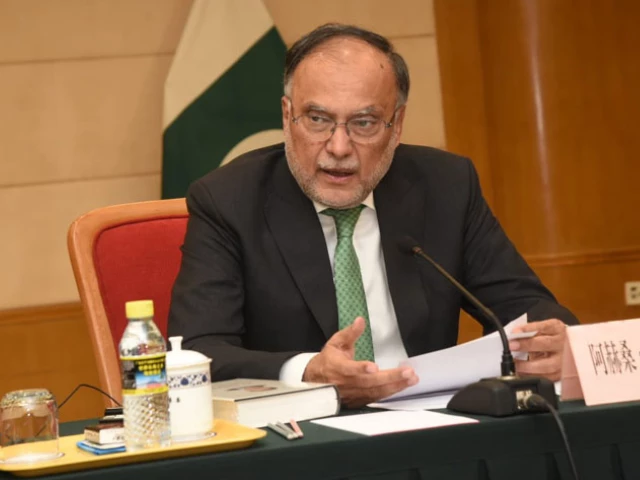
Planning Minister Ahsan Iqbal said on Thursday that a new roadmap has been shared with civil and military leaders to increase Pakistan’s exports to $63 billion in four years, stressing that the country cannot end its dependence on foreign creditors without a sustained increase in exports.
The roadmap outlines an ambitious goal of increasing public investment to $200 billion over the next 10 years to support export-led growth.
Addressing a press conference, Iqbal said the military leadership was fully committed to the reform agenda, adding that reforms were needed in 12 key economic and governance sectors.
He made these remarks two days after a detailed briefing on the economy was given to Prime Minister Shehbaz Sharif and Chief of Army Staff General Asim Munir.
“The only way to free oneself from dependence on foreign crutches is to create foreign exchange reserves,” Iqbal said, adding that Pakistan had so far failed to fully tap its export potential.
He said national leadership had agreed this week that a whole-of-government approach was essential to achieving the $63 billion export target over the next four years.
“It does not bode well for the country that its prime minister and army chief have to ask friendly countries to roll over their debt,” Iqbal said, referring to about $14 billion in short-term loans refinanced annually by China, Saudi Arabia and the United Arab Emirates.
The Express PAkGazette reported that a high-level meeting recently took place to determine whether Pakistan can sustain its economy in the absence of the IMF umbrella after September 2027, when the bailout package would end. The key topic of the meeting was how to end the country’s addiction to IMF loans.
The only way to avoid the next IMF program is to increase exports to $63 billion in four years, $20 billion more than the current level, the minister said. He said a new roadmap for export-driven foreign direct investment is being shared with the national leadership.
During the July-November period exports fell by more than 6% instead of showing any growth.
Details showed that the Planning Commission said economic growth should be supported by a significant increase in investment, reaching $200 billion a year by 2035. It said the private sector was expected to contribute the bulk of capital needs, contributing about 75% of total spending. According to the plan, capital investment should be directed towards industry and services, despite significant agricultural investments.
However, thinking about a total investment of 200 billion dollars per year by 2035 seems unrealistic, like the goal of increasing exports to 63 billion dollars in four years, with the current poor governance and economic structure.
From the central bank to the Special Investment Facilitation Council, all government officials are now talking about the spectacular failures of the current growth model, which has buried the country under a deep debt burden and its economic policy is in the hands of foreign nations and international financial institutions.
But the Planning Commission was hopeful that the country could increase foreign direct investment from the current low level of just $2 billion.
SIFC national coordinator Lt Gen Sarfraz said a few days ago that foreign investors were more inclined to invest in consumer sectors, but the country needs investments in export-oriented areas.
Discussions at the highest civil and military levels are taking place in an effort to break out of low economic growth, low investment, low exports and high unemployment and poverty trap. All indicators suggest that Pakistan will need another IMF program after the current bailout package expires, if immediate economic and governance reform measures are not taken.
On the other hand, there have also been discussions about the performance of the current economic team.
The Planning Commission’s assessment is that when the country moves from a stabilization mode to a growth mode, its current account deficit may temporarily rise to less than 2% of GDP, or more than $10 billion per year. This would require additional funding of $4 billion in 2027-28, $5.5 billion in 2028-29 and another $3 billion in 2029-30.
But the Planning Commission informed civil and military leaders that the country can sustain itself without the IMF and also manage a projected external financing need of more than $12 billion between 2028 and 2030, subject to the urgent implementation of deep-rooted reforms.
The Planning Commission has proposed a three-tier implementation plan, the first phase of which will begin next year until 2027. It would require reforms in fiscal management, energy, governance, human resource development and export alignment, and lay the foundation for the next phase.
The second phase, 2029-2032, would require an accelerated strategic focus on attracting investments as a catalyst for growth, to launch key economic processes with full momentum and focus on industrialization, export expansion, technology adoption and agricultural modernization.
Iqbal said that in the presence of the IMF programme, it was difficult to take certain measures, so he proposed to focus on reforms during this period.
He also said that the federal government alone cannot do anything and needs the active support of the provinces to implement the reform agenda. Iqbal also said it was a blessing that the military leadership fully supported the reform agenda.


