
Zardari-led meeting discusses oil supply risks, security prospects as Islamabad relays messages between US and Iran
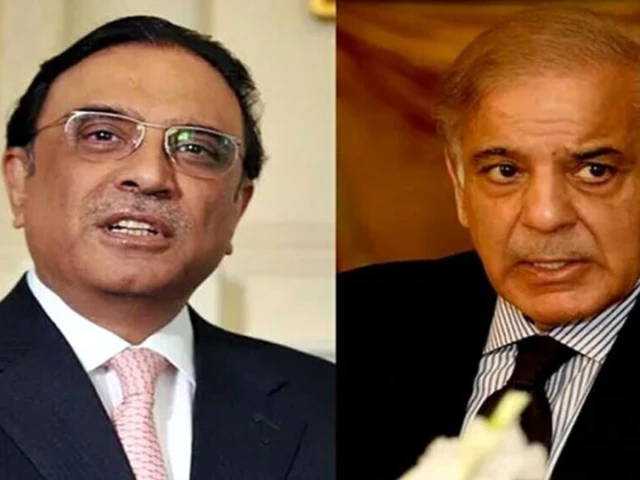
President Asif Ali Zardari on the left and Prime Minister Shehbaz Sharif on the right.
Pakistan’s top civilian and military leaders on Thursday emphasized the need for national consensus and closer institutional coordination to address emerging regional challenges, as the country faces pressure from rising energy costs and geopolitical uncertainty.
A high-level consultative meeting chaired by President Asif Ali Zardari at Aiwan-e-Sadr reviewed the evolving economic and energy situation in the context of oil supply constraints, rising oil prices and regional security developments, according to a statement issued by the Presidency.
Prime Minister Shehbaz Sharif and Chief of Defense Forces and Chief of Army Staff Field Marshal Syed Asim Munir attended the meeting, along with senior cabinet members and economic officials.
Among the participants were Deputy Prime Minister Ishaq Dar, PPP Chairman and former Foreign Minister Bilawal Bhutto Zardari, Home Minister Mohsin Raza Naqvi, Finance Minister Muhammad Aurangzeb, Petroleum Minister Ali Pervaiz Malik, Economic Affairs Minister Ahad Khan Cheema and Finance Secretary.
Read: Pakistan offers to host Iran-US talks
The meeting reviewed fluctuations in global oil and gas supply and its impact on Pakistan’s economy, with special focus on controlling inflation and ensuring energy security.
The finance and oil ministers briefed participants on measures to stabilize oil prices, manage the indirect effects of rising fuel costs across all economic sectors, and enforce fiscal discipline through austerity measures aimed at reducing pressures on spending.
The broader regional situation was also discussed, including implications for security, economic prospects and food security of Pakistan. Participants agreed that economic management, energy planning, food security and broader security considerations must remain closely aligned to address future challenges.
The meeting underlined the importance of maintaining national consensus and strengthening institutional coordination, emphasizing that political decisions must prioritize stability while safeguarding public interests.
Officials also highlighted the need to carry out public awareness campaigns to reduce fuel consumption, encourage the use of public transport and promote ride-sharing systems.
Earlier Thursday, Pakistan’s foreign minister said indirect communication was taking place between the United States and Iran through messages conveyed by Pakistan, and that Türkiye and Egypt also supported diplomatic efforts aimed at easing tensions in the Middle East.
“There has been unnecessary speculation in the media about peace talks to end the ongoing conflict in the Middle East. In reality, indirect talks between the United States and Iran are being carried out through messages conveyed by Pakistan,” the minister wrote in X.
There has been unnecessary speculation in the media about peace talks to end the ongoing conflict in the Middle East. In reality, the indirect talks between the United States and Iran are being carried out through messages transmitted by Pakistan. In this context, the United States has distributed 15 points, being…
-Ishaq Dar (@MIshaqDar50) March 26, 2026
He said Washington had shared 15 points with Tehran that were under consideration. “The brother countries of Turkiye and Egypt, among others, are also providing their support to this initiative.”
“Pakistan remains fully committed to promoting peace and continues to make all possible efforts to ensure stability in the region and beyond. Dialogue and diplomacy are the only way forward!” he added.
Read more: Iran rejects US proposal and outlines five conditions to end war: state television
Iranian Foreign Minister Abbas Araqchi previously said there had been no negotiations with the United States, although messages were exchanged through intermediaries.
“The messages that are transmitted through our friendly countries and that we respond by expressing our positions or issuing the necessary warnings is not called negotiation or dialogue,” Araqchi said in an interview on state television on Wednesday. “It’s just an exchange of messages through our friends.”
Meanwhile, U.S. President Donald Trump said Iran was eager to reach a deal to end nearly four weeks of fighting, contradicting Tehran’s stance that it was reviewing a U.S. proposal but had no intention of starting formal talks to end the conflict.


