
Annual exchange carried out; Islamabad warns India over Chenab project, backs China on Taiwan
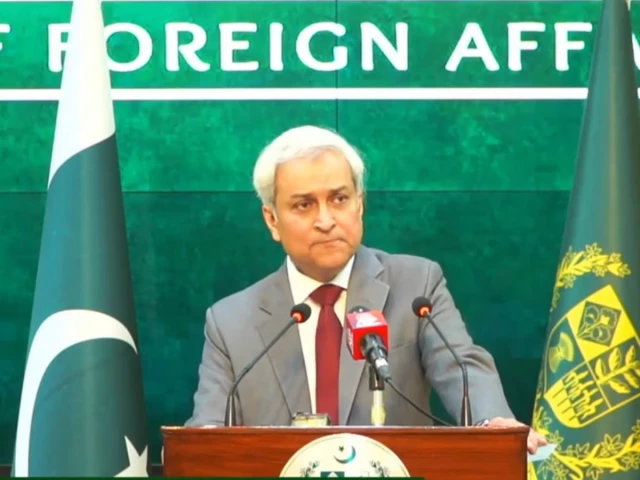
Ministry of Foreign Affairs Spokesperson Tahir Hussain Andrabi speaking at FO’s weekly press briefing on January 1. Photo: X/FO
Pakistan and India on Thursday exchanged updated lists of their nuclear facilities, continuing an annual confidence-building measure under a bilateral agreement signed in 1988, the foreign ministry said.
Foreign Ministry spokesman Tahir Hussain Andrabi said the exchange occurred in accordance with the Agreement on the Prohibition of Attacks on Nuclear Facilities and Facilities, signed on December 31, 1988. The agreement came into force on January 27, 1991, and the two countries have shared such lists on the first day of every year since 1992.
“As a continuation of practice, the exchange also took place today,” Andrabi said at a weekly news conference. “A list of nuclear installations and facilities in Pakistan was officially handed over to the representative of the Indian High Commissioner in the Ministry of External Affairs today.”
“I understand that the Indian government is also sharing the list of Indian nuclear facilities with our High Commission in New Delhi today,” he added.
The spokesman said the agreement requires both countries to report annually on their nuclear facilities and installations. He also confirmed that Pakistan and India exchanged prisoner lists.
“The Indian government is also sharing the list of Pakistani prisoners in its custody with the Pakistani high commission in New Delhi,” Andrabi said.
Under the Agreement on Consular Access, signed in 2008, both sides must exchange lists of prisoners in custody on January 1 and July 1 of each year.
New dams in Chenab
Referring to India’s recent moves on hydropower projects, Andrabi said New Delhi could not misuse its “restricted permission” under the Indus Water Treaty (IWT) to unilaterally build projects on the western rivers.
He was responding to a question on India’s approval of the 260 megawatt Dulhasti Stage-II hydropower project on the Chenab river in Kishtwar district of Indian illegally occupied Jammu and Kashmir.
“We have seen these media reports about India’s plans to build the Dulhasti Stage-II hydropower plant. [project] in the Chenab River,” he said. “Obviously, these reports raise serious concerns as no prior information or notification was shared with Pakistan regarding this project.”
Andrabi said sharing such information was mandated by the IWT, a water-sharing treaty negotiated by the World Bank signed in Karachi on September 19, 1960. The treaty gives India rights to the eastern rivers – Ravi, Sutlej and Beas – while Pakistan has rights to the western rivers – Indus, Jhelum and Chenab – with limited use allowed to India for purposes including power generation.
“Such acts of commission and omission once again exemplify a complete disregard for international law and bilateral treaties,” Andrabi said. He added that the Pakistani Indus Water Commissioner had sought clarification from his Indian counterpart on the nature, scope and technical details of the reported projects.
“You also want to determine if this is a new run-of-river project, a modification or additional work at an existing plant,” Andrabi said.
Read: Indian FM meets Pakistani National Assembly Speaker on the sidelines of Khaleda Zia’s funeral
He highlighted that any project in the western rivers was subject to strict operational and design controls, as well as information sharing requirements. “In the absence of formal communication from India, Pakistan cannot agree to the conformity of the project with the provisions of the treaty,” he said.
“We therefore call on India to urgently return to treaty compliance and respond to the questions raised by our Indus Water Commissioner in his most recent and previous communications,” it added.
Andrabi said Pakistan viewed the IWT as a binding international agreement and remained committed to peaceful dispute resolution, but “would never compromise our existential water rights.”
China-Taiwan issue
On relations with China, Andrabi said Pakistan had “consistently supported China, on all issues relating to its core interests, including Taiwan.” He reiterated that Pakistan adhered to the One China principle and regarded Taiwan as an inalienable part of China.
“We urge all relevant countries to honor their historic commitments and take measures to foster peace, security and development in Taiwan,” he said, calling on them to refrain from actions that could aggravate tensions or undermine regional stability.
Pakistanis stranded in Afghanistan
The spokesperson also provided an update on Pakistani nationals stranded in Afghanistan, saying that 15 students and 291 others had returned home safely. “We are in contact with the Afghan authorities,” he said.
It said a total of 1,199 Pakistanis had approached the embassy in Kabul for help, including 549 students and 402 others, adding that it was coordinating with Taliban authorities to ensure their safety.
Regional issues
On regional issues, Andrabi reaffirmed Pakistan’s commitment to the unity and sovereignty of Yemen and expressed solidarity with Saudi Arabia, supporting diplomatic efforts to resolve the conflict. “We hope that the Yemeni people and regional powers will work together to achieve a lasting solution,” he said.
He also rejected Israel’s recent recognition of Somaliland and reiterated Pakistan’s support for Somalia’s sovereignty. Andrabi said Foreign Minister Ishaq Dar, along with foreign ministers of other countries and representatives of the Organization of Islamic Cooperation, had issued a statement condemning the unilateral recognition of Somaliland.
Andrabi said Dar also held telephone conversations with officials in Tabuk, Uzbekistan and Somalia, discussing diplomatic cooperation and upcoming visits, including a planned visit to China for the Pakistan-China Strategic Dialogue.
The spokesperson further confirmed that former National Assembly Speaker Ayaz Sadiq attended the funeral prayers of former Bangladesh Prime Minister Khaleda Zia and met her family to offer his condolences. He said Sadiq also held talks with Bangladesh’s national security advisor.
Reports say India’s Foreign Minister Subrahmanyan Jaishankar briefly met Sadiq in Dhaka on the sidelines of the funeral, marking the first such interaction between senior officials of the two rivals since their military conflict in May. According to officials present, the two exchanged a brief handshake and pleasantries, with no formal conversations reported.


